
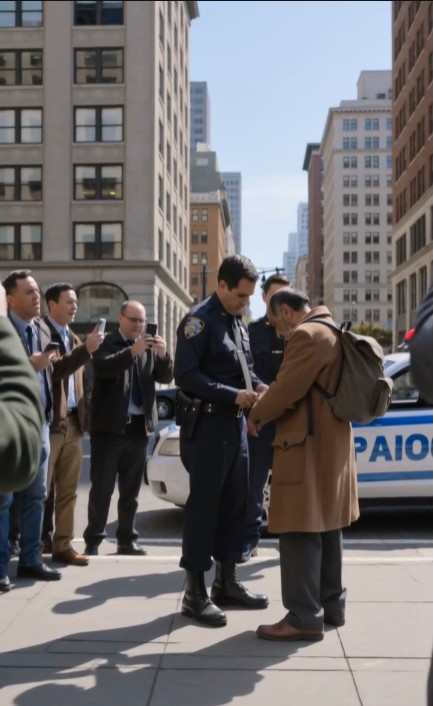
The downtown square was crowded when the police captain arrived.
It was the kind of afternoon when everyone seemed to be in a hurry. Office workers crossed the plaza with coffee in their hands. Shoppers moved between stores. Street musicians played near the fountain while tourists stopped to take pictures.
Near the courthouse steps, an elderly homeless man sat quietly on a folded piece of cardboard.
His coat was old. His shoes were worn through at the edges. Beside him was a small plastic bag filled with everything he owned.
He was not shouting.
He was not bothering anyone.
But someone had called the police.
By the time Captain Marcus Reed stepped out of his patrol car, a small crowd had already formed.
“There he is,” a man said, pointing. “He’s been sitting there all morning.”
A woman holding her phone added, “This area is supposed to be clean. Families come through here.”
The old man looked up slowly.
His eyes were tired, but calm.
Captain Reed walked toward him with two younger officers at his side.
“Sir,” one of the officers said, “you need to stand up.”
The homeless man nodded.
He did not argue.
He did not ask why.
He simply placed both hands on the ground and tried to push himself up. His knees shook, and for a moment it looked like he might fall.
Captain Reed reached out instinctively to steady him.
The old man looked at the captain’s face.
Something flickered in his eyes.
Recognition.
But it vanished almost immediately.
The crowd grew louder.
“Finally,” someone said. “Get him out of here.”
Phones came up.
People started recording.
The old man lowered his head and held out his wrists.
“I won’t cause trouble,” he said quietly.
The younger officer glanced at Captain Reed.
“Captain?”
Marcus looked at the old man’s hands.
Then at his face.
The old man’s beard was gray and uneven. His skin was weathered from years outside. His clothes hung loosely on his frame. He looked like a man the city had stepped around so many times that he had become part of the pavement.
But there was something about his eyes.
Something Marcus knew.
Something buried deep under twenty-five years of memory.
The captain slowly took the handcuffs from his belt.
The crowd began clapping.
“About time!”
“Good job, officer!”
“Clean up the square!”
Marcus heard every word.
He placed the cuffs around the old man’s wrists.
The metal clicked shut.
The old man did not resist.
He only looked into Marcus’s eyes.
For several seconds, neither of them spoke.
Then the old man smiled faintly.
Not bitterly.
Not fearfully.
Almost proudly.
“You grew tall,” he whispered.
Marcus froze.
The sound of the city seemed to disappear.
The fountain.
The traffic.
The crowd.
Everything faded except that voice.
Rougher now.
Older.
But still the same.
Marcus stared at him.
“What did you say?”
The old man looked down at the handcuffs.
“I said you grew tall.”
Marcus’s breathing changed.
A memory slammed into him with such force that he almost stepped back.
Smoke.
Heat.
Screaming.
A burning apartment building.
A man’s arms lifting him from the floor.
A voice near his ear saying, “Stay awake, little soldier. Stay awake.”
Marcus looked at the old man again.
His hand moved slowly toward the cuff key.
The crowd leaned closer.
Everyone expected him to begin reading the man his rights.
Instead, Marcus unlocked the handcuffs.
The metal opened.
The old man’s hands were free.
The clapping stopped.
A woman lowered her phone slightly.
One of the younger officers frowned.
“Captain, what are you doing?”
Marcus did not answer.
He stepped back.
Straightened his shoulders.
Placed his feet together.
Then, in front of the entire square, the police captain raised his hand and gave the old homeless man a perfect military salute.
The crowd went completely silent.
The old man stared at him.
His smile trembled.
The younger officer whispered, “Captain?”
Marcus kept his salute steady, but his voice cracked.
“Twenty-five years ago, this man carried me out of a burning building.”
Nobody moved.
Marcus swallowed hard.
“He saved my life.”
The words settled over the square like thunder after lightning.
The people who had been recording suddenly did not know where to look.
The man who had shouted earlier lowered his eyes.
The woman who had complained about families coming through the plaza slowly put her phone away.
The old homeless man looked at Marcus with tears gathering in the corners of his eyes.
“I always hoped,” he said softly, “you’d make something of yourself.”
Marcus’s salute broke.
He stepped forward and took the old man’s hands, not like a suspect, but like someone afraid the past might vanish again if he let go.
“What happened to you?” Marcus asked.
The old man gave a tired laugh.
“Life.”
His name was Samuel Brooks.
Twenty-five years earlier, he had been a firefighter.
Not famous. Not decorated in newspapers every week. Just a man who showed up when people were trapped, afraid, or out of options.
On a winter night long ago, an apartment building on East River Street caught fire.
Marcus had been seven years old.
His mother had gotten out through the front stairwell, screaming that her son was still upstairs. Flames had already swallowed the second floor. Smoke poured out of the windows. The ceiling inside was beginning to collapse.
The fire captain ordered his crew to hold back.
It was too dangerous.
But Samuel heard the mother screaming.
He went in anyway.
Marcus remembered only pieces.
The smoke burning his throat.
The heat against his face.
Hiding behind a dresser because he was too scared to move.
Then strong arms lifting him.
A gloved hand covering his mouth.
A voice telling him not to close his eyes.
Samuel carried Marcus through smoke so thick that neither of them could see the door. A beam fell behind them just as they reached the stairwell. Samuel shielded the boy with his own body.
Outside, Marcus survived.
Samuel collapsed.
He spent weeks in the hospital with burns and lung damage. After that, his life slowly came apart.
He could not return to full duty.
Medical bills followed.
His wife became ill.
He took small jobs, then lost them.
When she passed away, Samuel stopped fighting the world as hard as he once had. One missed rent payment became two. Two became an eviction. Friends helped for a while, then faded into their own struggles.
The firefighter who had once run into burning buildings began sleeping behind them.
And the city forgot him.
Marcus had not.
Not completely.
The boy he saved grew up with Samuel’s voice in his head.
Stay awake, little soldier.
Marcus joined the military first. Then, after coming home, he became a police officer. Every promotion, every uniform, every badge felt tied to the man who had pulled him from death when he was too young to understand what courage cost.
But Marcus never knew Samuel’s full name.
He only knew the firefighter who saved him had been called “Sam” by the others.
For years, he searched old reports, asked retired firefighters, and checked records whenever he could. But time had blurred the details. The building had been demolished. Departments had changed systems. People had moved or died.
Eventually, Marcus believed he would never find him.
Until he placed handcuffs on a homeless man in the square and heard the voice that had once saved him from the dark.
Marcus turned to the younger officers.
“Call social services,” he said. “And medical outreach. Now.”
Samuel shook his head.
“No need for all that.”
“Yes,” Marcus said gently. “There is.”
The old man looked embarrassed.
“I don’t want special treatment.”
Marcus’s eyes filled.
“You gave me my entire life. Let me at least give you a chair, a meal, and a warm place to sleep.”
Samuel looked away.
“I didn’t save you so you’d owe me.”
“I know,” Marcus said. “That’s why I do.”
The crowd stood frozen around them.
The same people who had wanted Samuel removed now watched as Captain Reed took off his own jacket and placed it around the old man’s shoulders.
A young boy near the fountain tugged on his mother’s sleeve.
“Mom,” he whispered, “was he a hero?”
His mother looked at Samuel, then at her phone in her hand, and her face filled with shame.
“Yes,” she said quietly. “He was.”
Marcus heard her.
He turned to the crowd.
“No,” he said. “He is.”
That one word changed the square.
Is.
Not was.
Not used to be.
Not once upon a time.
Samuel Brooks was still a hero, even if his coat was torn, even if his hands shook, even if the city had forgotten his name.
Within minutes, everything was different.
A café owner came outside with hot soup.
A woman offered a clean blanket from her car.
A retired firefighter who had been passing through the square stepped forward, stared at Samuel’s face, and suddenly began to cry.
“Sam Brooks?” he said.
Samuel blinked.
The retired firefighter covered his mouth.
“I thought you were dead.”
Samuel smiled weakly.
“Some days, I did too.”
By evening, the story had spread across the city.
But Marcus did not let it become just another viral clip.
He made calls.
Real calls.
The kind that changed paperwork, opened doors, and forced people to remember obligations they had ignored.
The fire department confirmed Samuel’s service record. A local veterans and first responders’ charity stepped in. A medical clinic offered treatment. Temporary housing was arranged before nightfall.
Samuel resisted at first.
Pride is sometimes the last thing a broken man has left.
But Marcus stayed beside him through every step.
When they reached the shelter apartment arranged for him, Samuel stood in the doorway and stared at the clean bed, the folded towels, the small kitchen, and the window that looked out over the city.
He did not enter right away.
Marcus waited.
Samuel whispered, “I haven’t had a key in seven years.”
Marcus placed one in his palm.
“Then it’s time.”
Samuel closed his fingers around the key like it was something holy.
The next week, Captain Reed visited him again.
This time, he brought an old framed photograph.
It showed a firefighter in full gear carrying a small boy wrapped in a blanket out of a smoke-filled building.
Samuel stared at it for a long time.
“Where did you get this?”
“My mother kept it,” Marcus said. “She said if I ever found you, I should show you what you gave back to her.”
Samuel touched the glass with trembling fingers.
In the photo, Marcus was unconscious in Samuel’s arms.
Alive.
Samuel sat down slowly.
“I thought I lost more than I saved,” he said.
Marcus shook his head.
“You saved generations you never met.”
Samuel looked at him.
“What do you mean?”
Marcus smiled.
“I have two children. A wife. A whole life. None of them exist without you.”
Samuel’s face broke.
For the first time, he cried without trying to hide it.
Months later, the city held a small ceremony in the same downtown square.
Not a grand event.
Not a political performance.
Just firefighters, police officers, neighbors, and people who wanted to make right what they had once judged too quickly.
Samuel arrived wearing a clean navy coat. His hair had been trimmed. His hands still shook, but he walked with his head higher.
Captain Reed stood beside him as the mayor presented a restored service medal that Samuel had lost years before.
But the moment everyone remembered most was not the medal.
It was when Marcus’s young son walked up to Samuel and handed him a drawing.
It showed a firefighter carrying a boy from a burning building.
At the top, written in big uneven letters, were the words:
Thank you for saving my dad.
Samuel read it once.
Then again.
Then he pulled the boy into his arms and cried.
The square was silent that day too.
But this time, not from shock.
From respect.
Later, when a reporter asked Marcus why he saluted a homeless man in front of everyone, he gave a simple answer.
“Because a uniform does not make a hero,” he said. “A clean coat does not make a man worthy. And losing everything does not erase what someone once gave.”
Samuel stood beside him, eyes shining.
Marcus looked at him and added, “This man didn’t lose his courage. He only lost his way. And the least a city can do is help one of its heroes find the road back.”
The video of the salute was watched millions of times.
People argued about it, shared it, cried over it, and promised to look differently at the people they passed on the street.
But for Marcus, the viral moment was never the point.
The point was a pair of handcuffs coming off.
A salute being given.
A forgotten name being spoken again.
And a city realizing that sometimes the person it wants removed from the sidewalk is the very person who once ran into fire so someone else could live.
Samuel Brooks never asked to be called a hero.
Most real heroes do not.
But every morning after that, when he unlocked the door to his small apartment, he paused for a second before stepping inside.
Because after years of being invisible, he finally had a place to return to.
And somewhere across the city, Captain Marcus Reed still carried the same lesson he had learned as a child in the smoke.
Never walk past someone just because the world has stopped seeing them.
Sometimes heroes are not gone.
Sometimes they are sitting quietly in the square, waiting for one person to remember their name.