
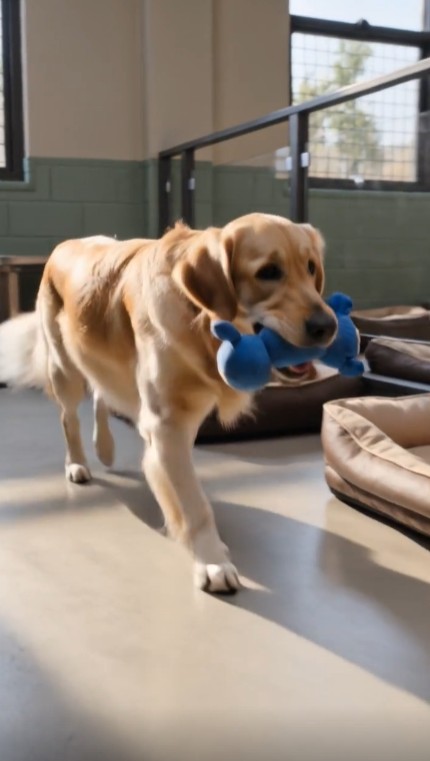
The shelter workers couldn’t understand why Teddy kept carrying his favorite toy to the new dog’s enclosure.
Teddy was a gentle golden retriever.
He had been at the shelter for several months.
Friendly with people.
Calm around other dogs.
Patient during walks.
But there was one thing he almost never shared.
A little blue plush toy.
The toy had faded from months of use.
One ear was slightly torn.
The stuffing had flattened.
But Teddy loved it.
He carried it from his bed to the outdoor run.
Brought it back inside after walks.
Sometimes slept with one paw resting over it.
Whenever staff collected toys for cleaning, Teddy watched carefully until the blue one returned.
Then a small brown rescue dog named Pip arrived.
Pip was younger than Teddy.
But far more cautious.
He did not bark at visitors.
Did not rush toward treats.
Did not show much interest in toys.
Mostly, he rested in the corner of his comfortable bed and watched the activity around him.
The shelter team gave him time.
No forcing.
No overwhelming introductions.
Just predictable meals.
Quiet handling.
Short walks.
Plenty of space.
Teddy noticed him almost immediately.
The dogs were housed in separate resting areas with a secure partition between them.
On Pip’s second morning, caretaker Emma saw Teddy walking down the corridor with the blue plush toy in his mouth.
Nothing unusual.
Then Teddy stopped beside Pip’s enclosure.
He placed the toy on the floor.
And sat down.
Pip looked toward him.
Teddy waited.
After several minutes, he picked the toy up and left.
Emma thought it was coincidence.
The next morning, Teddy did it again.
Blue toy.
Partition.
Sit.
Wait.
Then again the following morning.
Emma called another caretaker over.
“Look at this.”
Daniel watched from several feet away.
Teddy gently placed the toy near the partition.
Pip raised his head.
Neither dog became excited.
Neither barked.
They simply watched each other.
Daniel whispered:
“He’s never done that before.”
That was true.
Teddy liked other dogs.
But he had never deliberately carried his favorite toy toward another enclosure.
The staff did not assume Teddy was consciously “giving” Pip a present in the human sense.
Dogs can become interested in other animals, familiar routines, scents, objects, and social proximity for many reasons.
But the behavior was gentle.
And consistent.
So they let it continue.
Several days later, staff placed a second blue plush toy inside Pip’s area.
Not exactly the same.
But similar in size and texture.
At first, Pip ignored it.
Then one afternoon, Emma noticed him sniffing it.
The next day, he rested with his chin beside it.
A few days later, he picked it up.
Only for a second.
But it was the first toy he had touched since arriving.
Emma smiled.
“Okay, Pip.”
“That counts.”
Teddy continued visiting the partition.
Sometimes with his blue toy.
Sometimes without it.
Gradually, Pip began moving closer too.
The shelter’s behavior team decided they could begin a careful introduction.
First, parallel walks.
Two handlers.
Plenty of distance.
No forced contact.
Teddy walked calmly.
Pip stayed several steps away.
Then came another walk.
And another.
Over time, Pip’s body language relaxed.
Eventually, the dogs were allowed into a neutral fenced area together.
Teddy sniffed the grass.
Pip explored the opposite side.
Nobody rushed them.
After several minutes, Teddy lay down.
Pip watched him.
Then slowly settled several feet away.
Emma laughed softly.
“That might be the most boring successful introduction we’ve ever had.”
Daniel smiled.
“Boring is good.”
Over the following weeks, the dogs became increasingly comfortable sharing supervised space.
They were not inseparable.
They did not suddenly play all day.
Pip was still quieter.
Teddy was still more outgoing.
But they rested near each other.
Walked calmly together.
And sometimes shared the same sunny patch near the shelter courtyard.
Then one rainy afternoon, Daniel was reorganizing old intake files.
The shelter had recently begun digitizing older photographs.
He opened Teddy’s original intake folder.
There was a picture from Teddy’s first day.
Daniel stopped.
“Emma.”
She looked over.
“What?”
“Come here.”
The photograph showed Teddy months earlier.
He looked completely different.
Thin.
Uncertain.
Curled tightly against the back of his kennel.
Beside him was the same little blue plush toy.
Emma smiled.
“Well, that part we knew.”
But Daniel opened the next photograph.
Someone had taken it several days later.
Teddy was lying closer to the front of the kennel.
The blue toy was beside him.
And through the neighboring partition, another dog could be seen resting.
An older black Labrador named Molly.
Emma remembered her immediately.
“Molly.”
Molly had been at the shelter when Teddy arrived.
She was calm.
Older.
Easygoing.
She had been adopted only three weeks later.
Emma looked more closely.
Near Molly’s paw was a small green stuffed toy.
Daniel found the behavioral notes.
Teddy’s first days had been difficult.
He refused treats.
Avoided play.
Spent long periods in the back of the enclosure.
Then staff noticed he became calmer when Molly rested on the other side of the partition.
The notes did not describe some dramatic bond.
Just simple observations.
Teddy rested closer to the front when Molly was nearby.
His appetite improved.
He became more interested in enrichment.
Then a volunteer donated several small plush toys.
Molly received the green one.
Teddy received the blue one.
For several days, the dogs rested on opposite sides of the partition with the toys near them.
Emma sat down.
“So that’s what this reminds me of.”
Daniel nodded.
Someone had once helped Teddy adjust to an unfamiliar shelter simply by being calmly present nearby.
Not intentionally, perhaps.
Molly did not understand she was “comforting” him in the human sense.
But her calm behavior may have helped make the environment feel less threatening.
And the little blue toy had been there throughout that period.
Now Teddy was repeating a surprisingly similar pattern with Pip.
Rest near the partition.
Bring familiar toy.
Stay calm.
No pressure.
Emma looked toward the kennels.
“That’s actually sweeter than if he were just trying to play.”
Daniel smiled.
“Maybe.”
“But don’t write his autobiography yet.”
They laughed.
The shelter contacted Molly’s adopters.
They were delighted to hear the story.
Molly was now eleven years old.
Still doing well.
Her family sent a recent photograph.
She was asleep on a sofa.
Beside her was the faded green plush toy.
Emma stared at it.
“She still has hers too.”
Daniel printed the photograph.
Then placed it beside Teddy’s old intake picture.
Green toy.
Blue toy.
Two dogs resting quietly on opposite sides of a shelter wall.
The staff did not try to turn Teddy and Pip into an internet spectacle.
Their priority was finding stable homes.
Pip still needed confidence.
Teddy had already been waiting a long time.
Then a family visited looking for an adult dog.
Parents.
Two teenage children.
Quiet household.
Large fenced garden.
They met Teddy first.
He was friendly without becoming overwhelming.
Then they noticed Pip resting nearby.
The younger teenager asked:
“Are they friends?”
Emma answered carefully.
“They’re comfortable together.”
The family spent time with both.
Then went home to think.
The next morning, they called.
“We know we came for one dog.”
Emma smiled.
“That sentence usually has a second part.”
“It does.”
They wanted to ask whether adopting both was realistic.
The shelter evaluated the home and discussed responsibilities carefully.
Two dogs meant double veterinary costs.
More food.
More training.
More adjustment.
The family understood.
After several visits, the adoption was approved.
On the morning Teddy and Pip left, Emma packed their belongings.
Teddy’s blue plush toy.
Pip’s matching one.
Blankets.
Food.
Medical records.
The old photograph of Teddy remained in the shelter archive.
But Emma printed a copy for the family.
On the back she wrote:
This was Teddy when he arrived.
Give both of them time.
Their new family sent an update two weeks later.
Pip had discovered the sofa.
Teddy preferred the floor beside it.
The blue toys were usually scattered somewhere nearby.
Sometimes Teddy still carried his original one from room to room.
Sometimes Pip picked up his own.
They had begun playing briefly in the garden.
Then resting together afterward.
Nothing dramatic.
Just progress.
Several months later, another photograph arrived.
Teddy lay asleep on a rug.
Pip was curled several inches away.
Between them were both blue toys.
Emma printed it.
She placed it beside Teddy’s intake photograph and Molly’s updated picture.
Three moments.
Molly beside Teddy.
Teddy beside Pip.
Then Teddy and Pip together in a home of their own.
The shelter later used the photos during volunteer training.
Not to tell people that dogs understand kindness exactly as humans do.
But to illustrate something real.
Animals can learn routines.
They can form social preferences.
They can respond to calm companions.
And familiar objects can become associated with comfort during stressful transitions.
Teddy’s blue toy had been beside him when he first began relaxing in the shelter.
Months later, when Pip arrived frightened and withdrawn, Teddy repeatedly carried that same toy toward him.
Maybe Teddy simply wanted to be near the new dog.
Maybe the toy was part of Teddy’s own comfort routine.
Maybe Pip’s presence reminded him of the quiet companionship he once experienced beside Molly.
Nobody could know exactly what was happening inside Teddy’s mind.
They didn’t need to.
The behavior itself was enough.
A dog who once spent his first days curled alone in the back of a kennel eventually became the dog sitting calmly beside another frightened newcomer.
And the same small blue toy was present for both chapters.
Someone had once helped Teddy feel safer in an unfamiliar place.
Years of human meaning did not need to be added to that.
The real story was gentle enough.
One rescued dog found comfort.
Then, much later, another rescued dog found a little comfort beside him.
No grand gesture.
No miracle.
No words.
Just two animals resting near each other while an old blue toy lay between them.
Sometimes the smallest signs of trust are the ones worth noticing.