
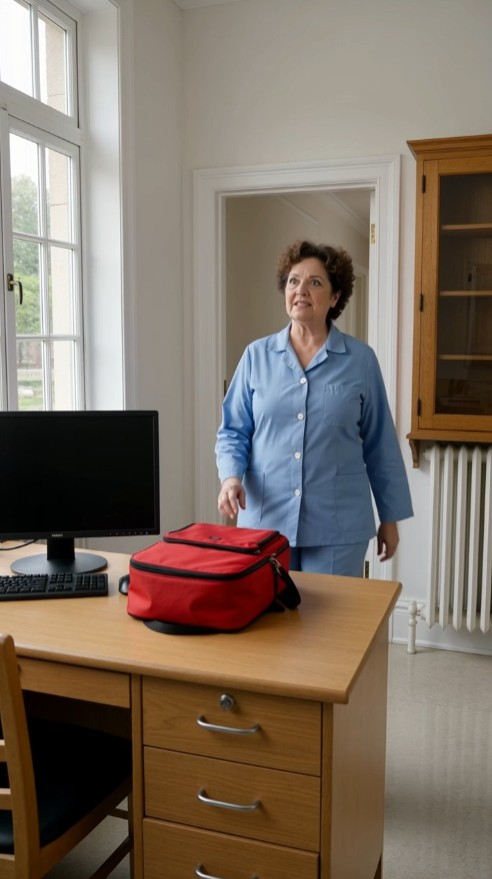
Rosa had worked at the same school for almost twenty years.
She knew every hallway.
Every classroom.
Every squeaky locker.
Every teacher who stayed too late.
Every student who regularly forgot a water bottle, lunchbox or jacket.
She arrived before most of the staff.
And usually left after almost everyone else.
Her job was simple.
Keep the school clean.
Make sure the classrooms were ready.
Pick up what everyone else left behind.
Rosa never expected anyone to leave something for her.
So when she walked into her tiny staff room one cold Monday morning and found a red backpack sitting on her desk, she assumed a student had forgotten it.
She picked it up.
No name tag.
No books.
Inside was a handmade scarf.
Dark red.
Soft.
Carefully folded.
Rosa frowned.
There was also a small envelope.
She opened it.
Inside was a note.
THANK YOU FOR SEEING ME WHEN I FELT INVISIBLE.
Rosa read it twice.
Then looked toward the hallway.
“Very funny.”
She assumed one of the teachers had arranged something.
Nobody admitted it.
The principal knew nothing.
The secretary shook her head.
Even the students Rosa asked looked confused.
She took the scarf home.
The next morning, another red backpack appeared.
Same place.
Different bag.
Inside was a small box of tea.
A pair of warm gloves.
And another note.
YOU HELPED ME ON A DAY I THOUGHT NOBODY WOULD.
Rosa became suspicious.
By Wednesday, a third backpack appeared.
This one held a small notebook.
A packet of sunflower seeds.
And a carefully folded piece of paper.
I NEVER FORGOT WHAT YOU SAID.
Rosa stared at the words for a long time.
Now she knew this was not random.
Somebody was trying to tell her something.
But who?
Rosa had helped hundreds of students over the years.
Most of the time, she did not even think of it as helping.
A child crying in the hallway?
She stopped.
Someone forgot lunch money?
She occasionally bought them something quietly.
A student sitting alone after school?
She asked if they needed a phone.
She had sewn torn backpack straps.
Found missing gloves.
Cleaned spilled drinks without making embarrassed children feel worse.
Rosa did these things because children were children.
That was all.
Thursday morning, the principal walked into her room.
His name was Mr. Bennett.
Rosa held up the latest backpack.
“This is getting ridiculous.”
He smiled.
“Still no idea?”
“None.”
She pulled out the scarf from the first bag.
Mr. Bennett stopped smiling.
He took it carefully.
Near one end, stitched into the fabric, was a tiny sunflower.
Yellow thread.
Green stem.
Very small.
Mr. Bennett stared at it.
“Rosa…”
“What?”
“Where did this come from?”
“I’ve been asking everyone that for four days.”
He turned the scarf over.
Then looked toward the hallway.
“I think I know who made this.”
Rosa sat down.
“Who?”
Mr. Bennett hesitated.
Then asked:
“Do you remember the student you helped last winter?”
Rosa’s eyes immediately filled.
“How could I forget?”
The student’s name was Maya.
She had been thirteen at the time.
Quiet.
Bright.
Always sitting near the back of the class.
The kind of student teachers described as “no trouble.”
Sometimes that meant nobody noticed when something was wrong.
That winter, Rosa began noticing Maya staying inside during lunch.
Not in the cafeteria.
Not in the library.
In a small corridor beside the auditorium.
Always wearing the same oversized coat.
Always carrying the same red backpack.
One afternoon, Rosa found her sitting there after school.
School had ended almost forty minutes earlier.
“Maya?”
The girl quickly wiped her face.
“I’m fine.”
Rosa did not believe her.
But she did not push.
“Your ride late?”
Maya nodded.
Then shook her head.
Rosa sat beside her.
“You don’t have to tell me anything.”
Maya stared at the floor.
After several minutes, she whispered:
“My mom lost our apartment.”
Rosa said nothing.
Maya continued.
They had been staying in temporary housing.
Sometimes a motel.
Sometimes with relatives.
Her mother was trying to keep everything together.
But money was tight.
Maya had started carrying most of her important belongings in the red backpack because she never knew where they would sleep next.
That explained why the bag was always so full.
Rosa noticed Maya’s hands.
No gloves.
Her fingers were red from the cold.
“Where are your gloves?”
Maya shrugged.
“Lost them.”
Rosa knew that probably was not true.
The next morning, Maya found a small paper bag inside her locker.
Gloves.
A scarf.
A few snacks.
And a note.
NO QUESTIONS. JUST STAY WARM.
There was no name.
But Maya knew.
Rosa was terrible at keeping secrets.
She had used the same floral wrapping paper she kept in the janitorial closet.
That afternoon, Maya found Rosa.
“You did this.”
Rosa pretended to be confused.
“Did what?”
“The gloves.”
“Those old things?”
“They’re new.”
“Maybe they became new overnight.”
Maya almost smiled.
Then began crying.
Rosa hugged her.
That was the first time Maya told an adult at school the full truth.
Mr. Bennett and the counselor were informed.
Carefully.
Privately.
The school connected Maya’s mother with local housing assistance and emergency support.
The situation did not magically become perfect.
There was no instant apartment.
No giant donation.
No rich stranger appearing with a house.
But things slowly improved.
The family moved into more stable temporary housing.
Maya began attending school more regularly.
Her grades recovered.
By spring, she joined an after-school art group.
That was where the sunflower came from.
Maya embroidered them constantly.
On fabric.
On notebooks.
On little patches.
She once told Rosa:
“Sunflowers always turn toward the light.”
Rosa had replied:
“Sometimes people do too.”
Mr. Bennett now held the scarf.
The tiny sunflower sat in the corner.
Rosa whispered:
“Maya made this?”
He nodded.
“She transferred schools last year.”
“I know.”
“She moved with her mother.”
“I know that too.”
Mr. Bennett smiled.
“She’s doing well.”
Rosa covered her mouth.
“How do you know?”
“Because she contacted me last month.”
Rosa stared.
“She did?”
“She asked if she could do something for you.”
Mr. Bennett finally explained.
Maya was now attending high school in another district.
Her mother had found steady work.
They had a small apartment.
Nothing luxurious.
But stable.
Maya had joined a community sewing program.
She had learned to make scarves, bags and simple clothing.
For one of her school projects, students were asked to create something representing a person who had changed their life.
Maya made the scarf.
Red.
Because of the backpack she once carried everywhere.
And a sunflower.
Because of what Rosa had said.
Then Maya had another idea.
She contacted a few former classmates.
They remembered Rosa too.
One student remembered Rosa repairing his torn coat.
Another remembered her finding a lost bracelet he thought was gone forever.
Another remembered Rosa sitting with her after a difficult phone call.
Within days, former students began sending small gifts and notes.
Maya asked Mr. Bennett to place them inside red backpacks.
One backpack each morning.
Rosa stared at him.
“You knew?”
“Not everything.”
“You lied to me.”
“I avoided answering creatively.”
“You’re the principal.”
“I know.”
“That’s worse.”
Mr. Bennett laughed.
Then handed Rosa the scarf.
“There’s one more backpack.”
She looked toward the desk.
Nothing.
“Where?”
Mr. Bennett pointed toward the hallway.
“Come with me.”
Rosa followed.
They walked toward the auditorium.
The doors were closed.
Mr. Bennett opened them.
Rosa stopped.
Rows of students were sitting inside.
Teachers too.
Some parents.
And near the front stood a teenage girl holding one final red backpack.
Maya.
Rosa froze.
Maya smiled.
“Hi.”
Rosa immediately started crying.
She walked down the aisle.
Maya met her halfway.
They hugged.
For several seconds, neither spoke.
Then Rosa stepped back.
“You got taller.”
Maya laughed.
“That’s what you say?”
“I haven’t seen you in almost two years.”
Maya held out the backpack.
“This one is actually for you.”
Rosa opened it.
Inside was a scrapbook.
Every page held a note from someone.
Former students.
Current students.
Teachers.
Staff.
Some Rosa remembered immediately.
Some she barely remembered at all.
One note said:
YOU CLEANED MY DESK AFTER I GOT SICK AND NEVER MADE ME FEEL EMBARRASSED.
Another:
YOU WAITED WITH ME UNTIL MY DAD CAME WHEN EVERYONE ELSE HAD GONE HOME.
Another:
YOU FOUND MY LOST RING AND KEPT IT SAFE FOR THREE DAYS.
Another:
YOU USED TO SAY GOOD MORNING EVEN WHEN I NEVER ANSWERED.
Another:
YOU NOTICED I WAS EATING LUNCH ALONE.
Rosa read slowly.
Then stopped at Maya’s page.
It contained a photograph.
Maya stood beside her mother outside a small apartment building.
Both were smiling.
Underneath, Maya had written:
YOU DIDN’T FIX EVERYTHING.
YOU JUST MADE ME FEEL LIKE I WAS WORTH HELPING.
THAT WAS ENOUGH TO MAKE ME ASK FOR MORE.
Rosa sat down.
Her hands were shaking.
Maya sat beside her.
“I used to think the gloves were the important part.”
Rosa looked at her.
“They weren’t?”
Maya shook her head.
“It was that you sat next to me.”
Rosa cried harder.
Mr. Bennett stepped onto the stage.
He explained to the students why they were there.
Not to embarrass Rosa.
Not to turn her into some perfect hero.
But to recognize something schools often overlook.
The people who change a child’s day are not always standing at the front of the classroom.
Sometimes they are cleaning the hallway.
Serving lunch.
Driving the bus.
Fixing a broken desk.
Holding a door open.
Or simply noticing that a child is sitting alone.
Rosa hated speeches about herself.
So she interrupted.
“I have work.”
Everyone laughed.
Mr. Bennett said:
“Not today.”
Then the students stood.
One by one.
They applauded.
Rosa covered her face.
Maya hugged her again.
After the assembly, Rosa asked:
“Why the backpacks?”
Maya looked at the row of red bags.
“Because I used to carry everything I had in one.”
Rosa became quiet.
Maya continued.
“I hated that backpack.”
“It reminded me that we didn’t have one place to keep our things.”
“But now?”
“Now I wanted it to mean something else.”
“What?”
Maya smiled.
“That sometimes you can carry good things too.”
Rosa never forgot that answer.
The school eventually donated the backpacks to a local family-support program.
Not as part of a publicity campaign.
Just because there was no reason to leave twenty-eight useful bags sitting in a storage room.
Maya asked that each one include a small card.
YOU DESERVE A GOOD START.
No names.
No story attached.
Rosa approved.
The handmade scarf stayed with her.
She wore it every winter.
Students noticed the sunflower.
Some asked what it meant.
Rosa usually said:
“Someone made it for me.”
Nothing more.
But occasionally, when a student seemed lonely, she told the longer version.
Not about herself.
About Maya.
About the red backpack.
About how people can look completely fine while carrying problems nobody sees.
Maya continued sewing.
She eventually started helping with the same community program where she had learned.
Younger students came in after school.
Some from difficult homes.
Some simply wanting to learn.
Whenever a child struggled with a stitch, Maya said:
“Again.”
If they became frustrated:
“Again.”
One girl once asked:
“Why do you always make sunflowers?”
Maya smiled.
“Because someone once told me people can turn toward the light.”
Years passed.
Rosa eventually retired.
On her last day, she expected cake.
Maybe flowers.
Definitely too many speeches.
Instead, she walked into her staff room and found one red backpack.
Just one.
She laughed immediately.
Inside was the original scarf.
Rosa had accidentally left it at home weeks earlier, or so she thought.
Maya had borrowed it from her after arranging with Rosa’s daughter.
Alongside it was a new note.
This time, Maya’s handwriting was older.
More confident.
It read:
YOU ONCE GAVE ME SOMETHING WARM WHEN I WAS COLD.
BUT WHAT I REMEMBER MOST IS THAT YOU NOTICED.
THANK YOU FOR SPENDING TWENTY YEARS NOTICING PEOPLE.
Rosa folded the note carefully.
Then placed it back inside the backpack.
When people later asked what she was proudest of after twenty years at the school, Rosa never mentioned spotless floors.
Or polished windows.
Or classrooms ready before sunrise.
She usually said:
“I learned everybody leaves something behind.”
Sometimes she meant paper.
Sometimes muddy footprints.
Sometimes a forgotten jacket.
But sometimes people left stories.
A sentence.
A kindness.
A memory.
Something that stayed long after the hallway was empty.
Rosa had spent almost twenty years cleaning up what others left behind.
She never imagined that one day, former students would return to show her everything she had left behind too.