
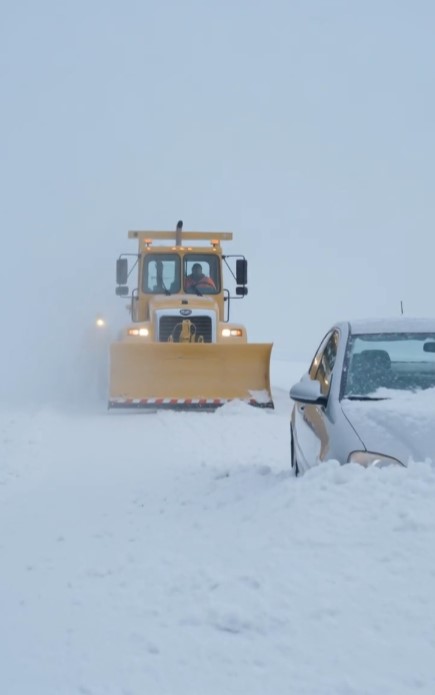
The highway had disappeared beneath the storm.
By midnight, the blizzard had swallowed everything. The road, the shoulder, the mile markers, even the trees beyond the guardrail were buried under a thick white blur. Wind slammed against the snowplow so hard the metal frame shook with every gust.
Inside the cab, Walter Hayes leaned over the steering wheel, eyes narrowed against the endless snow.
He had been plowing roads for nearly thirty years.
He knew winter.
He knew when a storm was dangerous.
And this one was different.
The radio kept crackling with warnings. Visibility was almost nothing. Several roads had already been closed. Drivers were told to stay home, but there were always people who tried anyway.
Walter had already passed two empty cars that night, half-buried near the shoulder. Both had been reported abandoned. The state patrol had tagged them for removal when conditions improved.
Then he saw the third one.
An old dark sedan sat crooked near the edge of the highway, almost completely covered in snow. Only part of the roof, the side mirror, and one icy window were still visible.
Walter slowed the plow.
The dispatcher’s voice came through the radio.
“That sedan was called in earlier. No occupants reported. Continue clearing if safe.”
Walter looked at the car.
It looked dead.
Frozen.
Forgotten.
He adjusted his grip and prepared to push the growing wall of snow farther off the road. If he did not clear the shoulder now, the next drift would block the lane entirely.
The plow blade lowered.
Snow rolled forward like a white wave.
Then Walter saw it.
A tiny handprint appeared on the frozen rear window.
He slammed on the brakes.
The plow stopped inches from the car.
For one second, Walter just stared.
The handprint faded beneath frost.
Then another one pressed slowly against the inside of the glass.
Small.
Weak.
Real.
Walter’s heart nearly stopped.
“There’s someone in the car,” he shouted into the radio. “I need emergency response now.”
He grabbed his flashlight, jumped from the cab, and stepped into snow that reached above his knees. The wind hit him like a wall. Ice stung his face as he fought his way toward the sedan.
“Hello!” he yelled. “Can you hear me?”
No answer.
He reached the rear door and yanked the handle.
Frozen shut.
He tried the front door.
Nothing.
He pulled harder, but the ice had sealed the car like a tomb.
Walter swept his flashlight across the window.
For a terrifying moment, he saw nothing.
Then movement.
A little girl’s face appeared in the shadows.
Pale.
Exhausted.
Barely conscious.
Walter’s hands shook as he ran back to the plow and grabbed the emergency hammer from behind the seat.
“Hold on,” he yelled, though he did not know if she could hear him. “I’m getting you out.”
He returned to the car, turned his face away, and struck the side window.
Once.
Twice.
On the third hit, the glass shattered.
Snow and icy air rushed into the car.
Walter cleared the remaining glass with his gloved hand and reached inside to unlock the door. It took all his strength to force it open against the packed snow.
The smell inside was cold fabric, fear, and stale air.
His flashlight swept across the back seat.
There, curled beneath a pile of blankets, was a little girl.
She could not have been more than eight.
Her lips were pale. Her eyelashes were crusted with frost. A pink backpack was tucked beside her like she had been holding it for comfort.
Walter climbed halfway into the car.
“Sweetheart, look at me,” he said, trying to keep his voice calm. “You’re safe now.”
The girl’s eyes opened slightly.
Her hand moved toward him.
Walter wrapped her in his coat and carefully lifted her from the back seat. She was so cold he could barely feel warmth through her clothes.
He carried her through the snow toward the plow, shielding her face from the wind.
Inside the cab, he turned the heater up as high as it would go and wrapped emergency blankets around her small body.
“What’s your name?” he asked.
The girl’s lips trembled.
“Lily,” she whispered.
“Okay, Lily. Help is coming. You’re doing great.”
Her eyes fluttered.
Walter leaned closer.
Then she whispered four words that froze him more than the storm ever could.
“My little brother…”
Walter stared at her.
“What?”
Lily’s weak fingers gripped his sleeve.
“My little brother…”
Walter looked back at the sedan.
His stomach dropped.
He had checked the back seat.
He had checked the floor.
He had seen no little boy.
“Where is he, Lily?” Walter asked quickly. “Was he in the car with you?”
She nodded faintly.
“He went… to find help.”
Walter’s blood ran cold.
Outside, the blizzard screamed across the empty highway.
A little boy was somewhere in it.
Walter grabbed the radio.
“Dispatch, I have one child recovered from the vehicle. She says a second child, younger male, left the car on foot. I repeat, a second child may be outside in the storm.”
For a moment, there was silence.
Then the dispatcher’s voice sharpened.
“Copy. All units responding. Do you have direction of travel?”
Walter looked at Lily.
“Which way did he go?”
The girl’s eyes filled with tears.
“He followed the lights.”
Walter looked through the windshield.
Far ahead, barely visible through the snow, a faint orange glow blinked near a curve in the road.
An old roadside emergency beacon.
It stood almost half a mile away.
To an adult, it was a short distance.
To a five-year-old child in a blizzard, it was forever.
Walter had a choice.
Wait for help and keep Lily warm.
Or search.
He looked at the girl shaking under the blankets.
Then he looked at the storm.
He could not leave her alone.
So he did the only thing he could.
He radioed again.
“I’m staying with the girl, but I’m sweeping the area with the plow lights. I need units here fast.”
Walter positioned the snowplow so the headlights and side lamps blasted across the shoulder and tree line. He climbed out again, tied a safety rope around his waist, and secured the other end to the plow’s front hook.
He moved slowly into the snow, calling into the darkness.
“Hello!”
The wind tore his voice away.
“Can you hear me?”
Nothing.
He swept his flashlight along the ground.
Snow.
Branches.
A broken road sign.
Then he saw something small near the guardrail.
A mitten.
Blue.
Half-buried.
Walter’s throat tightened.
He picked it up and shouted into the radio.
“I found a child’s mitten near the guardrail. Continuing search.”
He pushed forward.
Every step was harder than the last. The snow swallowed his boots. His lungs burned from the cold. The rope dragged behind him, the only thing keeping him connected to the plow.
“Buddy!” he yelled. “I’m here to help!”
Still nothing.
Then, between gusts of wind, he heard the faintest sound.
Not a cry.
Not a word.
A small tapping.
Walter froze.
He turned toward the sound.
Tap.
Tap.
Tap.
It came from the direction of the trees.
Walter aimed his flashlight and saw a shape beyond the guardrail.
A small roadside maintenance shed, nearly hidden by snow.
The door was half blocked.
Walter stumbled toward it, dropped to his knees, and dug with both hands.
“Hello?” he shouted.
The tapping stopped.
Then a tiny voice answered.
“I’m here.”
Walter nearly broke down.
He cleared enough snow to pull the shed door open.
Inside, curled against a stack of sandbags, was a little boy.
He was wrapped in a thin jacket, one hand bare, his cheeks red from cold. In his other hand, he held a small metal wrench he had been using to tap against the wall.
Walter reached for him.
The boy looked up with terrified eyes.
“My sister,” he whispered. “I have to get help for my sister.”
Walter’s voice cracked.
“She’s safe. I found her.”
The little boy began to cry.
Only then did Walter realize how young he was.
Five, maybe six.
A child who had walked into a blizzard because he thought saving his sister was his job.
“What’s your name?” Walter asked.
“Noah.”
Walter wrapped Noah in another emergency blanket and carried him back through the snow, following the rope by touch whenever the wind blinded him.
When they reached the plow, Lily was still inside, barely awake.
Walter opened the door.
“Noah,” he said gently, “look who’s here.”
Lily turned her head.
The moment she saw her brother, she began to sob.
Noah climbed beside her, shaking, and grabbed her hand.
“I found help,” he whispered.
Lily closed her eyes.
“I knew you would.”
Walter turned away for a moment, pretending to adjust the heater, because tears had filled his eyes.
Minutes later, the first patrol car arrived, followed by an ambulance and another snowplow. Paramedics rushed both children into the ambulance, wrapping them in heated blankets and checking their breathing, pulse, and temperature.
Lily was weak from exposure.
Noah had early signs of frostbite in his fingers.
But both were alive.
As the ambulance doors were about to close, Noah reached out.
“Sir?”
Walter stepped closer.
The boy held up the blue mitten Walter had found.
“You found this?”
Walter nodded.
Noah’s lips trembled.
“I dropped it and thought I was going to die because my hand got so cold.”
Walter placed the mitten gently back into his hand.
“You didn’t give up.”
Noah shook his head.
“Lily told me to be brave.”
The ambulance doors closed.
The siren disappeared into the storm.
Only after they were gone did Walter finally learn the full story.
The children had been traveling with their mother when the car slid off the road during the blizzard. She had gone to find help after the phone lost service, telling the children to stay under the blankets and not open the doors.
But she never made it far.
A rescue team later found her unconscious near a ditch, alive but badly weakened by the cold. She had collapsed while trying to reach the emergency beacon.
The car had been reported abandoned because passing drivers saw no movement inside and assumed everyone had already left.
If Walter had not noticed the handprint, the next pass of the plow would have buried the car deeper under the snow.
By morning, the storm had passed.
The highway reopened.
But Walter could not stop thinking about that tiny handprint on the glass.
He visited the hospital two days later, still wearing his snowplow jacket. He felt awkward walking into the children’s ward, holding a small stuffed bear he had bought at the gift shop.
Lily was sitting up in bed, her cheeks warmer now, her mother beside her with tears in her eyes.
Noah sat in the next bed with bandaged fingers, proudly eating pudding.
When he saw Walter, his face lit up.
“The snowman man!” Noah shouted.
Walter laughed softly.
“I guess that’s me.”
Lily looked at him with serious eyes.
“You saw my hand?”
Walter nodded.
“I did.”
“I was scared nobody would.”
Walter sat beside her bed.
“I almost missed it.”
Lily reached for his gloved hand.
“But you didn’t.”
Her mother began crying.
“I don’t know how to thank you,” she said. “You saved both my babies.”
Walter looked at the children.
“No,” he said quietly. “They saved each other. I just followed the signs.”
Weeks later, the highway department added a new emergency rule. No vehicle would be treated as abandoned during severe weather until responders physically checked every door and window. Snowplow drivers were issued extra rescue tools, thermal blankets, and child-alert training.
Walter did not ask for attention.
He returned to work like he always had.
But people in town remembered.
They remembered the snowplow driver who stopped for a handprint.
They remembered the little girl who held on long enough to be seen.
They remembered the little boy who walked into a blizzard because his sister needed help.
One afternoon, after the snow finally began to melt, Walter received a drawing in the mail.
It showed a big orange snowplow, a small car, and two children wrapped in blankets. Above them, drawn in blue crayon, were four words:
He saw my hand.
Walter pinned it inside his truck, right above the radio.
From then on, every time he drove through a storm, he looked twice at every buried car, every drift, every shadow near the road.
Because he knew the truth now.
Sometimes an abandoned car is not abandoned.
Sometimes silence is not emptiness.
Sometimes the smallest sign in the middle of a storm can be the difference between life and death.
And sometimes the first rescue is only the beginning.