
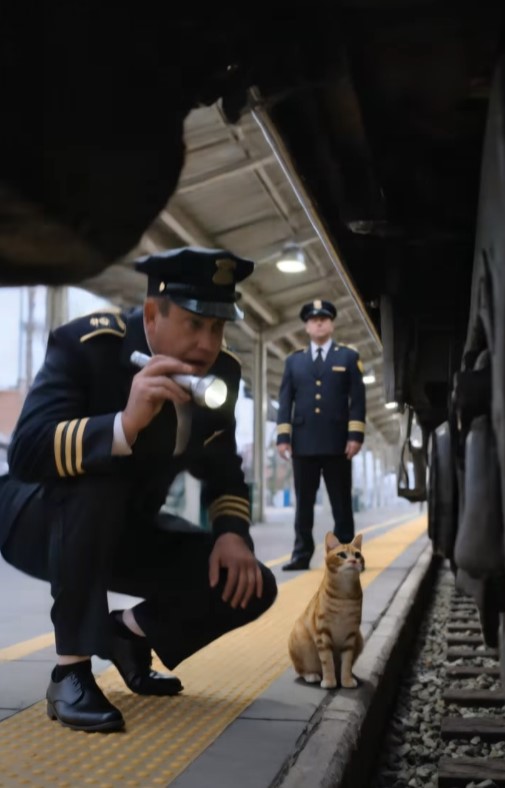
The last train of the night was almost ready to leave.
The station had grown quiet in that strange way only late-night stations do. The busy noise of the day had faded. The ticket windows were closed, the platforms were nearly empty, and the cold air carried the distant hum of the waiting train.
A few tired passengers hurried toward the doors, pulling coats tighter around their shoulders. Some carried small bags. Others checked their phones, eager to get home before midnight. The conductor glanced at his watch, then raised his hand to signal that departure was only moments away.
Everything seemed ordinary.
Then the old orange cat appeared.
Everyone at the station knew her. She had lived there for years, sleeping under benches, wandering between platforms, and charming passengers into sharing bits of food. Some called her Marmalade. Others simply called her the station cat. She belonged to no one, but somehow she belonged to everyone.
Most nights, she stayed near the warm lights of the entrance or curled up beside the vending machines. But that night, she came running down the platform as if something had frightened her.
She was meowing loudly.
Again.
And again.
At first, the staff thought she was hungry. That was the usual explanation whenever she became noisy around passengers. One worker bent down and tried to wave her away from the train, but the cat slipped past him and kept running.
She stopped beside the third passenger car.
Then she looked underneath it.
The conductor sighed. The train was already behind schedule, and the doors were beginning to close. He told a staff member to move the cat away before someone complained or the departure was delayed.
But the cat refused to leave.
She crouched near the edge of the platform, her orange tail stiff, her ears pulled back. She looked under the train, then turned toward the conductor and cried again. It was not the soft, casual meow people were used to hearing from her. It was sharp. Urgent. Almost desperate.
A passenger standing near the door laughed nervously and said the cat probably wanted attention.
Another person said she was just chasing a mouse.
But the conductor did not move right away.
Something about the way the animal behaved felt wrong.
The cat was not wandering. She was not begging from passengers. She was not moving randomly from place to place. She had chosen one exact spot beside one exact car, and she would not leave it.
A station worker stepped forward again, trying to scoop her up. The cat darted away, but only for a second. Then she returned to the same place and scratched at the platform near the track.
Once.
Twice.
Then she looked directly at the conductor.
The man felt a chill move through him.
He had worked at the station long enough to know the old cat’s habits. She was stubborn, yes, but not like this. She never chased trains. She never risked getting that close to the edge of the platform. She had survived for years because she knew exactly where danger was.
So why was she standing beside a departing train?
The conductor raised his hand and stopped the departure.
The doors remained closed, but the train did not move.
A few passengers groaned. Someone asked what the delay was. Another person looked out the window, annoyed. But the conductor ignored them. He took a flashlight from one of the staff members and walked toward the place where the cat was still staring beneath the train.
The old orange cat stepped back just enough to let him kneel.
The conductor crouched beside the platform and shined the flashlight into the darkness beneath the passenger car.
At first, he saw only metal, wheels, cables, shadows, and the narrow space between the train and the tracks. It was the kind of place no one wanted to look at for too long.
Then the beam of light caught something that made his whole body freeze.
A hand.
The conductor’s breath caught in his throat.
He moved the flashlight again, lower this time, and the truth became terrifyingly clear. Someone was underneath the train, pressed into the narrow space, barely moving.
For one second, the conductor could not speak.
Then he stood up so quickly that one of the workers stepped back in alarm.
“There’s someone under the train,” he shouted.
The platform changed instantly.
The annoyed passengers fell silent. Station staff rushed forward. The driver was ordered not to move. Emergency services were called. The area was cleared as quickly as possible, and the last train of the night became the center of a life-or-death rescue.
The old orange cat remained nearby, watching from a few steps away.
She was no longer meowing.
It was as if the moment someone finally understood, her job was done.
Nobody knew at first how the person had ended up under the train. Perhaps they had slipped near the platform edge. Perhaps they had fallen while trying to cross where they should not have been. Perhaps they had been hidden in the darkness so completely that no passenger, camera, or worker had noticed.
But the cat had noticed.
While people walked past, focused on tickets, phones, bags, and schedules, she had seen what everyone else missed. She had heard something, smelled something, or sensed movement beneath the carriage. Whatever had alerted her, she knew something was wrong.
And she refused to let the train leave.
That was the part that haunted the station workers afterward.
If she had stayed quiet, the train would have departed.
If she had walked away, no one would have looked under that passenger car.
If the conductor had dismissed her as a nuisance, the outcome could have been unthinkable.
Instead, an old station cat delayed the last train of the night just long enough for someone to be found.
The rescue was careful and tense. Workers had to make sure the train remained completely still. Emergency responders moved slowly into position, speaking calmly as they reached the person hidden beneath the car. The cold platform, which had moments earlier felt sleepy and ordinary, now felt heavy with fear.
Passengers stood behind the safety line, whispering in disbelief.
Some stared at the cat.
Only minutes before, many of them had been irritated by the delay. Now they understood that the delay had saved a life.
The cat sat near a bench, her orange fur bright beneath the station lights. She looked smaller now, quieter, almost tired. A staff member offered her food, but she did not rush to eat. She simply watched as rescuers worked.
Finally, the person was brought out from beneath the train.
A wave of emotion moved across the platform. Some passengers covered their mouths. Others lowered their heads. The conductor stood still, holding the flashlight that had revealed the truth, unable to stop looking at the old cat.
She had not been begging.
She had not been causing trouble.
She had not been chasing food.
She had been warning them.
In the days that followed, the story spread through the station. Workers who had passed the cat for years began seeing her differently. She was no longer just the stray who slept near the ticket machines or waited outside the café for scraps. She had become part of the station’s history.
A quiet guardian.
The kind of hero no one expects until the moment they are needed.
People often underestimate animals because they cannot explain themselves in human words. But animals notice the world differently. They hear sounds we ignore. They smell things we cannot detect. They sense fear, movement, and danger in ways that can seem almost mysterious.
The old orange cat could not shout for help.
She could not point like a person.
She could not tell the conductor what was hidden under the train.
So she did the only thing she could do.
She refused to leave.
She ran beside the train. She meowed until people looked. She scratched at the platform. She stared underneath the carriage and pleaded in the only language she had.
And because one man finally listened, the last train of the night did not become a tragedy.
That is why the people who were there would never forget what happened on that cold platform.
They came to the station expecting an ordinary ride home.
Instead, they witnessed an old orange cat stop a train and save a life no one knew was in danger.
Sometimes heroes do not arrive with sirens.
Sometimes they do not wear uniforms.
Sometimes they are small, quiet, and easily ignored.
But they see what others miss.
And when it matters most, they refuse to walk away.