
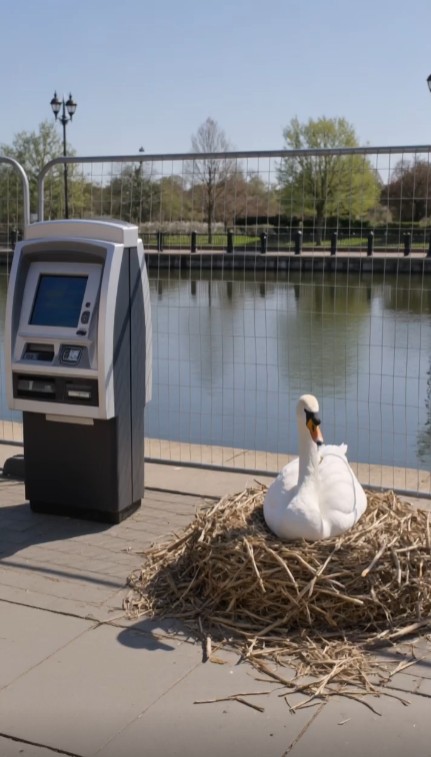
A swan built an entire nest beside a busy train station.
Right next to the ticket machine.
Commuters could barely believe what they were seeing.
A magnificent white swan.
Sitting calmly.
Surrounded by dry reeds and twigs.
While hundreds of people hurried toward their trains.
The station manager was called.
His name was Daniel.
He came out of the office, looked across the plaza, and stopped.
“How did she even get here?”
Nobody knew.
The swan had apparently chosen that exact spot.
And she was not leaving.
At first, staff thought she might simply be resting.
Then a wildlife specialist arrived.
Her name was Claire.
She stayed well back from the bird and raised a long-lens camera.
After several minutes, she lowered it.
“She’s nesting.”
Daniel frowned.
“Here?”
Claire nodded.
“And she’s sitting on eggs.”
That changed everything.
The area around the ticket machine was usually one of the busiest parts of the station.
Morning commuters crossed it constantly.
People pulled suitcases through.
Children ran past.
Delivery workers pushed carts.
None of that was compatible with a nesting swan.
The station reacted quickly.
Portable barriers were placed at a wide distance.
One ticket machine was temporarily taken out of use.
Pedestrian traffic was redirected.
Large signs asked people not to approach or feed the bird.
Most commuters were fascinated.
Some took photographs from a distance.
Others complained about the detour.
Daniel stood near the barriers and repeated the same explanation:
“She got here first.”
Claire corrected him once.
“Technically, the station got here first.”
Daniel smiled.
“You know what I mean.”
Then a maintenance worker named Marco noticed something.
Across the plaza, near the canal, another swan was standing beside a temporary construction fence.
Marco pointed.
“Is that another one?”
Claire raised her binoculars.
The second swan stood on the far side of the barrier.
It paced along the fence.
Stopped.
Looked toward the station.
Then moved again.
Daniel walked over.
“Could that be her mate?”
Claire did not answer immediately.
Swans can form strong pair bonds, but she did not want to make assumptions based on one observation.
Then she noticed the layout.
A temporary construction fence blocked the normal path from the canal toward the plaza.
The station had begun resurfacing work several days earlier.
Before that, a narrow access route had remained open between the water and the station landscaping.
Now it was completely closed.
Claire pointed toward the fence.
“When was this installed?”
Daniel thought.
“Three days ago.”
“And when did the swan appear here?”
“Yesterday morning.”
Claire looked back toward the nesting bird.
Then at the swan by the canal.
“That may explain part of it.”
The swans had likely been using the area before the construction work began.
The nesting female may have selected the sheltered corner near the station because the landscaping there offered cover.
The temporary fencing could then have separated the pair’s usual route between the nest and the canal.
That did not mean the birds understood the construction in human terms.
But the new barrier had clearly changed access through the site.
Marco asked:
“Can we just open the fence?”
Claire shook her head.
“Not yet.”
The fence protected an active construction zone.
Removing it without a plan could expose people and wildlife to machinery and uneven ground.
So the station contacted the construction supervisor.
Then local wildlife authorities.
Everyone met that afternoon.
Claire explained the problem.
One nesting swan.
One second swan repeatedly appearing near the canal.
A blocked route.
Heavy commuter traffic.
Active construction.
The solution had to protect all of them.
The first idea was moving the nest.
Claire rejected it.
“Unless there is an immediate safety reason and proper authorization, we should not be relocating an active nest.”
Daniel nodded.
“So we work around her.”
“Yes.”
Then they examined the fence.
There was one section away from machinery where a temporary wildlife passage could be created.
Not wide enough for people.
Not connected to public foot traffic.
Just a controlled opening between the canal-side vegetation and the quieter edge of the plaza.
The construction crew repositioned several panels.
Additional barriers prevented commuters from entering the work zone.
Then everyone backed away.
Nothing happened.
For nearly an hour, the male swan remained by the canal.
Daniel said:
“Maybe he doesn’t care.”
Claire smiled.
“Or maybe he hasn’t noticed yet.”
They left the area quiet.
Later that afternoon, Marco called Claire.
“You need to see this.”
The second swan had moved through the new opening.
Slowly.
Carefully.
He crossed toward the station landscaping.
Then stopped several meters from the nest.
The nesting female lifted her head.
The male remained nearby.
Nobody at the station claimed some dramatic reunion.
No rushing.
No theatrical display.
Just two birds now able to occupy the same area again.
Claire was pleased.
“That’s much better.”
The station adjusted its plan again.
The temporary wildlife route would remain open.
The construction schedule near that section was changed.
Loud work was moved elsewhere.
Crews were told to check with station management before operating machinery close to the nest zone.
Over the following days, the swans became part of the morning routine.
Commuters arrived.
Trains departed.
Announcements echoed through the station.
And beside all of it, the female swan continued sitting.
The male often stayed nearby.
Sometimes at the canal.
Sometimes closer to the nest.
People became strangely protective.
One commuter scolded another for stepping too close to the barrier.
A child drew a picture of the swans and gave it to Daniel.
Someone suggested naming them.
Claire discouraged it.
“They’re wild animals.”
Daniel said:
“Can I privately call them Station One and Station Two?”
Claire laughed.
“Privately.”
Then came another problem.
Food.
People began throwing bread toward the swans.
Claire stopped that quickly.
She explained that feeding wild birds around a busy station could create dependence, attract other animals, and encourage the swans to remain closer to people than was safe.
The station added clearer signs.
PLEASE DO NOT FEED THE SWANS.
That helped.
Then one morning, Claire noticed a change in the nest.
The female stood briefly.
Beneath her were eggs.
Several.
She settled again.
Daniel asked:
“How long?”
Claire gave him a rough estimate but reminded him that nature did not follow station timetables.
That became the running joke.
“Train 7:42 delayed.”
“Swans: on schedule.”
Weeks passed.
The construction crew completed work everywhere except the protected section.
The station learned to function around the nesting site.
Then early one morning, Marco arrived before sunrise.
He called Daniel immediately.
“They’re hatching.”
Daniel came out.
Claire was contacted.
Nobody approached.
Through binoculars, they could see movement beneath the female.
Tiny heads.
One.
Then another.
By midday, several cygnets were visible.
Soft.
Gray.
Almost completely hidden against the nest.
The station staff were delighted.
But Claire reminded everyone that the most difficult part was still ahead.
The family would eventually need to reach the canal.
That meant crossing part of the plaza.
And a swan family with very young cygnets should not have to navigate hundreds of rushing commuters if the station could safely reduce disturbance.
So the team planned carefully.
They did not try to force the family to move.
Instead, they prepared.
Temporary barriers were positioned so staff could quickly create a wide, quiet corridor if the swans began heading toward the water.
The wildlife passage through the construction fence remained open.
Station staff were briefed.
Then they waited.
The swans decided the timing.
Two mornings later, the female stood.
The cygnets gathered around her.
The male was already nearby.
Slowly, the family began moving.
Daniel saw them first.
“Claire.”
She raised her binoculars.
“They’re going.”
Station staff immediately redirected pedestrians.
One entrance was temporarily closed.
Commuters were guided along another path.
Nobody touched the birds.
Nobody walked behind them trying to push them faster.
The swans moved at their own pace.
The female first.
Cygnets close behind.
The male nearby.
The entire station seemed to slow down.
People stopped.
Some held phones.
Most simply watched.
The little family crossed the section of plaza that had been roaring with commuters every morning.
Then reached the temporary opening.
The female passed through.
The cygnets followed.
One.
Two.
Three.
Four.
Then the male.
Within moments, they were at the canal.
The cygnets entered the water.
The adults followed.
A cheer started somewhere in the station.
Then applause.
Daniel laughed.
“I don’t think we’re supposed to applaud wildlife.”
Claire smiled.
“It’s probably fine from here.”
The nest remained empty.
The staff waited before removing the barriers.
Claire wanted to be certain the family was not returning immediately.
Once that was clear, the construction team completed the remaining work.
But the station made one permanent change.
The rebuilt landscaping included a clearer buffer between the canal and the busiest pedestrian areas.
Maintenance schedules were adjusted during nesting season.
Before future construction projects, staff would consider wildlife access routes rather than assuming fences only affected people.
The incident had exposed something simple.
Temporary barriers can alter how animals move through familiar spaces.
A fence designed to protect a construction area may also block access between feeding, nesting and water areas.
That did not mean construction had to stop forever.
It meant planning had to be better.
The following spring, swans appeared near the canal again.
Nobody knew whether they were the same pair.
There were no identifying markers.
Claire refused to guess.
But the station was ready.
The staff checked access routes.
Monitored the landscaping.
And kept the new procedure in place.
No swan nested beside the ticket machine that year.
Daniel pretended to be disappointed.
Marco said:
“Maybe they finally read the signs.”
Years later, commuters still remembered the morning when the station temporarily became a wildlife crossing.
The story grew slightly more dramatic every time people told it.
Some claimed the male swan stood for days desperately calling to his mate.
That was not documented.
Others said station staff carried the cygnets to the water.
They did not.
The real story was better because it was simpler.
A female swan chose an awkward but sheltered nesting spot beside a busy station.
Construction altered the usual route to the nearby canal.
A second swan repeatedly appeared on the opposite side of the barrier.
Wildlife specialists and station staff noticed the problem.
Instead of moving the birds, they changed the human environment around them.
They created space.
Opened a safer route.
Adjusted construction.
Redirected commuters.
Then waited.
Eventually, the swans did the rest themselves.
The station had not “rescued” them in some dramatic sense.
It had simply stopped getting in their way.
And for one unforgettable morning, hundreds of commuters stood still while a family of swans crossed the plaza and disappeared toward the water.