
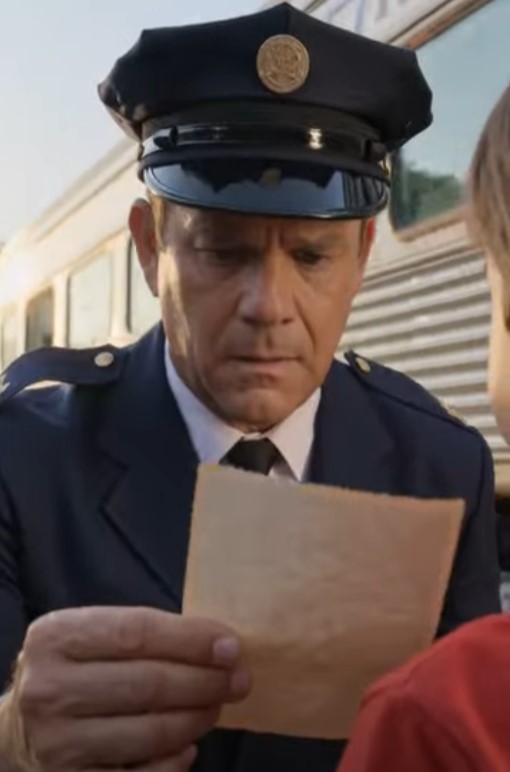
The train had already begun to move when the conductor saw the boy.
It was supposed to be a normal afternoon route. The luxury passenger train had just pulled away from a small countryside station, carrying business travelers, tourists, and families heading toward the city. Inside, passengers settled into leather seats, opened laptops, checked watches, and complained about the rain tapping against the windows.
Everything was on schedule.
Then the brakes screamed.
Coffee spilled across tray tables. Suitcases shifted overhead. Several passengers gasped as the train slowed hard and came to a complete stop only a short distance from the platform.
Within seconds, irritation filled the carriage.
“What happened?”
“Why are we stopping?”
“We just left!”
Near the front of the train, a wealthy businessman in a dark suit stood from his seat and stormed toward the conductor’s cabin.
“Do you know how much this delay is costing?” he shouted. “Some of us have important places to be.”
But the conductor did not answer.
His name was Thomas Hale, and he had worked the railway for more than thirty years. He was known for being calm, strict, and almost painfully punctual. He had never stopped a train without reason. Not once.
But now he stood frozen beside the open door, staring back toward the platform.
Outside, near the edge of the tracks, stood a small barefoot boy.
He looked no older than nine.
His clothes were worn. His hair was messy from the wind. He was not crying, not waving, not running after the train.
He was simply standing there alone, holding an old photograph with both hands.
Thomas stared at the picture from a distance.
Then his face changed.
The color drained from his cheeks.
Before anyone could stop him, he pulled the emergency latch, opened the side door, and jumped down onto the platform.
The businessman shouted after him.
“Are you insane?”
Thomas ignored him.
Passengers pressed their faces to the windows as the conductor ran through the rain toward the boy.
The child did not move.
He only held the photograph higher.
Thomas slowed as he approached. His breath came fast. His polished shoes splashed through puddles. When he finally reached the boy, he looked down at the picture and seemed to forget the entire world behind him.
His hands began to tremble.
Then, in front of the passengers, station workers, and the angry businessman watching from the train, Thomas removed his conductor’s hat.
He knelt in front of the child.
“Where did you get this?” he asked, his voice barely louder than the rain.
The boy looked at him carefully.
“My grandmother said if I ever saw you, I should give it back.”
Thomas blinked.
“Your grandmother?”
The boy nodded.
“She said you would know her.”
Thomas took the photograph with shaking fingers.
It was faded and bent at the corners, but he knew it instantly.
A young woman stood beside a train platform, smiling shyly at the camera. Her dark hair was tucked beneath a scarf. Around her neck hung a small silver locket.
Beside her stood a younger version of Thomas, wearing his first railway uniform.
On the back of the photograph, written in blue ink, were six words.
Wait for me at the station.
Thomas covered his mouth.
For twenty-eight years, he had carried the memory of that woman like a wound that never healed.
Her name was Clara.
She had been his first love.
And one winter morning, she had disappeared without saying goodbye.
Thomas had searched for her for years. He wrote letters. He visited towns. He called every number he could find. No one knew where she had gone.
Some said she had left him.
Some said she had married someone else.
Some said he should move on.
But Thomas never believed she would disappear by choice. Not Clara. Not after everything they had promised each other.
Still, life continued. Trains came and went. Seasons changed. Thomas grew older. The station where they had once met was rebuilt, renamed, and almost forgotten.
But he never forgot her.
And now a barefoot boy was standing in front of him with the one photograph Thomas thought he had lost forever.
“What is your grandmother’s name?” Thomas whispered.
The boy looked down.
“Clara.”
Thomas’s eyes filled with tears.
Around him, the platform seemed to fade away. The train, the passengers, the angry voices, the schedule, the money, the noise—all of it disappeared.
Only the boy remained.
“What’s your name?” Thomas asked.
“Eli,” the child said.
Thomas stared at him.
The boy had Clara’s eyes.
The same quiet sadness. The same gentle way of looking at people as if he was afraid to ask for too much.
“Where is she?” Thomas asked quickly. “Where is Clara?”
Eli tightened his small hands together.
“She’s sick,” he said. “She lives in the old house past the mill. She told me not to bother anyone, but when I saw your picture at the station office, I knew it was you.”
Thomas frowned.
“My picture?”
The boy nodded toward the platform wall. There, behind the ticket window, hung an old framed photo of longtime railway employees. Thomas was in the front row, older now but unmistakable.
Eli had recognized him from the photograph his grandmother kept hidden in a tin box beneath her bed.
Thomas stood too quickly, nearly losing his balance.
“Why didn’t she come herself?”
Eli looked away.
“She can’t walk far anymore.”
Those words struck Thomas harder than the train brakes ever could.
He turned back toward the train.
The businessman was still near the open door, red-faced with anger.
“This is ridiculous!” he yelled. “You stopped an entire train over an old photograph?”
Thomas looked at him for the first time.
“No,” he said quietly. “I stopped it because someone I lost twenty-eight years ago might still be waiting.”
The businessman opened his mouth, but no words came out.
One of the passengers, an elderly woman sitting near the window, wiped tears from her eyes.
Another passenger whispered, “Let him go.”
Soon the mood inside the train began to change. The irritation faded. People stopped checking their watches. Even those who had complained at first leaned closer to the windows, watching the conductor and the barefoot child standing together in the rain.
Thomas called the station manager and gave fast instructions. Another crew member would take over the train. The delay would be explained. The passengers would continue safely.
Then he looked at Eli.
“Can you take me to her?”
The boy nodded.
Thomas walked with him past the platform, across a narrow road, and down a muddy path toward the old mill district.
The rain softened as they reached a small house hidden behind overgrown hedges. The paint was peeling. The porch sagged slightly. A single warm light glowed behind a curtain.
Eli opened the door.
Inside, the house smelled faintly of tea, old wood, and medicine.
An elderly woman sat in a chair near the window with a blanket over her knees. Her hair had turned silver, and time had carved lines into her face, but Thomas knew her before she even looked up.
Clara.
For a moment, neither of them moved.
Then the cup in Clara’s hand began to shake.
“Thomas?” she whispered.
He stepped into the room slowly, as if afraid this was a dream.
“Clara.”
Her eyes filled with tears.
“You came.”
Thomas dropped to his knees beside her chair.
“I waited,” he said. “For years, I waited. I looked everywhere.”
Clara covered her face.
“I thought you hated me.”
Thomas stared at her, confused and heartbroken.
“Hated you? I thought you left.”
She shook her head.
“I wrote to you. So many times.”
“I never received anything.”
Clara closed her eyes, and the truth finally came out.
Her father had never approved of Thomas. He believed a young railway worker was not good enough for his daughter. When Clara became ill and had to leave town for treatment, her father hid Thomas’s letters and destroyed hers before they could be sent.
By the time Clara returned months later, she was told Thomas had moved on.
Thomas had been told Clara had left by choice.
Both of them had been lied to.
Both had spent decades believing the other had forgotten.
Thomas bowed his head, overcome by the cruelty of all the years they had lost.
Clara reached for his hand.
“I kept the photograph,” she said softly. “It was the only proof I had that we were real.”
Thomas held her hand like it was something fragile and sacred.
“You should have never had to wait alone.”
Clara looked toward Eli.
“I wasn’t alone. Not completely.”
Eli stood quietly by the door, watching them.
Thomas turned to the boy.
“Is he your grandson?”
Clara nodded.
“My daughter’s boy. She passed away two years ago. Eli has been taking care of me more than any child should.”
Thomas looked at the barefoot child again, and now everything made sense—the worn clothes, the tired eyes, the small backpack, the courage it had taken to stand beside the tracks and hold up a photograph to a moving train.
He had not stopped the train for a stranger.
He had stopped it for the last piece of the life that had been stolen from him.
In the days that followed, the story spread across the railway.
Some people called Thomas reckless. Others called him romantic. But the passengers who had been on that train told a different version.
They said they had seen a man choose a human life over a schedule.
They said they had watched anger turn into silence, and silence turn into tears.
They said a barefoot boy with an old photograph had reminded an entire train full of strangers that not every delay is a waste of time.
Thomas helped Clara get proper medical care. He made sure Eli had shoes, warm clothes, and a safe place to sleep. And every afternoon, after his shift ended, he visited the small house by the mill.
Sometimes he and Clara spoke for hours.
Sometimes they simply sat together by the window, holding hands, grieving the years they lost but grateful for the days they still had.
One evening, Eli found Thomas sitting on the porch, staring at the old photograph.
“Are you sad?” the boy asked.
Thomas smiled gently.
“A little.”
“Because you lost her?”
Thomas looked through the window at Clara, who was sleeping peacefully in her chair.
“No,” he said. “Because I almost didn’t stop.”
Eli sat beside him.
“My grandmother said you always stopped for people.”
Thomas laughed softly, tears in his eyes.
“She remembered me better than I remembered myself.”
Months later, the railway company quietly placed a new photograph in the station office.
It showed Thomas in his conductor’s uniform, Clara beside him in her wheelchair, and Eli standing between them wearing polished shoes and a shy smile.
Under the frame was a small engraved plaque.
Some journeys are delayed because something more important is waiting.
Passengers still pass that photograph every day.
Most do not know the full story.
They do not know about the barefoot boy.
They do not know about the woman who waited twenty-eight years.
They do not know about the conductor who stopped a million-dollar train because of an old faded picture.
But those who were there never forgot.
Because sometimes a train does not stop because something has gone wrong.
Sometimes it stops because, after years of loss, life is finally giving someone the chance to make things right.