
Grace was supposed to wipe the table and go home.
The diner had been closed for twenty minutes. The neon sign in the front window was off, the last coffee pot had been emptied, and the kitchen staff were already laughing near the back door, waiting to clock out.
Only Table 12 remained dirty.
A half-empty glass of milk.
A plate of cold fries.
A napkin crumpled beside the booth.
And ketchup smeared across the table in a long red streak.
The manager, Victor, pointed at it with irritation.
“Grace, clean it already. We’re done.”
Grace stood beside the booth with a rag in her hand.
But she did not move.
She kept staring at the ketchup.
Victor sighed loudly.
“Seriously? It’s ketchup. Wipe it.”
One of the cooks laughed from the kitchen doorway.
“Maybe she’s waiting for it to apologize.”
But Grace did not smile.
Because she remembered the little girl.
She had been sitting at Table 12 less than an hour earlier with a man who claimed he was her uncle. The girl looked about six years old, with a pink sweater, tangled brown hair, and shoes that did not match.
Grace noticed her because she barely spoke.
The man did all the talking.
“She’s tired,” he said when Grace asked the child what she wanted to drink.
The girl looked down at the table.
“Milk,” she whispered.
The man’s hand tightened around the girl’s shoulder.
Grace saw it.
A small thing.
Quick.
Easy to miss.
But Grace had worked in diners long enough to know when a child was shy and when a child was scared.
The man kept checking his phone. He kept looking toward the windows. He asked if there was a back exit and laughed as if it were a joke.
“Parking lot’s crowded out front,” he said.
But the front lot had only three cars in it.
Grace felt something wrong in her chest, but she did not know what to do. The man had money. He spoke calmly. The girl never cried. Nothing looked like an emergency.
Then, just before they left, the little girl dragged one finger slowly through the ketchup on the table.
The man snapped, “Stop making a mess.”
The girl pulled her hand back and lowered her head.
Grace remembered that moment now.
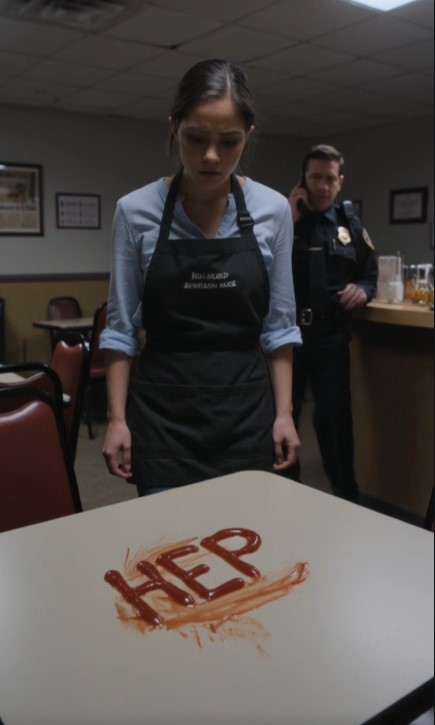
The ketchup was not random.
It was shaped.
Not perfectly.
Not clearly from across the room.
But when Grace leaned closer, her breath caught.
There was one word written across the table.
HELP
The rag fell from her hand.
Victor frowned.
“What now?”
Grace pointed.
Nobody laughed this time.
Victor stepped closer.
His face changed.
“Is that…?”
“Yes,” Grace whispered.
The kitchen went silent.
Grace turned toward the door.
“Where’s the girl?”
Victor looked toward the front windows.
“They left.”
Grace shook her head.
“No. Check the cameras.”
Victor hesitated.
Grace’s voice rose.
“Check them now.”
They rushed to the small office behind the register. Victor pulled up the security footage while Grace stood behind him, her hands shaking.
The camera showed the man paying at the counter. He smiled. He waved politely.
The little girl stood beside him, still looking down.
Then the man guided her toward the hallway near the restrooms.
Not the front door.
The back hallway.
Grace’s stomach dropped.
Victor clicked to another camera.
The footage showed the man pushing through the employees-only door with the child in front of him. She looked back once.
Only once.
Straight toward the dining room.
Toward Grace.
Then they disappeared from view.
Grace covered her mouth.
“She didn’t leave through the parking lot.”
Victor grabbed the phone and called 911.
Within minutes, police cars pulled into the diner lot with lights flashing silently against the windows. Officers reviewed the footage. Grace described the man, the girl, the table, the ketchup, every small detail she could remember.
The pink sweater.
The mismatched shoes.
The way the man gripped her shoulder.
The way the girl looked at the back hallway like she already knew she should not go there.
One officer asked, “Did the man say her name?”
Grace closed her eyes.
“He called her Mia once.”
The officer’s head lifted.
A missing child alert had been issued that afternoon for a six-year-old girl named Mia Carter.
She had disappeared from a grocery store two towns over while her mother was distracted at checkout.
The man was not her uncle.
The diner changed instantly from a closing shift into a crime scene.
Police searched the back hallway and found the emergency exit propped open with a folded cardboard box. Behind the diner, tire marks cut through the gravel near the alley.
The man had not parked in front.
He had used the back.
But he had made one mistake.
He had stopped at Table 12.
And Mia had been brave enough to leave a message.
Grace stood near the booth while officers photographed the ketchup before anyone touched it. The word was shaky, uneven, and half-smeared near the final letter.
But it was enough.
HELP.
One word from a terrified little girl who understood she might not get another chance.
Police sent the security footage to nearby patrol units. The suspect’s vehicle appeared briefly on an alley camera behind the diner, then again near a gas station on the edge of town.
Less than an hour later, officers found the car outside an abandoned storage building.
Mia was inside.
Alive.
Scared.
But alive.
When the call came through, Grace was still sitting in the diner booth, staring at the table.
Victor walked over slowly.
“They found her,” he said.
Grace broke down.
The cook who had laughed earlier turned away and wiped his eyes.
The next morning, Mia’s mother came to the diner.
She looked exhausted, like she had cried through an entire lifetime in one night. Mia stayed close to her side, holding a small stuffed rabbit the police had given her.
Grace froze when she saw them.
Mia recognized her immediately.
The little girl stepped forward.
“You saw it,” she whispered.
Grace knelt in front of her.
“Yes, sweetheart. I saw it.”
Mia’s mother began to cry.
“She told me she tried to write it because you looked nice,” the mother said. “She said she thought maybe you would understand.”
Grace pressed one hand to her heart.
“I almost wiped it away.”
“But you didn’t,” Mia’s mother said.
Then she hugged Grace so tightly that neither of them could speak.
Victor later apologized to Grace in front of the entire staff.
“I thought you were being dramatic,” he admitted. “You were paying attention.”
Grace looked toward Table 12.
“No,” she said softly. “She was asking for help. I just finally listened.”
After that night, the diner changed.
Employees were trained on what to do if something felt wrong. Cameras were upgraded. The back hallway door was locked from the outside. A small sign was placed near the register, not for customers to notice, but for staff to remember:
Look twice. Listen closely.
Table 12 was cleaned eventually.
But Grace asked Victor to wait until after the police finished.
She could not bring herself to wipe away that word too soon.
Because to everyone else, it had looked like a mess.
A child dragging ketchup across a table.
A small annoyance at the end of a long shift.
Something to clean and forget.
But it had been a message.
A lifeline.
A scream written silently by a little girl who could not scream out loud.
Weeks later, Mia returned to the diner with her mother. This time, she ordered pancakes with extra strawberries. She laughed when whipped cream got on her nose.
Grace watched from behind the counter with tears in her eyes.
Mia looked like a child again.
Not a victim.
Not a missing person.
A child.
Before leaving, Mia placed a folded napkin on Table 12.
Grace opened it after they were gone.
Inside, in careful purple crayon, Mia had written:
Thank you for reading my word.
Grace kept that napkin in her locker.
On the hardest days, when customers were rude and her feet ached and the world felt too busy to notice anything small, she would look at it and remember.
Sometimes danger does not look like danger.
Sometimes it sits quietly in a booth.
Sometimes it smiles and says it is family.
Sometimes the only warning is a frightened child’s finger moving through ketchup before anyone can stop her.
And sometimes a life is saved because one waitress refuses to clean the table too fast.