
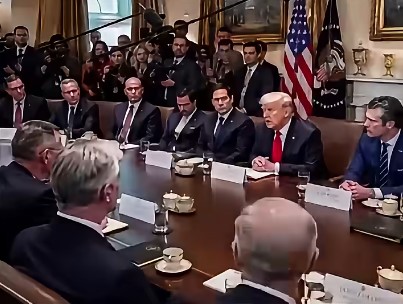
Several high-profile personnel developments have fueled debate about the direction of President Donald Trump’s foreign and national security policies.
The retirement of a senior State Department official responsible for African affairs, the unexpectedly early departure of the commander of U.S. Southern Command, and Trump’s public suggestion that Senator Ted Cruz could someday be nominated to the Supreme Court have each drawn attention for different reasons.
Taken together, the episodes illustrate an administration in which diplomatic priorities, military leadership, and political alliances can shift quickly.
However, the developments did not occur at the same time.
Troy Fitrell retired from the State Department in July 2025, Admiral Alvin Holsey left U.S. Southern Command in December 2025, and Trump made his widely reported Ted Cruz remark on February 27, 2026.
Fitrell had been serving as the State Department’s senior official overseeing African affairs when he announced plans to retire during the summer of 2025.
The department described his departure as a planned retirement following a long and distinguished career rather than a resignation caused by one particular policy dispute.
Fitrell had spent decades working in diplomacy and was serving as the most senior official directing the Bureau of African Affairs at a time when no Senate-confirmed assistant secretary was in place.
Jonathan Pratt, then the bureau’s second-ranking official, was selected to assume leadership responsibilities following Fitrell’s departure.
The timing attracted attention because the Trump administration was also redefining the way the United States approached the African continent.
The administration placed greater emphasis on trade, critical minerals, private investment, infrastructure, and commercial agreements.
That represented a shift away from an approach centered more visibly on traditional development assistance and democracy-promotion programs.
Supporters viewed the strategy as a more practical way to compete economically and build mutually beneficial relationships.
Critics worried that reducing emphasis on aid, governance, and human rights could weaken long-standing partnerships or leave vulnerable communities with fewer resources.
Africa has also become increasingly important in the strategic competition involving the United States, China, and Russia.
China has invested heavily in infrastructure, transportation, energy, mining, and telecommunications across the continent.
Russia has expanded its influence through security partnerships, arms relationships, political cooperation, and involvement in resource-rich states.
American policymakers have warned that inconsistent diplomatic engagement can create openings for both countries.
That makes leadership continuity inside the Bureau of African Affairs particularly important.
Fitrell had been managing the bureau without a Senate-confirmed assistant secretary of state for African affairs above him.
Career diplomats can provide institutional experience and maintain daily operations, but prolonged vacancies in politically appointed positions may limit a bureau’s influence within an administration.
A senior official without full political backing may find it more difficult to secure funding, obtain access to the White House, or resolve disagreements with other agencies.
Fitrell’s replacement therefore inherited not only a demanding regional portfolio but also an uncertain leadership structure.
Jonathan Pratt later led the bureau after Fitrell’s departure, but he eventually announced his own retirement after nearly three decades of public service.
That created another transition within the Africa team and reinforced concerns about continuity at a time of growing strategic competition across the continent.
Reporting indicated that Deputy Assistant Secretary Nicholas Checker would take over senior leadership responsibilities following Pratt’s exit.
Still, diplomatic turnover should not automatically be interpreted as evidence of a policy crisis.
Senior career officials retire regularly, particularly after decades of government service.
A departure by itself does not prove that an official objected to presidential policies or was forced out.
In Fitrell’s case, the State Department publicly described the move as planned.
Repeated turnover can nevertheless become significant when important leadership positions remain vacant or when policy is undergoing a major transformation.
The larger concern is not simply that one official leaves, but whether the institution retains enough experience and authority to carry out a coherent strategy.
The retirement of Navy Admiral Alvin Holsey raised a different set of questions because he left U.S. Southern Command after only about a year as commander.
Combatant commanders typically serve longer terms, often remaining in their positions for several years.
Holsey assumed command in November 2024 and relinquished it on December 12, 2025, retiring after more than 37 years in the Navy.
The unusually short tenure led lawmakers, military observers, and journalists to question why he had chosen to leave so early.
U.S. Southern Command is responsible for military activities across Central America, South America, and much of the Caribbean.
Its mission includes security cooperation, counternarcotics operations, humanitarian assistance, disaster response, intelligence coordination, and military partnerships.
The command also plays an important role in monitoring Venezuela, regional trafficking networks, and growing Chinese and Russian engagement in the Western Hemisphere.
Holsey became the first Black officer to lead SOUTHCOM when he assumed the role.
His departure came while the Trump administration was carrying out an intensified military campaign against vessels suspected of involvement in drug trafficking.
The operations included lethal strikes in the Caribbean and nearby waters.
The administration argued that the campaign targeted organizations it had linked to terrorism and transnational crime.
Critics in Congress, human rights organizations, and the legal community questioned whether the strikes had sufficient legal authorization and whether suspected traffickers were being treated as wartime combatants without adequate evidence or judicial review.
Anonymous officials and media reports suggested that Holsey had concerns about the expanding scope of the Caribbean mission and the administration’s broader approach toward Venezuela.
Those reports fueled speculation that policy disagreements contributed to his early departure.
Holsey did not publicly confirm that explanation.
At his retirement ceremony, he spoke positively about his military career and emphasized the importance of maintaining U.S. credibility and supporting democratic partners.
Because he did not provide a detailed public reason for leaving early, claims about a direct policy break should be treated as reported speculation rather than established fact.
Defense Secretary Pete Hegseth publicly announced Holsey’s retirement without identifying any dispute or controversy as the cause.
Official statements focused on the admiral’s decades of service and leadership.
That praise did not stop questions about why a combatant commander would depart so soon after taking the position.
In Washington, an unexplained early retirement can generate speculation even when officials insist that a transition is orderly.
Air Force Lieutenant General Evan Pettus initially assumed command duties when Holsey retired in December 2025.
The transition allowed SOUTHCOM to continue operating while the administration and Senate considered a permanent commander.
Marine Lieutenant General Francis Donovan was later confirmed as a four-star general and commander of U.S. Southern Command in January 2026.
Holsey’s retirement also came during a period of wider change among senior military officers.
Trump and Hegseth had already removed or replaced several high-ranking leaders as the administration sought commanders aligned with its strategic and cultural priorities.
Supporters argued that presidents and defense secretaries have the authority to select leaders capable of carrying out their agenda.
Critics warned that rapid turnover could politicize the officer corps or make commanders more hesitant to provide candid military advice.
The United States military operates under civilian leadership.
The president and defense secretary determine policy, while military commanders are responsible for advising them and implementing lawful orders.
Tension can arise when commanders believe a mission is too broad, inadequately planned, legally uncertain, or unsupported by sufficient resources.
Such disagreement does not necessarily amount to insubordination.
A functioning civil-military relationship depends on senior officers being able to provide honest assessments before final decisions are made.
Venezuela remained at the center of regional tensions as the Trump administration adopted an increasingly confrontational approach toward Venezuelan leader Nicolás Maduro and criminal organizations operating in the region.
Officials discussed expanded military pressure, intelligence activity, and possible action against targets connected to trafficking networks.
Venezuela responded by accusing Washington of aggression and increasing its military preparedness.
The possibility of escalation raised concerns among neighboring governments and members of Congress who wanted clearer explanations of U.S. objectives.
A counternarcotics operation can also expand rapidly when officials begin describing trafficking groups as terrorist organizations or enemy forces.
That shift affects rules of engagement, legal authority, intelligence standards, and the risk of civilian casualties.
Military leaders must determine whether missions are clearly defined and whether forces understand the conditions under which lethal action is permitted.
Holsey’s unexplained early departure became part of that debate even though he never publicly linked his retirement to a specific operational disagreement.
While diplomatic and military departures raised questions about institutional stability, Trump also generated headlines with a different kind of personnel discussion involving Senator Ted Cruz.
On February 27, 2026, Trump said he was considering Cruz as a possible future nominee to the U.S. Supreme Court.
He then joked that Cruz might receive every vote in the Senate because Democrats and Republicans would both be eager to remove him from the chamber.
The remark reflected Trump and Cruz’s complicated political history.
The two were bitter rivals during the 2016 Republican presidential campaign.
Their contest included personal attacks and years of political tension.
Cruz later became a dependable supporter of many Trump administration priorities while maintaining his reputation as an aggressive and sometimes divisive senator.
Trump referred to Cruz as both a talented ally and a difficult presence, turning the possibility of a Supreme Court nomination into a joke about Senate relationships.
Cruz has long been discussed as a possible conservative Supreme Court nominee.
He is a former Texas solicitor general, a former Supreme Court law clerk, and a senator with extensive experience in constitutional law.
His legal background has repeatedly placed him on conservative lists of potential judicial nominees.
At the same time, Cruz has previously indicated that he was not seeking a seat on the Supreme Court.
Trump’s statement therefore did not amount to a formal nomination or confirmation that an upcoming vacancy existed.
It was a public expression of interest mixed with political humor.
Supreme Court speculation nevertheless attracts enormous attention because a president’s choices can shape American law for decades.
Justices receive lifetime appointments and decide cases involving presidential authority, abortion, voting, firearms, regulation, civil rights, immigration, and the power of federal agencies.
Even an informal suggestion can generate serious political discussion as groups begin evaluating a potential nominee’s record and likelihood of confirmation.
Trump’s remarks also highlighted the role that loyalty, personal relationships, and ideological alignment can play in his selection process.
Any Supreme Court nominee must receive Senate confirmation.
Trump joked about Cruz securing unanimous support, but an actual nomination would almost certainly produce a highly partisan debate.
Democrats would closely examine Cruz’s positions on abortion, executive power, LGBTQ+ rights, healthcare, election law, and federal regulation.
Republicans would also need to consider the political consequences of removing a prominent senator from the chamber.
If Cruz were nominated and confirmed, Texas would need to fill his Senate seat under the state’s applicable succession process.
Although Texas has generally favored Republicans in statewide races, a vacancy could create an unpredictable and expensive political contest.
Party leaders would therefore have to weigh the value of placing Cruz on the Court against the potential political risks associated with his Senate seat.
Trump frequently introduces serious possibilities through jokes, teasing remarks, or improvised public comments.
This style can allow him to test audience reaction without immediately committing to a decision.
Supporters often interpret the approach as candid and entertaining.
Critics argue that it can make it difficult for officials, allies, and foreign governments to determine when a statement reflects actual policy.
The Cruz remark fit that familiar pattern.
The three developments represent different kinds of change.
Fitrell’s retirement was presented as the planned conclusion of a long diplomatic career.
Holsey’s departure was an unexpectedly early military retirement that produced unresolved questions.
The Cruz discussion was not a departure at all, but speculation about a possible future appointment.
Combining all three into a single narrative of sudden institutional collapse would oversimplify the facts.
Still, each episode reveals something about the administration’s approach to personnel and power.
The transition from Fitrell to Pratt and then to another acting leader showed the difficulty of managing a major regional bureau without a confirmed political appointee.
Africa includes more than 50 countries with widely different governments, economies, security challenges, and relationships with Washington.
Strong policy requires long-term engagement rather than occasional attention driven only by competition with China or access to minerals.
Frequent leadership changes can make that consistency more difficult to maintain.
Holsey’s exit similarly highlighted the importance of clearly explaining controversial military operations.
When lethal force is being used in a region not formally recognized as a conventional war zone, Congress and the public are likely to demand information about the legal basis, strategic objective, and criteria for success.
Silence surrounding a senior commander’s early retirement naturally intensifies those questions.
Trump’s comment about Cruz showed how personal politics can become intertwined with decisions involving the judiciary.
Cruz’s legal credentials make him a plausible conservative candidate.
Trump’s joke about senators wanting Cruz gone also transformed the discussion into a commentary on personality and congressional rivalries.
That combination of serious institutional power and personal humor has long been characteristic of Trump’s political style.
Foreign governments closely monitor leadership changes inside the State Department and Pentagon.
African partners want to know whether U.S. commitments will continue when senior diplomats retire.
Latin American governments want clarity about the military mission in the Caribbean and the administration’s intentions toward Venezuela.
American allies also watch judicial and political developments because they can reveal how power is being organized inside Washington.
Competitors such as China and Russia may benefit when U.S. leadership changes delay decisions or weaken diplomatic follow-through.
They can offer financing, arms, political support, or infrastructure agreements while American positions remain unfilled.
In the Western Hemisphere, criminal organizations and hostile governments may also test whether U.S. strategy remains consistent.
Turnover does not automatically create weakness, but prolonged uncertainty can provide opportunities for competitors.
Senior diplomats and military officers also accumulate relationships, regional knowledge, and institutional memory over decades.
When they leave, successors can review briefing materials, but they cannot immediately recreate those personal networks.
This is especially important in regions where trust is built through years of direct engagement.
A new leader may need months to understand the informal dynamics behind official agreements.
At the same time, presidents have the right to reshape their teams.
No administration is required to preserve every official or policy inherited from its predecessor.
Presidents are elected partly to change direction.
They may prioritize commercial diplomacy over foreign aid, pursue a more aggressive regional security strategy, or select judicial nominees with different philosophies.
The central question is whether those changes are implemented with clear objectives, qualified leadership, and sufficient institutional support.
Not every retirement should therefore be interpreted as evidence of disloyalty.
Washington often treats departures as signs of hidden conflict.
Sometimes those suspicions may be justified.
In other cases, officials simply reach the end of long careers or decide that the personal demands of public service have become too great.
Fitrell’s publicly described planned retirement should not be presented as proof of a break with Trump without additional evidence.
Holsey’s unusually early exit justifies further questions, but his precise motivation remains unconfirmed.
Anonymous reports can provide valuable information when officials fear retaliation or are not authorized to speak publicly.
They can also be incomplete, politically motivated, or difficult to verify.
Reports about Holsey’s policy concerns therefore deserve attention, but they should not be described as a public admission by the admiral himself.
Distinguishing confirmed facts from informed speculation is particularly important in national security reporting.
Washington turnover can also create real operational costs.
Each leadership transition requires security briefings, policy reviews, personnel adjustments, and renewed engagement with foreign counterparts.
When several transitions overlap, important decisions may be delayed.
Staff members may also become more cautious if they are uncertain which priorities will survive the next appointment.
The result can be an administration that appears highly active at the top while experiencing inconsistency in implementation.
The administration’s commercial diplomacy in Africa will also continue to receive close scrutiny.
Its strategy will be judged partly by whether commercial agreements provide lasting benefits to both American companies and African communities.
Critical-mineral deals may strengthen supply chains, but they can also generate concerns about labor conditions, environmental damage, corruption, and unequal distribution of profits.
Effective diplomacy will require balancing competition with China and Russia against the interests and priorities of African governments and citizens.
Military operations against suspected drug vessels in the Caribbean are also likely to remain controversial.
Congress may seek classified briefings, operational records, legal opinions, and intelligence supporting target decisions.
The administration will need to explain whether the campaign is primarily law enforcement, counterterrorism, armed conflict, or some combination of those categories.
Each classification carries different legal standards and oversight requirements.
Holsey’s legacy, however, extends beyond questions surrounding his departure.
He served more than 37 years in the Navy and held a series of senior leadership positions before becoming commander of SOUTHCOM.
His appointment as the command’s first Black leader represented an important milestone.
Whatever ultimately explains the timing of his retirement, his long career cannot be reduced solely to controversy surrounding his final year.
Fitrell’s career similarly spanned multiple administrations.
Career diplomats routinely serve presidents from both parties, carrying out policies they did not personally create.
Fitrell’s decades of service included assignments and responsibilities extending far beyond the Trump administration.
His retirement represented the loss of substantial expertise at a time when Africa was becoming increasingly important to global economic and security competition.
Cruz, meanwhile, would bring a long and strongly defined ideological record to any future Supreme Court nomination.
If Trump were ever to formally nominate him, Cruz’s extensive public record would provide supporters and opponents with substantial material to examine.
Conservatives would likely emphasize his constitutional experience, appellate advocacy, and originalist legal philosophy.
Critics would focus on his strongly partisan role in the Senate and his positions on divisive social and political issues.
Any confirmation battle would likely become one of the most consequential political events of Trump’s presidency.
For now, however, there has been no formal Supreme Court nomination involving Cruz.
Trump’s remark should not be confused with an announcement of an actual vacancy or selection.
Presidents and political allies frequently discuss possible nominees long before a seat becomes available.
Until a justice retires or dies and the White House submits a nomination, the possibility of Cruz joining the Court remains speculation.
The broader picture is one of an administration where personnel decisions, policy changes, and political messaging can shift rapidly.
Trump has often valued unpredictability as both a negotiating and political tool.
He may praise an official one day, criticize an institution the next, or introduce an unexpected appointment idea without warning.
That can make him difficult for opponents to anticipate.
It can also leave allies and government employees uncertain about the stability of existing plans.
The departures of Fitrell and Holsey and the Cruz remark together create a compelling picture of political change, but accuracy requires separating their timelines and circumstances.
Fitrell’s retirement was announced in June 2025 and completed the following month.
Holsey announced his early retirement in October 2025 and relinquished command in December.
Trump raised the Cruz Supreme Court possibility in February 2026.
The broader story is therefore not that all three developments happened simultaneously.
Rather, Trump’s second term has featured rapid changes in personnel, strategy, and political messaging.
The State Department is redefining engagement with Africa.
The Pentagon is managing controversial operations in the Caribbean while dealing with transitions among senior commanders.
The president has also publicly discussed potential future changes to the Supreme Court.
What happens next will determine how significant these developments ultimately become.
The effectiveness of U.S. Africa policy will depend on whether new leaders can build durable partnerships while competing with China and Russia.
The credibility of military operations in the Caribbean will depend on legal clarity, congressional oversight, and realistic strategic objectives.
The importance of Trump’s comments about Cruz will depend on whether a Supreme Court vacancy actually emerges and whether Cruz ever becomes a formal nominee.
For now, the episodes serve as reminders that personnel decisions are more than Washington gossip.
They can influence diplomacy, military operations, alliances, political strategy, and the direction of American law.
In an administration where a retirement, command change, or unexpected public remark can quickly reshape the political conversation, officials and allies have learned to expect rapid change.
