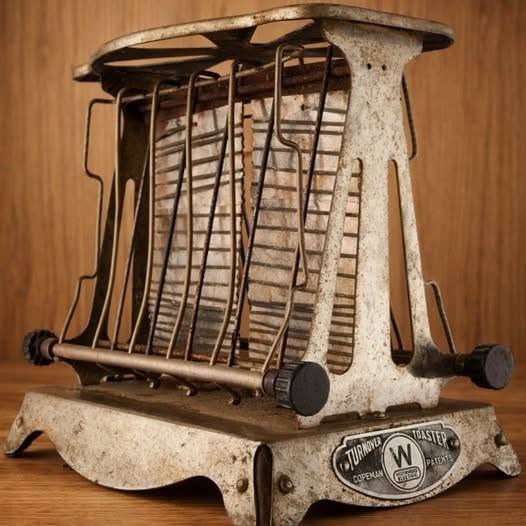
A strange-looking metal appliance from the early days of household electricity has been leaving modern viewers puzzled, with many wondering whether it was once used in a laboratory, workshop, or even a medical setting.
Its exposed coils, heavy wiring, open frame, and rotating metal holders certainly make it look unusual by today’s standards. But the object had a much simpler purpose.
It was an early turnover toaster.
Nearly a century ago, appliances like this could be found in homes at a time when electricity itself was still becoming part of everyday domestic life. Instead of hiding the heating elements inside an enclosed machine, the turnover toaster displayed nearly every part of the process in plain sight.
Slices of bread were placed inside metal holders positioned beside glowing electrical coils.
When the appliance was switched on, the coils gradually became red with heat. The bread remained fully visible, allowing the person preparing breakfast to watch it brown.
There was no automatic timer.
There was no pop-up mechanism.
There was no setting that allowed someone to press a lever and walk away.
The user had to remain nearby and judge the process by eye.
Once one side of the bread had browned enough, the metal holder was turned by hand so the other side faced the heat.
That simple action is what gave the appliance its name.
The result depended almost entirely on the person operating it.
A few extra seconds could mean the difference between lightly toasted bread and a burned slice.
In many ways, the person standing beside the toaster acted as the machine’s timer, sensor, and automatic shutoff system.
That level of attention feels unusual today because modern kitchen appliances are designed to reduce the amount of supervision required.
A contemporary toaster hides the heating elements, controls the timing, browns both sides at once, and automatically releases the bread when the cycle is complete.
The turnover toaster worked in almost the opposite way.
It made the user an essential part of every step.
Families learned to recognize the changing color of the bread and the increasing glow of the coils. They became familiar with how long different types of bread needed to remain near the heat.
The results were not always perfectly consistent.
One side might be darker than the other.
An edge could brown too quickly.
A center could remain lighter.
But that variation was simply part of the normal breakfast routine.
The appliance also looked far more exposed than anything most people would expect to see in a modern kitchen.
The heating system was visible.
The metal cages sat close to the coils.
The wiring and structure were easy to see.
Today, electrical appliances are usually designed to create distance between the user and the source of heat. Components are enclosed, protective barriers are added, and controls are kept away from the hottest parts of the machine.
Early appliances often followed a very different philosophy.
The mechanism was not hidden.
People could see electricity being converted into heat directly in front of them.
That visibility reflected the era in which these machines appeared.
Electricity had not yet become the invisible background feature of daily life that it is today.
For many families, an electric toaster was evidence that household technology was changing rapidly.
Before appliances like this became common, toast might be prepared using a stove, open flame, or another heated cooking surface.
Those methods could be slower, messier, and less convenient.
A small electric toaster offered a focused source of heat that could be used specifically for bread.
It also allowed toast to be prepared closer to the breakfast table rather than requiring the use of a large stove.
That may seem like a minor convenience now, but at the time it represented an important shift in the way electricity entered ordinary family routines.
The appliance made electrical power practical.
It showed that electricity was not only useful for factories, public lighting, or large machines.
It could also make breakfast easier.
Because the toaster required constant supervision, it often became part of the social atmosphere of the meal.
Someone had to remain nearby while the coils heated.
The bread needed to be checked.
The cages had to be turned.
Family members could watch the entire process unfold.
The toaster was not simply a silent appliance operating in the background.
It glowed.
It produced heat.
It required movement.
And it demanded attention.
That is one reason photographs of these machines are so confusing to modern viewers.
The design has almost nothing in common with the familiar rectangular toaster found on countertops today.
There are no narrow bread slots.
There is no spring-loaded lever.
There is no numbered browning dial.
There is no automatic release.
Instead, there is exposed metal, visible wiring, hinged holders, and glowing coils.
Without historical context, the machine can easily look like a piece of medical equipment or an experimental electrical device.
The confusion shows just how much appliance design has changed.
Modern toasters now perform almost every task automatically.
They hold the bread internally.
They regulate the heat.
They control the timing.
They toast both sides simultaneously.
And they signal or release the bread when it is ready.
The old turnover toaster did none of those things.
It belonged to a period when electricity had entered the kitchen, but automation had not yet fully followed.
Over time, enclosed toaster designs gradually replaced these open-frame machines.
Safer housings, more consistent heating, internal slots, timers, and automatic mechanisms made breakfast easier and more predictable.
As those improvements became standard, turnover toasters disappeared from everyday kitchens.
Today, surviving examples are usually valued as historical objects rather than practical cooking appliances.
Collectors are drawn to their unusual appearance and to the way their design reveals exactly how they worked.
Nothing is hidden.
The coils produced the heat.
The cages held the bread.
The hinges allowed each slice to be turned.
The entire process can be understood simply by looking at the machine.
Age often makes these surviving appliances even more striking.
Metal darkens.
Surfaces become scratched.
Old wiring appears heavier and rougher than the cables used on modern kitchen equipment.
Those signs of wear can make the object look even stranger, but they also reflect decades of use.
Each mark hints at ordinary breakfasts prepared by people who once considered the machine completely normal.
That may be the most fascinating thing about the turnover toaster.
It shows how quickly everyday technology can become unfamiliar.
An object that once required no explanation can eventually look mysterious simply because later designs changed so dramatically.
The toaster was eventually replaced because newer machines were safer, easier to use, and more consistent.
But its importance goes beyond the simple task of browning bread.
It represents a moment when electricity was beginning to transform household life.
Innovation did not always arrive through dramatic inventions or enormous machines.
Sometimes it appeared quietly on a breakfast table.
Families still selected the bread.
They still watched it cook.
They still decided when it was ready.
The difference was the source of the heat.
Electricity had entered the routine.
And the strange-looking turnover toaster became part of that transition.
By modern standards, the machine can appear awkward, exposed, and demanding.
But in its own time, it represented progress.
It offered families a new way to perform one of the simplest household tasks.
What looks today like a mysterious piece of forgotten machinery was actually designed for something almost everyone still does.
It made toast.
And in doing so, it became a small but revealing piece of the history of the modern kitchen.