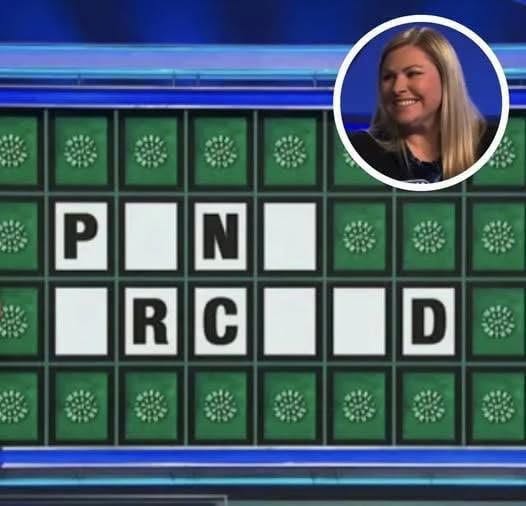
A Wheel of Fortune contestant was left stunned after losing out on a $40,000 bonus prize when judges rejected what many viewers believed was the correct final answer.
The contestant, Megan, entered the final round under intense pressure, with only seconds available to solve the puzzle and potentially walk away with a major cash prize.
As the countdown neared its end, she gave the answer “Pink Orchid.”
For a brief moment, it appeared she had done enough.
The completed puzzle on the board matched the phrase she was trying to say, and many viewers believed her response could be heard clearly. But the celebration never came. The judges ruled that her answer had not been accepted before time expired.
Megan’s expression changed almost immediately.
What had looked like confidence and relief turned into confusion as she realized the $40,000 would not be awarded.
The controversy centered on pronunciation and timing rather than whether she actually understood the puzzle.
Megan appeared convinced that she had said the correct phrase. The judges, however, determined that they had not heard an acceptable version of “Pink Orchid” before the clock reached zero.
That distinction quickly became the focus of the public reaction.
Viewers were not watching a contestant who had no idea what the answer was.
They were watching someone who appeared to know exactly what the board said but still lost because the spoken response was not judged clear enough.
For many fans, that made the moment feel especially harsh.
Televised game shows depend on strict rules, and contestants know that timing matters. A correct answer delivered after the clock expires cannot normally be accepted.
Pronunciation matters as well.
Officials must be able to determine what a contestant actually said rather than what they may have intended to say.
The problem in Megan’s case was that many viewers believed they heard the words “Pink Orchid” themselves.
Some replayed the moment and insisted the phrase was understandable, even if it was delivered quickly under pressure.
The judges reached a different conclusion.
That created two competing interpretations of the same few seconds.
In one, Megan solved the puzzle and said the correct words in time.
In the other, her final response was not pronounced clearly enough to satisfy the show’s rules before the countdown ended.
Because the entire controversy came down to a few rushed syllables, there was no complicated strategy or hidden rule for viewers to examine.
There was simply Megan’s voice, a ticking clock, and the final judgment.
The pressure of the bonus round also became part of the discussion.
Contestants are standing beneath bright studio lights while cameras record every reaction.
An audience is watching.
A significant amount of money may depend on a single phrase.
And a countdown is constantly reminding them that time is disappearing.
Under those conditions, even someone who knows the answer perfectly may rush a word or pronounce it differently than they would during an ordinary conversation.
That is why some viewers felt the judges should have shown more flexibility.
They argued that the meaning of Megan’s response appeared clear enough and that the completed board demonstrated she knew the answer.
Others defended the ruling.
From that perspective, the rules have to be applied consistently. If judges are uncertain about what was said or whether it was completed before time expired, they cannot simply assume what the contestant meant.
That debate is part of what made the moment so memorable.
The $40,000 prize also raised the stakes dramatically.
For most contestants, that amount is not merely a number appearing on a game show screen.
It could help pay bills.
It could reduce debt.
It could cover education expenses, home repairs, savings, or other major financial needs.
Megan appeared to believe she had won that money.
Then, within seconds, she learned she had not.
Her reaction captured the emotional shock of that reversal.
Game shows are built around the expectation that contestants can win or lose in an instant, but viewers generally accept those outcomes when the mistake is obvious.
A missed letter makes sense.
A wrong answer makes sense.
Running out of time without completing the puzzle makes sense.
A situation feels more complicated when viewers believe they heard the correct answer and the judges say otherwise.
That is when attention shifts from the contestant to the judging itself.
Fans began questioning whether the same pronunciation standard would be applied to every player.
Some wondered whether similar responses had been accepted in previous episodes.
Others argued that the officials were simply doing their job and enforcing the rules exactly as written.
The disagreement continued after the broadcast because there was no dispute about what the puzzle actually was.
The only question was what Megan said and whether it was clear enough.
That kind of dispute can be difficult to resolve because speech is not always perfectly precise.
Accents, speed, nerves, background noise, and the pressure of a countdown can all change how a phrase sounds.
Different people can listen to the same recording and hear slightly different things.
For the audience, Megan’s answer sounded recognizable.
For the judges, it apparently did not meet the required standard.
Both conclusions came from the same brief moment.
That uncertainty also raises a larger issue for any long-running game show.
The format depends on trust.
Viewers accept that producers establish the rules and officials enforce them. In return, audiences expect those decisions to be fair, consistent, and understandable.
When a close ruling appears difficult to explain, that trust can be tested.
The controversy surrounding Megan did not necessarily mean the judging was wrong.
But it did show how quickly confidence can be shaken when viewers believe they heard something different from the officials.
For Megan, the consequences were immediate.
She left without the $40,000 bonus.
For viewers, the moment became something to replay, debate, and analyze long after the episode ended.
Some saw it as an unfortunate but legitimate application of the rules.
Others saw it as one of those painful moments when a contestant appeared to do enough and still walked away without the prize.
What made the scene so powerful was Megan’s reaction.
She did not look like someone who had realized she answered incorrectly.
She looked like someone trying to understand why the answer she believed she had given was not being accepted.
That expression captured the controversy better than any technical explanation could.
One moment she appeared certain she had solved the puzzle.
The next, $40,000 was gone.
And for many viewers, one question remained after the credits rolled: