
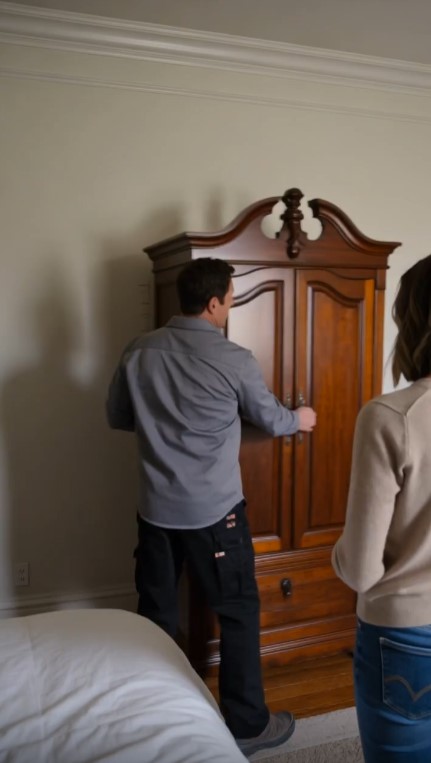
Rachel was renovating the house she grew up in when the worker called her upstairs.
“You need to see this.”
Behind an old wardrobe…
were pencil marks showing Rachel’s height as a child.
Age 5.
Age 6.
Age 7.
Her mother had made them.
Rachel smiled.
Then the worker pointed beside them.
A second column.
Same years.
Same dates.
But another name:
MICHAEL.
Rachel had no brother.
She was an only child.
She called her mother.
“Mom… who’s Michael?”
Silence.
Then her mother said:
“Where did you find that name?”
Rachel looked closer.
At age eight…
Michael’s measurements stopped.
Rachel’s continued.
But underneath the final mark was something newer.
Fresh pencil.
One sentence:
I came back, Rachel.
The renovation worker stared at her.
Rachel touched the writing.
The graphite came off on her finger.
It hadn’t been there long.
Then someone knocked downstairs.
Three slow knocks.
Rachel’s mother screamed through the phone:
“Don’t open that door.”
Rachel froze.
The knocking came again.
Three slow taps.
Not pounding.
Not urgent.
Almost careful.
The worker, Daniel, looked toward the staircase.
“Are you expecting anyone?”
Rachel shook her head.
Her mother was still speaking rapidly through the phone.
“Rachel, listen to me. Lock the upstairs door. Call the police if you have to.”
“Mom, who is Michael?”
“Not now.”
“Then when?”
Another knock.
Rachel’s voice hardened.
“You’ve had more than thirty years.”
Silence.
Then her mother, Evelyn, whispered:
“He was your brother.”
Rachel stopped breathing.
Daniel heard enough from across the room to understand something was wrong.
He quietly moved toward the hallway.
Rachel said:
“My what?”
“Your brother.”
“No.”
“Yes.”
“I don’t have a brother.”
“You did.”
The final word broke something.
Did.
Rachel stared at the pencil marks.
MICHAEL.
Same dates.
Same wall.
Same childhood.
Her mother continued.
“He was two years older than you.”
Rachel looked again.
That matched.
When she was five, Michael’s mark was labeled seven.
When she was six, his said eight.
Then the final one.
Michael, age ten.
Nothing after.
Rachel whispered:
“What happened to him?”
Before Evelyn could answer, a man’s voice came from downstairs.
“Rachel?”
She froze.
Not because she recognized the voice.
Because whoever was outside knew her name.
Daniel whispered:
“Do you want me to call someone?”
Rachel nodded.
“Stay here.”
But she didn’t hide.
She walked toward the stairs.
Her mother shouted through the phone:
“Rachel, no.”
“Mom, he already knows I’m here.”
“Please.”
Rachel stopped.
There was fear in Evelyn’s voice.
Not vague discomfort.
Fear.
Rachel asked:
“Is Michael dangerous?”
Her mother took too long to answer.
“No.”
That changed everything.
“Then why shouldn’t I open the door?”
“Because you don’t know what he wants.”
Rachel almost laughed.
“Neither do I.”
She went downstairs.
Daniel followed several steps behind.
The front door remained locked.
Rachel looked through the side window.
An elderly man stood on the porch.
Not elderly exactly.
Late fifties.
Maybe sixty.
Gray hair.
Dark jacket.
Hands empty.
No weapon.
No bag.
He looked frightened.
Rachel spoke through the door.
“Who are you?”
The man closed his eyes.
Then said:
“Michael.”
Rachel’s knees nearly failed.
She unlocked only the upper latch and kept the chain in place.
Opened the door two inches.
The man looked at her.
His face changed immediately.
“You look like Dad.”
Rachel stared.
That was something relatives had told her all her life.
She had her father’s eyes.
His narrow chin.
His habit of raising one eyebrow when confused.
The stranger had the same eyebrow.
Rachel whispered:
“You’re supposed to be dead.”
Michael’s face tightened.
“So that’s what she told you.”
Evelyn heard him through the phone.
She began crying.
“Michael.”
He looked toward Rachel’s phone.
“Hi, Mom.”
Rachel nearly dropped it.
Her mother sobbed.
Michael did not sound angry.
That was worse somehow.
He sounded tired.
Rachel opened the door fully.
Daniel stayed nearby.
Michael did not enter until Rachel said:
“Come in.”
He stepped inside the house.
Then stopped.
He looked toward the staircase.
Toward the hallway.
Toward the room where the old wardrobe had been moved.
His eyes filled.
“It still smells the same.”
Rachel stared at him.
“You were here recently.”
Michael nodded.
“The writing.”
“Yes.”
“How did you get inside?”
“The back door.”
Daniel immediately frowned.
“It was locked when we started.”
Michael nodded.
“I still had a key.”
Rachel looked at him.
“To a house you haven’t lived in for thirty years?”
He held up an old brass key.
“Dad gave it to me.”
That raised more questions.
Rachel said:
“Sit down.”
Michael sat at the old kitchen table.
The same one Rachel had eaten breakfast at as a child.
For a few seconds, nobody spoke.
Then Rachel put her mother on speaker.
“Now tell me everything.”
Evelyn cried quietly.
Michael stared at the table.
Rachel waited.
Finally, her mother began.
Michael had been born when Evelyn was twenty.
Rachel came two years later.
For the first eight years, they were a normal family.
Not perfect.
But normal.
Michael and Rachel shared the upstairs room for a while.
Then Michael moved into the smaller room near the back stairs.
Rachel remembered that room.
She had always been told it was a sewing room.
It wasn’t.
It had been Michael’s bedroom.
Rachel felt sick.
“How do I not remember him?”
Evelyn answered carefully.
“You do.”
Rachel frowned.
“No.”
“You just don’t know what the memories are.”
A red bicycle.
A boy teaching her how to tie shoelaces.
Someone sliding cereal across the table.
A voice calling her “Rachie.”
Rachel had fragments.
She had always assumed they belonged to cousins.
Neighbors.
Dreams.
Michael looked at her.
“You used to steal my socks.”
Rachel stared.
“What?”
“You said mine were softer.”
A memory surfaced.
Blue socks with white stripes.
A boy chasing her down the hallway.
She covered her mouth.
“Oh my God.”
Michael started crying.
Rachel did too.
Then she asked:
“What happened when you were ten?”
Evelyn answered:
“Your father and I separated.”
Rachel knew that part.
Her father, Thomas, had left when she was eight.
She was told the marriage failed.
That he moved away.
That she stayed with her mother.
But the truth was more complicated.
Thomas did not leave alone.
Michael went with him.
Rachel stared.
“Why?”
Because of the custody fight.
Evelyn and Thomas had become bitter.
Not violent.
But destructive.
Every disagreement became about winning.
Money.
School.
Where the children should live.
Michael was closer to Thomas.
Rachel was closer to Evelyn.
At first, the plan was temporary.
Michael would spend one school term with his father.
Rachel would stay.
Then courts would decide.
But Thomas moved farther away.
Evelyn became furious.
She accused him of taking Michael.
Thomas accused her of keeping Rachel.
Lawyers got involved.
Calls stopped.
Visits stopped.
Then Thomas made an unforgivable decision.
He told Michael that Evelyn did not want him back.
Michael looked at the table.
“I believed him.”
Evelyn cried harder.
Rachel asked:
“And you told me Michael died?”
“No.”
“Then what did you tell me?”
Evelyn hesitated.
“That he went away.”
Rachel’s voice rose.
“I grew up believing I had no brother.”
“Not at first.”
Evelyn explained.
Rachel did ask.
For months.
Where’s Michael?
When is Michael coming home?
Why did he take his clothes?
At first, Evelyn said:
“Soon.”
Then:
“Not yet.”
Then:
“He lives with Dad now.”
Years passed.
Rachel gradually stopped asking.
Then when she was around twelve, Evelyn made a terrible choice.
Rachel found an old photograph of herself and Michael.
Asked who he was.
Evelyn panicked.
Said:
“A cousin who died.”
Not brother.
Not exactly.
But enough to erase the connection.
Rachel stood.
“You erased him.”
Evelyn sobbed.
“I was angry.”
“At Dad?”
“Yes.”
“So you erased Michael?”
“I know.”
Rachel turned toward Michael.
“And Dad?”
Michael’s expression hardened.
“Dad erased you too.”
Rachel froze.
Thomas told Michael that Rachel barely remembered him.
That Evelyn wanted no contact.
That Rachel was better off.
Michael wrote letters.
Thomas claimed they were sent.
They weren’t.
Rachel’s hands shook.
“Where are they?”
Michael looked at her.
“I found them after Dad died.”
Thomas had died five years earlier.
While clearing his house, Michael discovered a box.
Letters.
Dozens.
All addressed to Rachel.
Birthday cards.
Drawings.
Even a tiny friendship bracelet Michael had made when he was eleven.
None mailed.
That was the moment Michael learned the truth.
Not everything.
But enough.
He realized Rachel might never have rejected him at all.
So he began looking.
Rachel asked:
“Five years ago?”
“Yes.”
“Why did it take until now?”
Michael looked ashamed.
“Fear.”
Rachel laughed bitterly.
“Apparently this family runs on that.”
He nodded.
“I found your social media.”
Saw she was married.
Then divorced.
Saw photographs.
Learned where she worked.
But he couldn’t contact her.
He told himself he needed proof first.
Then he found property records showing Rachel had inherited the childhood house after Evelyn moved into assisted living.
A renovation permit appeared.
Michael realized the house might be changed permanently.
Walls torn out.
Marks painted over.
The height chart.
The last physical proof they had grown up together.
So three weeks earlier, he drove to the house.
Used the old key.
Went upstairs.
Found the wardrobe still there.
Moved it just enough.
Saw the pencil lines.
And wrote:
I came back, Rachel.
Rachel stared.
“You broke into my house to write that?”
Michael grimaced.
“When you say it like that…”
“How else would I say it?”
“You’re right.”
Daniel almost smiled.
Michael continued.
He had planned to leave his phone number.
Then lost his nerve.
He left.
Today, he came back because he saw the contractor’s truck outside.
Knew someone had found the wall.
So he knocked.
Rachel looked at her mother’s name glowing on the phone screen.
“Why were you so afraid of me opening the door?”
Evelyn answered:
“Because I didn’t know what he believed.”
Michael looked hurt.
“Mom.”
“I haven’t seen you in thirty-two years.”
“You could have.”
Silence.
That line landed hard.
Evelyn whispered:
“I know.”
Michael had tried to contact her too.
After Thomas died.
He mailed one letter.
No response.
Called the assisted living facility.
Evelyn refused the call.
Rachel stared.
“You knew he was alive.”
Her mother cried.
“Yes.”
“How long?”
“Five years.”
Rachel felt something collapse inside her.
Not because her mother had lied decades ago.
Because she was still choosing silence now.
Rachel said:
“You let me stand upstairs thinking a dead person wrote on my wall.”
Evelyn whispered:
“I was scared you would hate me.”
Rachel answered:
“I’m much angrier about the hiding.”
That was the truth.
Michael looked toward the hallway.
“Can I show you something?”
Rachel hesitated.
Then nodded.
He went to his car.
Returned with a cardboard box.
Inside were the letters.
Every one.
Rachel recognized her father’s house address.
Her childhood address.
Her own name in Michael’s handwriting.
The earliest ones looked like a child had written them.
RACHEL I GOT A NEW BIKE. IT IS RED. DAD SAYS YOU HAVE ONE TOO.
Another:
I MISS OUR ROOM EVEN THOUGH YOU STOLE MY SOCKS.
Then:
WHY DON’T YOU WRITE BACK?
Rachel covered her mouth.
Another:
DAD SAYS MOM DOESN’T WANT ME CALLING. TELL HER I CAN BE GOOD.
Rachel stopped reading.
Michael looked away.
Then came letters from teenage years.
Angrier.
I don’t know what I did.
Then colder.
Happy birthday.
Then eventually nothing.
Rachel asked:
“Did Dad ever explain?”
“No.”
Near the end of Thomas’s life, he had dementia.
Moments of clarity.
Moments of confusion.
One night he told Michael:
“I thought separating you would stop the fighting.”
Michael asked:
“Separating us from what?”
Thomas said:
“From each other.”
That was his justification.
Evelyn and Thomas had been using the children to wound one another.
He convinced himself giving each parent one child would calm things.
Instead, it destroyed the sibling relationship.
Then shame prevented him from correcting it.
Rachel whispered:
“You were ten.”
Michael nodded.
“And I was eight.”
“Yes.”
Neither had chosen anything.
That was the part Rachel could not stop thinking about.
Adults made decisions.
Children carried the consequences.
Daniel eventually excused himself.
“This is family.”
Rachel thanked him.
Before leaving, he photographed the wall for renovation documentation.
Rachel immediately said:
“Don’t paint over it.”
He nodded.
“Wasn’t planning to.”
After he left, Rachel and Michael remained at the table.
For hours.
At first they talked about facts.
Schools.
Jobs.
Marriages.
Children.
Michael had a daughter named Sophie.
Rachel had no children.
Michael had worked as a mechanic for twenty-nine years.
Rachel was an accountant.
Then the details became smaller.
Favorite food.
Coffee.
Music.
Habits.
Rachel discovered Michael tapped his fingers when nervous.
She did too.
He hated tomatoes.
So did she.
Both loved thunderstorms.
Neither knew their father had feared them.
At some point Rachel laughed.
“This is ridiculous.”
“What?”
“I’m interviewing my brother.”
Michael smiled.
“Better than not knowing one.”
That hurt.
But it was true.
Then Rachel asked:
“Why did the height marks stop at eight?”
Michael’s face changed.
“Because that was the last year we were together.”
The date beside his final mark was three days before Thomas took him away.
Rachel stared.
Her mother had continued measuring Rachel against the same wall.
Never erased Michael’s marks.
Never painted over them.
Even when the wardrobe was moved in front.
That complicated things.
Rachel asked Evelyn later:
“Why did you keep his marks?”
Her mother answered:
“Because I couldn’t erase everything.”
Rachel cried after hearing that.
Anger remained.
But grief joined it.
Evelyn had not been a monster.
Thomas had not been one either.
They had been hurt adults making catastrophic decisions and then becoming too ashamed to repair them.
That did not excuse what happened.
It simply made the truth more painful.
The next week, Rachel drove Michael to see Evelyn.
He had not agreed immediately.
Neither had she.
Rachel refused to mediate forever.
She said:
“You’re both adults.”
“If you want to talk, talk.”
“If you don’t, don’t.”
“But no more making me carry messages.”
They agreed.
Evelyn sat near the window when Michael entered.
She looked at him.
He looked at her.
Then she said:
“You have your father’s gray hair.”
Michael laughed once.
“You could start with hello.”
She cried.
“Hello, Michael.”
He sat.
The conversation was not beautiful.
There were accusations.
Apologies.
Silences.
Michael asked why she never fought harder.
Evelyn said she did at first.
Lawyers.
Court motions.
Letters.
Then exhaustion.
Money.
Pride.
Eventually she let anger become surrender.
Michael said:
“You should have kept fighting.”
She answered:
“Yes.”
No excuses.
Then she asked:
“Do you hate me?”
Michael thought.
“Sometimes.”
Evelyn nodded.
Fair.
Then he added:
“But I came.”
That was enough for the first day.
Not forgiveness.
Not resolution.
Just presence.
Over the next year, Rachel and Michael became siblings slowly.
There was no instant closeness.
Thirty-two years cannot be replaced by one discovery.
They disagreed.
Missed calls.
Misread jokes.
Sometimes Michael tried too hard.
Sometimes Rachel pulled away.
Then they learned.
Michael brought Sophie to meet her aunt.
Sophie was twenty-three.
She stared at Rachel.
“You look like Dad.”
Rachel laughed.
“He says I look like Grandpa.”
“Unfortunately, both can be true.”
That felt like family.
Rachel showed Sophie the height marks.
Sophie touched Michael’s final one.
Age ten.
Then Rachel’s at age eight.
Two names.
Same date.
Sophie whispered:
“This is awful.”
Rachel nodded.
“Yes.”
Then:
“But it’s ours.”
The renovation plan changed.
Rachel kept the wall.
Daniel built a shallow protective frame around the markings.
Not glass like a museum.
Just enough to preserve them.
And beneath Michael’s fresh sentence—
I came back, Rachel.
Rachel added one line.
I was still here.
Michael saw it the next weekend.
He cried.
Then complained she had ruined his dramatic message.
She said:
“You broke into my house.”
“Technically Dad’s key still worked.”
“Still illegal.”
“You’re never letting that go?”
“No.”
Good.
They had enough lost years without pretending the reunion had to be perfect.
Evelyn died peacefully two years later.
Before she died, she asked Rachel and Michael to visit together.
She gave them one envelope.
Inside was a photograph.
The two children against the height wall.
Michael ten.
Rachel eight.
Thomas holding the pencil.
Evelyn standing beside them.
Everyone smiling.
On the back Evelyn had written years later:
The last day before we broke the family into pieces.
Below that, more recently:
I am sorry you had to find each other yourselves.
Michael kept the photograph.
Rachel kept the wall.
They both kept copies of the letters.
Years later, Rachel sold the house.
Before the sale, the new owners agreed to leave the framed height chart intact.
They had children.
Rachel liked that.
One final afternoon, she and Michael stood upstairs.
The wardrobe was gone.
Fresh paint everywhere except that section.
Age five.
Six.
Seven.
Eight.
Two childhoods recorded in pencil.
Michael looked at his newer sentence.
“I came back, Rachel.”
Rachel smiled.
“You really thought that was a normal thing to write and leave?”
“At the time.”
“You scared me half to death.”
“Sorry.”
She looked at him.
“No more disappearing.”
Michael held out his hand.
“Deal.”
Rachel shook it.
Then laughed.
“We’re way too old for this.”
“Speak for yourself.”
They walked downstairs together.
For decades, Rachel believed she had grown up alone.
She hadn’t.
There had once been another child in the hallway.
Another name on the wall.
Another voice in the kitchen.
A brother who disappeared not because he died…
but because the adults around them confused separation with protection and silence with healing.
The pencil marks survived all of it.
Years of furniture.
Paint.
Arguments.
Distance.
Lies.
Then one renovation uncovered them.
And beside the final childhood measurement…
fresh graphite.
Five words:
I came back, Rachel.
For once, somebody in that family finally had.