
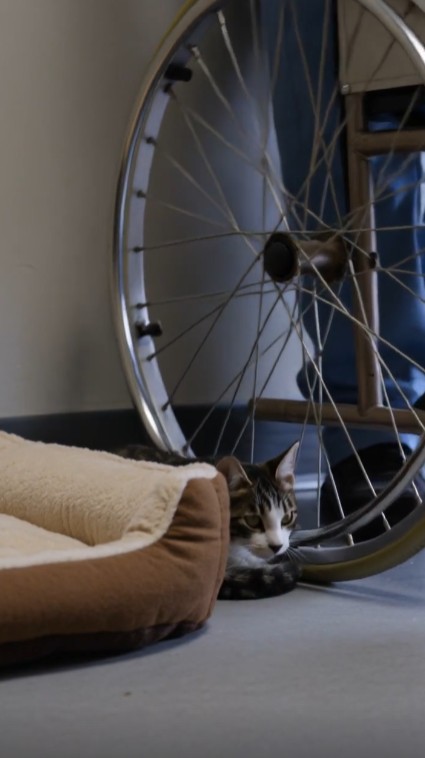
The rescued cat refused every soft bed in the shelter.
Her name was Luna.
She had blankets.
A heated mat.
A padded cat tower.
Even a little covered bed placed near the quietest corner of the room.
She ignored all of them.
Every night, Luna walked into the hallway and curled up beside an old empty wheelchair.
At first, the shelter workers thought it was coincidence.
Then they moved the chair.
Luna found it again.
They moved it to another hallway.
She followed.
They stored it temporarily in an equipment room.
Luna sat outside the door.
Nobody understood why.
The wheelchair was not used by anyone at the shelter.
It had been donated months earlier.
Old.
Scratched.
One wheel slightly squeaky.
A faded blue cushion still attached to the seat.
The manager, Daniel, eventually told everyone:
“Leave it where she can reach it.”
So they did.
Every evening, after feeding time, Luna walked to the wheelchair.
She circled once.
Then slept beside the left wheel.
Always the left side.
Every night.
Then one Saturday morning, an elderly man arrived with his granddaughter.
His name was Arthur.
He was seventy-seven.
His granddaughter, Emily, had been encouraging him to adopt a cat.
Arthur had recently moved into a smaller apartment.
He had spent months insisting he didn’t need an animal.
Emily disagreed.
“You talk to the television.”
“The television listens.”
“That is exactly why you need a cat.”
Arthur finally agreed to visit the shelter.
Only to look.
That was his condition.
They walked through the cat room.
Several cats approached the glass.
Arthur smiled.
But none made him stop.
Then Luna heard his voice.
She lifted her head.
She had been resting beside the wheelchair.
Suddenly, she stood.
The caretaker noticed.
Luna rarely rushed toward visitors.
This time she walked directly into the hallway.
Toward Arthur.
She stopped several feet away.
Looked at him.
Then turned back toward the wheelchair.
Arthur frowned.
“What is she doing?”
Luna placed one paw on the lower metal frame.
Emily looked down.
Then noticed the collar.
It was old.
The shelter had kept it because Luna arrived wearing it.
A narrow red collar.
Faded almost pink.
Attached was a tiny metal tag.
Emily leaned closer.
Then suddenly started crying.
“Grandpa…”
Arthur looked at her.
“What?”
“Look at her collar.”
He bent down.
Daniel stepped closer in case he needed help.
Arthur carefully read the engraved name.
Then froze.
For several seconds, he said nothing.
His hands began trembling.
Finally, he whispered:
“Rosie.”
Luna looked toward him.
Arthur repeated it.
“Rosie.”
Emily covered her mouth.
Daniel frowned.
“You know this cat?”
Arthur did not answer immediately.
He sat down in the wheelchair.
The moment he did, Luna walked toward the left side.
Then curled beside the wheel.
Exactly where she slept every night.
Arthur began crying.
“That’s where she used to sleep.”
Daniel stared.
“You’re saying she belonged to you?”
Arthur shook his head.
“No.”
“She belonged to my wife.”
Six years earlier, Arthur’s wife, Margaret, had been recovering from major surgery.
For nearly a year, she used a wheelchair.
Margaret hated it.
Not because she was embarrassed.
Because she had always been active.
Garden.
Market.
Long walks.
The wheelchair made her feel trapped.
Then one afternoon, their daughter brought home a tiny stray cat.
The kitten was thin.
Dirty.
Terrified of people.
Margaret named her Rosie.
Arthur thought the cat would hide under the furniture.
Instead, Rosie became attached to Margaret.
Especially the wheelchair.
Whenever Margaret moved through the house, Rosie followed.
When Margaret stopped, Rosie lay beside the left wheel.
Always the left.
Arthur used to joke:
“You’ve hired a security guard.”
Margaret would answer:
“She works for tuna.”
Rosie slept beside the chair.
Waited beside it during meals.
Sometimes rode briefly on Margaret’s lap when she was tired.
As Margaret recovered and slowly began walking again, the wheelchair was used less.
But Rosie still slept beside it.
Then tragedy came from somewhere else.
Margaret died unexpectedly two years later.
Not from the surgery.
A sudden medical emergency.
Arthur was devastated.
Their daughter helped clear some of the house.
Arthur eventually moved in with relatives for a while.
Rosie went to live with Arthur’s sister, Helen.
That was supposed to be temporary.
Then Helen moved unexpectedly.
During that move, Rosie slipped outside.
They searched for weeks.
Flyers.
Local shelters.
Veterinary offices.
Nothing.
Arthur believed Rosie was gone.
Emily had been young then.
But she remembered the red collar.
She remembered the little engraved tag.
And she remembered what her grandmother called the cat.
Rosie.
Daniel listened carefully.
Then said:
“We should verify everything.”
Arthur nodded.
“Of course.”
The shelter checked Luna’s intake records.
She had arrived four months earlier.
Found near an industrial area almost twenty miles away.
No microchip was detected at intake.
The collar was old but still readable enough for staff to preserve.
Daniel tried scanning her again.
Nothing.
Then Arthur provided photographs.
One showed Margaret sitting in the old wheelchair.
A young Rosie curled beside the left wheel.
Same markings.
White chest.
Gray ears.
Small dark patch near the nose.
Same red collar.
Another photograph showed Rosie asleep on Margaret’s lap.
Daniel compared them.
The resemblance was extremely strong.
Still, they wanted more than resemblance.
Arthur contacted his old veterinary clinic.
The clinic still had records.
Rosie had never been microchipped.
But the notes included a distinctive description.
Small crescent-shaped white patch under right front paw.
Daniel checked.
Luna had it.
Age matched.
Coloring matched.
Collar matched.
Behavior around the wheelchair matched.
The shelter concluded that Luna was almost certainly Rosie.
Arthur sat beside her for nearly an hour.
Luna did not rush into his arms.
She sniffed him.
Walked away.
Returned.
Then rested beside the wheelchair again.
Arthur smiled.
“She was always like that.”
Emily asked:
“Do you think she remembers Grandma?”
Arthur looked down at Luna.
“I don’t know.”
Daniel answered carefully.
“Cats can remember familiar routines, places, sounds, and people, especially when those things were part of repeated experiences.”
“But nobody can know exactly what she’s remembering.”
Arthur nodded.
“That’s alright.”
He touched the old blue cushion.
“I remember enough for both of us.”
Then Daniel noticed something.
“Where did the wheelchair come from?”
The shelter had received it as part of a donation from a local estate-clearance company.
No detailed history had been recorded.
Just:
Mobility equipment — usable condition.
Arthur looked closer.
There was a small scratch beneath the left armrest.
Three letters.
M.A.B.
Arthur’s face changed.
He ran his finger over them.
“Margaret Anne Bennett.”
Emily stared.
“This was Grandma’s chair?”
Arthur nodded.
He had carved those initials himself.
Margaret hated people mixing up equipment during rehabilitation appointments.
So Arthur scratched her initials beneath the armrest.
Not elegant.
But practical.
Daniel looked stunned.
Somehow, Rosie and Margaret’s old wheelchair had both reached the same shelter separately.
The chair had been cleared from storage years after Arthur moved.
It passed through an estate company.
Then was donated.
Rosie had been found elsewhere.
Transferred through a rescue network.
Two unrelated paths.
Same destination.
That explained why Luna had been sleeping beside it.
The chair carried a familiar shape.
Possibly familiar scent residues at first.
More importantly, it recreated a routine she had known for years.
Left wheel.
Quiet hallway.
Rest.
The shelter staff had believed Luna disliked cat beds.
Maybe she simply preferred something that felt known.
Arthur asked:
“Can I take her home?”
Daniel smiled.
“You can apply.”
Arthur laughed.
“Fair.”
The shelter followed its usual process.
Health check.
Home assessment.
Adoption paperwork.
No special shortcuts.
Arthur’s apartment allowed pets.
Emily lived nearby.
Arthur had enough support for veterinary care.
Everything checked out.
Three days later, Rosie left the shelter.
Arthur asked one question.
“What happens to the wheelchair?”
Daniel smiled.
“That depends.”
Arthur looked at Emily.
She already knew.
“We’re taking it.”
The shelter transferred it after checking that it was safe and no longer needed for shelter use.
At Arthur’s apartment, Emily placed the chair near a sunny window.
Rosie walked around the room.
Kitchen.
Bedroom.
Hallway.
Then she returned.
She curled beside the left wheel.
Arthur sat nearby.
For a long time, he said nothing.
Finally, he whispered:
“Margaret would never believe this.”
Emily smiled.
“Yes, she would.”
“She believed strange things happened around that cat.”
Arthur laughed.
“She did.”
Weeks passed.
Rosie slowly developed new routines.
She slept on Arthur’s sofa.
Sat beside him during breakfast.
Watched birds from the window.
The wheelchair stayed.
Not because Arthur wanted to live in the past.
Because Rosie liked it.
And because it reminded him of Margaret in a way that felt gentle instead of painful.
One afternoon, Emily found Arthur asleep in his chair.
Rosie was curled beside the old wheelchair.
The scene looked almost identical to an old photograph of Margaret.
Emily quietly took a picture.
Later, she placed the two photographs side by side.
Margaret with Rosie.
Arthur with Rosie.
Six years apart.
Same chair.
Same cat.
Different chapter.
Arthur kept both pictures on his shelf.
He never called what happened a miracle.
He knew there were ordinary explanations.
A donated wheelchair.
A lost cat.
Incomplete records.
Chance.
But ordinary explanations did not make the reunion less meaningful.
Sometimes chance is enough.
At the shelter, staff remembered Luna differently after that.
They had assumed she was strange because she refused soft beds.
Then they discovered she had been choosing something familiar all along.
A shape.
A place.
A routine linked to years of quiet companionship.
And the elderly man who entered that morning thought he was visiting a shelter to look at cats.
Instead, he heard a name he had not said in six years.
Rosie.
A name connected to his wife.
To an old red collar.
To a scratched blue wheelchair.
And to a small cat who had somehow found her way back into the same family.
Emily later asked her grandfather:
“What was the first thing Grandma ever said about Rosie?”
Arthur smiled.
“She said, ‘I think she chose me.’”
Emily looked toward the cat sleeping beside the wheelchair.
“And now?”
Arthur watched Rosie for a moment.
Then answered:
“I think she just chose us twice.”