
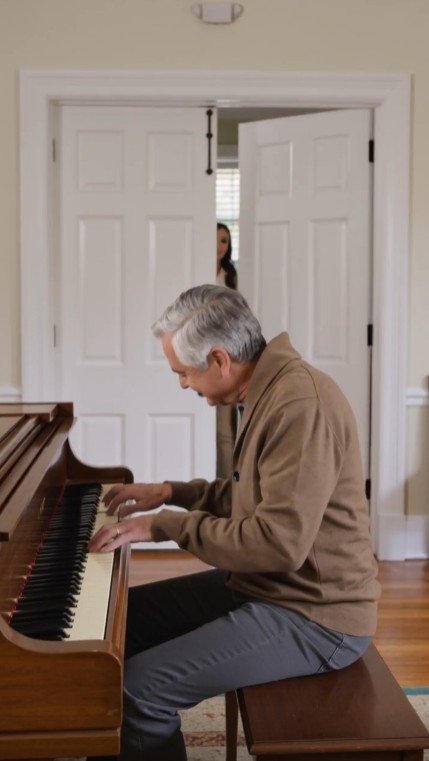
An elderly man sat at a piano and pressed the same key over and over.
One note.
Then silence.
Then the same note again.
He wasn’t playing a song.
He didn’t know how.
But he kept trying.
His name was Daniel.
He was seventy-two years old.
The piano sat in the corner of a small community center where his daughter, Anna, occasionally taught music workshops.
Daniel had come early to help her carry equipment.
While Anna was speaking with another teacher in the hallway, he wandered toward the piano.
He sat down.
Placed one hand awkwardly above the keys.
Then pressed middle C.
Again.
Again.
Again.
A woman working nearby smiled.
“Are you learning?”
Daniel laughed nervously.
“I wouldn’t call it learning.”
She looked at the keyboard.
“What would you call it?”
“Trying not to embarrass myself.”
Then she noticed a small photograph resting on top of the piano.
A younger Daniel stood beside a little girl holding a music award.
The girl was perhaps ten years old.
Proud smile.
Dark dress.
Small gold trophy in both hands.
The woman picked up the photograph.
At that exact moment, Anna entered the room.
She saw it.
Then stopped.
“Dad?”
Daniel turned.
Anna walked closer.
She stared at the picture.
“That’s me.”
Daniel smiled.
“You used to hate that dress.”
“I still hate that dress.”
He laughed.
Anna sat beside him.
“What are you doing?”
“Nothing.”
“You’re sitting at a piano pressing the same key.”
“That qualifies as nothing.”
Anna smiled.
Then noticed the way his fingers rested on the keyboard.
Careful.
Almost shy.
She asked:
“Have you always wanted to play?”
Daniel looked down.
For a moment, he said nothing.
Then:
“Yes.”
Anna stared.
“You never told me.”
“There wasn’t much to tell.”
“What do you mean?”
Daniel looked at the old photograph.
“I used to love listening to you practice.”
Anna smiled.
“You complained constantly.”
“I complained about the same song being played fifty times.”
“That is called practice.”
“That is called psychological warfare.”
Anna laughed.
Then Daniel became quiet.
“I wanted lessons too.”
The smile left Anna’s face.
“What?”
Daniel nodded.
“When I was young.”
“My father had a friend with an old upright piano.”
“I used to sit beside him when he played.”
“But lessons cost money.”
“So that was that.”
Anna looked at him.
“But when I started lessons…”
Daniel shrugged.
“You wanted them.”
Anna remembered.
She was six when she first asked.
Daniel had taken her to a small music school.
He had stood at the counter while the receptionist explained the fees.
Anna had been too young to notice his expression.
She remembered only that he signed her up.
She remembered the piano arriving at their house two years later.
Secondhand.
Scratched.
But beautiful to her.
She remembered competitions.
Sheet music.
Exams.
Travel.
What she did not remember was ever hearing Daniel say he wanted any of it for himself.
“You paid for everything.”
Daniel nodded.
“That’s what parents do.”
“No.”
Anna shook her head.
“You worked overtime.”
“Sometimes.”
“You took weekend shifts.”
“Sometimes.”
“You repaired that old car for years instead of replacing it.”
Daniel laughed.
“That car was a masterpiece.”
“It had one working speaker.”
“A masterpiece with limitations.”
Anna smiled, but tears had already started forming.
“How much did you give up?”
Daniel looked surprised by the question.
“I didn’t think of it that way.”
“But you wanted lessons.”
“Yes.”
“And you never took them.”
“No.”
“Because you were paying for mine.”
Daniel nodded.
“There wasn’t much left for mine.”
Anna looked down at the keys.
For years, Daniel had driven her to lessons.
Sat outside rehearsal rooms.
Waited through competitions.
Listened to scales through walls.
Helped carry music books.
Clapped too loudly at recitals.
Once, when Anna wanted to quit at thirteen, he told her:
“You don’t have to become great.”
“But don’t stop just because today was difficult.”
She continued.
Eventually, music became her career.
She studied.
Performed.
Then began teaching.
And through all of it, Daniel stayed in the audience.
Never once saying:
I wanted this too.
Anna placed her hand beside his on the keyboard.
“Then it’s your turn.”
Daniel laughed.
“I’m seventy-two.”
“So?”
“My fingers are stiff.”
“So?”
“I can’t read music.”
“So?”
“I have absolutely no rhythm.”
Anna smiled.
“That one may actually be true.”
Daniel nudged her shoulder.
“I’m too old to start.”
Anna shook her head.
“No.”
“You’re exactly the right age.”
He looked at her suspiciously.
“That sounds like something people say when someone is definitely too old.”
Anna ignored him.
She placed his thumb over one key.
“C.”
Then another.
“D.”
Another.
“E.”
Daniel stared at his hand.
“That’s it?”
“That’s three notes.”
“I expected something more impressive.”
“You pressed one note for ten minutes.”
“We’re making excellent progress.”
He laughed.
Anna showed him a very simple melody.
Three notes.
Then four.
Daniel missed one.
Started again.
Missed another.
Then finally played the phrase.
Slowly.
Unevenly.
But correctly.
His face changed.
Anna noticed immediately.
That small expression of surprise.
Almost childlike.
“I did that.”
“Yes.”
“That was actually a song.”
“Part of one.”
Daniel played it again.
Then again.
Anna added a few notes above his.
Soon they were playing together.
Not perfectly.
Not professionally.
But beautifully enough.
The woman nearby quietly left them alone.
Over the next few weeks, Anna began giving Daniel lessons.
At first, he treated them like a joke.
He arrived saying things like:
“Professor, I forgot my homework.”
Anna would answer:
“You’re grounded.”
But he practiced.
Every day.
Ten minutes.
Then twenty.
He bought a beginner’s book.
Then complained that the print was too small.
Anna bought him a larger edition.
He learned where the notes were.
Then simple chords.
Then timing.
It was difficult.
His fingers did not move as quickly as Anna’s.
He forgot things.
Sometimes he became frustrated.
One afternoon, he closed the book.
“I knew I was too old.”
Anna sat beside him.
“You told me the same thing when I was thirteen.”
Daniel frowned.
“What?”
“You said not to quit because one day was difficult.”
“That was different.”
“No.”
“It was exactly this.”
Daniel laughed.
“I hate when children remember things.”
“I’m forty-one.”
“Still counts.”
He opened the book again.
Months passed.
Then Anna discovered something else.
Daniel had kept nearly every program from her childhood performances.
Concerts.
School recitals.
Competitions.
Inside one folder, she found handwritten notes.
Not about her scores.
About the music.
Questions.
What does this symbol mean?
Why does left hand repeat?
How does pedal work?
Anna realized he had been trying to understand music for years.
Quietly.
From the audience.
She brought the folder to him.
“You’ve been studying.”
Daniel looked embarrassed.
“I was curious.”
“For thirty years?”
He shrugged.
“Some people are slow learners.”
Anna sat down.
“Dad, why didn’t you ever ask me to teach you?”
He looked toward the piano.
“Because music was yours.”
Anna frowned.
“I didn’t want to take it.”
That sentence stayed with her.
Daniel had spent so much of his life making room for Anna’s future that he worried stepping into the same world would somehow make it smaller.
Anna reached for his hand.
“You never took anything from me.”
“You gave me all of this.”
He smiled.
“Then maybe you can give me the easy version.”
She laughed.
“Deal.”
About a year after Daniel first pressed that single piano key, the community center held a small student recital.
Children played.
Adults played.
Beginners played.
Nobody was judged.
Anna asked Daniel to participate.
He immediately refused.
“No.”
“Why?”
“Because I have dignity.”
“Not after what you wore to my first recital.”
“That sweater was fashionable.”
“It had reindeer on it.”
“It was December.”
“It was April.”
Daniel refused for three weeks.
Then changed his mind.
On recital day, he sat in the front row looking more nervous than any child in the room.
Anna leaned over.
“You okay?”
“No.”
“Good.”
“That is not supportive.”
“It means you care.”
When his name was called, Daniel slowly walked to the piano.
The room applauded.
He sat down.
Looked at the keys.
Then toward Anna.
She smiled.
He began.
A simple melody.
Nothing difficult.
His left hand played basic chords.
His right carried the tune.
He made one mistake.
Paused.
Then continued.
Anna felt tears running down her face.
Not because the performance was technically impressive.
It wasn’t.
Because she remembered Daniel sitting outside her lessons in worn work clothes.
Waiting.
Always waiting.
Now, finally, he was the one at the piano.
When he finished, the room applauded.
Daniel looked embarrassed.
Then very pleased.
Anna walked toward him.
He whispered:
“I missed two notes.”
“You played hundreds.”
“That sounds suspiciously encouraging.”
“I learned from you.”
He smiled.
Afterward, Anna gave him something.
The old photograph.
The one showing Daniel beside her childhood music award.
She had placed it in a frame beside a new picture.
Daniel at the piano.
She wrote underneath:
Then you gave music to me.
Now we share it.
Daniel stared at the frame for a long time.
Then said:
“I didn’t give you music.”
“You already had it.”
Anna shook her head.
“You gave me the chance to find it.”
Years later, Daniel never became an accomplished pianist.
He didn’t care.
He learned enough to play songs he loved.
Birthday songs for grandchildren.
Old melodies he remembered from childhood.
Simple duets with Anna.
Sometimes he still hit the wrong note.
Sometimes he stopped halfway through and laughed.
But the piano became part of his life.
And something changed between father and daughter.
For most of Anna’s life, their relationship had moved in one direction.
Daniel taught.
Daniel paid.
Daniel drove.
Daniel encouraged.
Daniel sacrificed.
Now Anna got to give something back.
Not repayment.
Love is not a debt.
Just reciprocity.
Time.
Patience.
Lessons.
The same kind of encouragement he had given her.
One evening, they sat together at the piano after everyone else had gone home.
Daniel played the first melody Anna ever taught him.
The one that began with the single note he once pressed over and over.
Anna joined him.
Halfway through, he smiled.
“Do you remember when I said I was too old?”
“Yes.”
“You could have agreed.”
“I considered it.”
He laughed.
Then kept playing.
For years, Daniel believed music belonged to the people he had worked to support.
Especially his daughter.
He never imagined there could still be room in the story for him.
But there was.
He had given Anna a lifetime of music.
Lessons.
Practice rooms.
Competitions.
A piano when money was tight.
The confidence to keep going.
And decades later, when she discovered the dream he had quietly put aside, Anna gave him something simple in return.
A seat beside her.
A few notes.
A beginning.
Sometimes the dreams we postpone do not disappear.
They wait.
And sometimes all it takes to find them again is someone you once helped saying:
“Your turn.”