
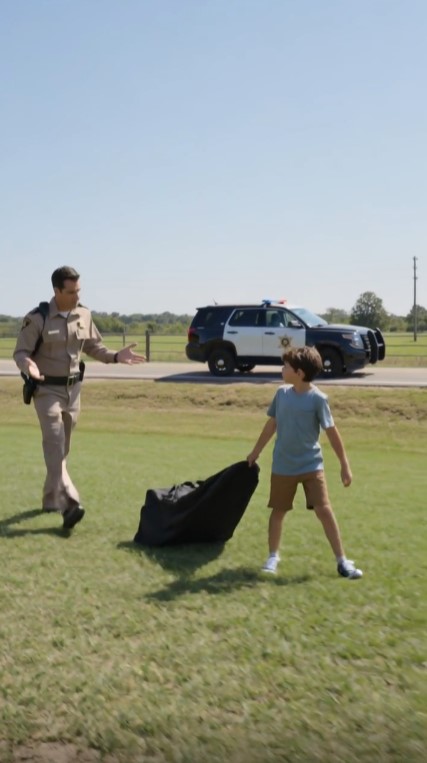
I thought the little boy was lost.
Then I saw what he was dragging.
A huge black bag.
Almost as big as he was.
Alone on the side of a rural highway.
Dust on his clothes.
No car.
No adults anywhere.
I stopped my patrol vehicle well away from traffic and approached him.
“Hey, buddy. Where are your parents?”
The boy looked at me like it was the strangest question in the world.
Then calmly said:
“Mom told me not to come back without him.”
I looked at the black bag.
It was heavy.
Something inside shifted.
For a second, I thought I’d misunderstood him.
“What do you have in there?”
The boy immediately grabbed the bag tighter.
“He gets scared around strangers.”
My stomach dropped.
I carefully opened it.
And froze.
But what I found inside wasn’t the part of the story that stayed with me.
It was what the boy whispered next.
“He’s all I have left from my dad.”
And when we finally reached his home…
his mother saw what her son had brought back.
She covered her mouth.
Because she had been searching for it too.
Inside the bag was a dog.
An old one.
Black-and-brown coat.
White around the muzzle.
Thin, tired, and trembling.
But alive.
The moment the opening widened, he tried to pull himself deeper into the bag.
The boy put one hand on his head.
“It’s okay, Max.”
The dog stopped moving.
I looked at the child.
“How long has he been in there?”
“Not long.”
“How far did you carry him?”
The boy pointed down the road.
“From the old bridge.”
That was almost two miles away.
I stared at him.
He couldn’t have been older than seven.
Maybe eight.
The bag had small ventilation holes cut carefully along the top.
There was an old blanket inside.
A plastic water bottle.
And a worn red collar wrapped around the boy’s wrist.
This was not something he had done carelessly.
He had planned it.
Which somehow made it more concerning.
I said:
“What’s your name?”
“Ethan.”
“Okay, Ethan. We need to get you and Max off this road.”
He shook his head immediately.
“I have to take him home.”
“We will.”
That word mattered.
We.
Not you.
I radioed dispatch.
No emergency lights.
No drama.
Just a child and an elderly dog who both needed to get somewhere safely.
I lifted the bag carefully.
Heavier than I expected.
Ethan tried to take it back.
“I can carry him.”
“I know.”
“But I’ve got it now.”
He hesitated.
Then nodded.
Max growled softly when I moved him.
Ethan crouched near the opening.
“Max. It’s me.”
The dog calmed.
That was the first sign the two really knew each other.
The second came when we reached my vehicle.
Ethan climbed into the back.
I placed the bag beside him.
Max slowly pushed his head out.
Then rested it against Ethan’s leg.
I asked for his address.
Ethan gave it.
I recognized the road.
A small house near an abandoned feed store.
Maybe ten minutes away.
As we drove, I asked:
“How did Max get to the bridge?”
Ethan stared out the window.
“I don’t know.”
“Was he missing?”
“Yes.”
“For how long?”
“Forty-three days.”
That number was too exact to be guessed.
“You counted?”
He nodded.
“Mom did too.”
Then he said:
“She stopped saying the number out loud.”
I looked at him in the mirror.
“What happened?”
Ethan explained.
His father, Daniel, had died the previous year.
Not suddenly.
He had been sick for months.
Max had been Daniel’s dog long before Ethan was born.
They worked together on a farm.
Not as a trained working dog exactly.
Max simply followed Daniel everywhere.
Fence repairs.
Feed runs.
Early mornings.
Late evenings.
When Ethan was born, Max moved into the role of family dog without much difficulty.
He slept near Ethan’s crib.
Then outside his bedroom.
Then beside the kitchen door every afternoon waiting for Daniel’s truck.
After Daniel died, Max changed.
Ate less.
Slept more.
Waited by the road.
Ethan’s mother, Rachel, tried keeping him closer to the house.
But Max had known the property for years.
Then one stormy night, a gate was left unsecured.
Max disappeared.
Rachel searched for weeks.
Neighbors helped.
Shelters were called.
Flyers went up.
Nothing.
Then that morning, Ethan saw something from the school bus.
A black shape near the old bridge.
He thought it was trash at first.
Then it moved.
He recognized the white muzzle.
“Max.”
He asked the bus driver to stop.
The driver couldn’t safely let him out along the highway.
So Ethan waited through school.
Then walked home by a different route.
Except he never went home.
He went to the bridge.
I tightened my grip on the steering wheel.
“You walked there alone?”
Ethan nodded.
“You know that was dangerous.”
“I know.”
“Why didn’t you tell your mom?”
He looked down.
“Because she would’ve said wait.”
“And you didn’t want to wait.”
“No.”
He found Max beneath the bridge, exhausted.
The dog could barely walk.
Ethan tried lifting him.
Couldn’t.
So he went to a nearby abandoned maintenance shed.
Found an old heavy-duty bag.
Cut holes in it with a small multitool he carried for his bike.
Lined it with his sweatshirt.
Got Max inside.
Then started dragging him home.
The idea was bad.
Dangerous.
But the reason was simple.
He thought if he left Max to get help, the dog might disappear again.
I said:
“Next time, call an adult.”
Ethan answered:
“There won’t be a next time.”
I almost smiled.
“Good.”
Then he looked down at Max.
“He’s all I have left from Dad.”
That was the sentence I remembered.
Not because it was literally true.
Ethan had his mother.
Family.
People who cared.
But to a grieving seven-year-old, Max was the part of his father he could still touch.
The dog who had sat beside Daniel’s boots.
Ridden in his truck.
Slept near his chair.
Watched the same door.
Children often attach memory to objects.
Photographs.
Clothes.
Tools.
Ethan had attached it to a living animal.
And Max was old.
That meant Ethan was going to have to face another loss someday.
Maybe sooner than anyone wanted.
We reached the house.
Rachel was outside before I fully stopped.
Barefoot.
Phone in hand.
Her face was wild with panic.
She ran toward the car.
“Ethan!”
He got out.
She grabbed him.
Checked his face.
Arms.
Shoulders.
Then anger arrived.
“Where were you?”
“I found him.”
“What?”
Ethan opened the rear door.
Max lifted his head.
Rachel stopped.
Her hands went over her mouth.
“Max?”
The dog tried to stand.
Couldn’t.
Rachel crouched.
“Oh my God.”
Max gave one small whine.
Rachel started crying.
Not loudly.
She just put her hand on his face.
“You found him.”
Ethan nodded.
“I told you I would.”
Rachel looked at me.
“What happened?”
I told her.
Not every detail at once.
First:
“Everyone’s okay.”
Then:
“We need a vet.”
That became the priority.
I helped them get Max into the house long enough for Rachel to grab shoes, keys, and a blanket.
Then I followed them to the veterinary clinic.
Max was dehydrated.
Underweight.
One paw had an old injury.
Nothing catastrophic.
The veterinarian believed he had likely survived by scavenging and finding water near the creek.
At his age, forty-three days outside had taken a toll.
But he had a chance.
Ethan sat beside him during the examination until staff needed room.
Then he waited outside with me.
I asked:
“Why did your mom say not to come back without him?”
Ethan looked confused.
“She didn’t.”
I stared.
“You told me she did.”
He shrugged.
“She said it a long time ago.”
Rachel had apparently said something during the first week Max was missing.
Not to Ethan directly.
To a neighbor.
Something like:
“I don’t care how long we search. We’re not giving up until Max comes home.”
Ethan had turned it into a mission.
Mom told me not to come back without him.
Children do that.
They take adult emotion and make it literal.
I said:
“She didn’t mean you should walk onto a highway.”
“I know now.”
“Good.”
Then the veterinarian came out.
“Max can go home tonight.”
Ethan smiled for the first time.
The vet prescribed medication.
Rest.
Short supervised walks.
High-quality food introduced carefully.
Follow-up tests.
And absolutely no more highway expeditions.
Ethan promised.
Rachel made him promise twice.
Max recovered slowly.
Very slowly.
For the first week, he mostly slept.
Ethan sat nearby doing homework.
Rachel said sometimes the dog woke, looked around, saw Ethan, and went back to sleep.
Nothing magical.
Just familiarity.
Within a month, Max could walk comfortably around the yard again.
He never returned to the road.
Rachel repaired the gate.
Then added a second latch.
Then, because grief had taught her not to trust one latch, a third.
I visited once.
Not officially.
I happened to be nearby.
Ethan saw my patrol vehicle and ran out.
Max followed several steps behind.
Ethan shouted:
“He remembers you!”
I laughed.
“He probably remembers that I carried him.”
Ethan considered that.
“Maybe.”
He had started accepting “maybe.”
That was good.
Rachel thanked me.
I told her she didn’t need to.
I had simply seen a child near a highway.
Anyone doing the job properly should have stopped.
Then she asked:
“Can I show you something?”
Inside, above the fireplace, was a photograph.
Daniel.
Younger.
Holding Ethan as a toddler.
Max beside them.
Daniel wore a red cap.
Around Max’s neck was the same worn collar Ethan had carried that day.
Rachel said:
“Ethan wouldn’t let me throw the collar away when Max disappeared.”
“Good thing.”
She smiled.
“Yes.”
Then she told me something Ethan didn’t know.
Max had disappeared once before.
Years earlier.
Before Ethan was born.
Daniel found him near the same bridge.
I stared.
“The exact bridge?”
“Pretty much.”
Apparently Max had followed Daniel’s truck one morning after slipping through a gate.
Daniel didn’t notice until later.
He searched.
Found Max under the bridge.
Carried him home in an old feed sack because the dog had injured a paw.
Rachel laughed.
“When Ethan told me what he did, I almost couldn’t believe it.”
Same dog.
Same bridge.
Same improvised bag.
Different person.
Ethan had never heard the story.
Daniel died before thinking to tell him.
I said:
“You should tell him.”
Rachel hesitated.
“I don’t want him thinking it means something mystical.”
“It doesn’t have to.”
That evening she did.
Ethan listened wide-eyed.
“Dad carried Max home too?”
“Yes.”
“In a bag?”
“A feed sack.”
“That’s basically the same thing.”
Rachel smiled.
“Basically.”
Ethan looked toward Max.
Then asked:
“Do you think Max remembered the bridge?”
Rachel answered carefully.
“Maybe.”
That was the honest answer.
Maybe Max remembered it as familiar shelter.
Maybe he wandered there by chance.
Maybe the creek nearby provided water.
No one knew.
But the parallel mattered emotionally.
Father and son had both found the same dog near the same place years apart.
Both refused to leave him behind.
Rachel later found an old photograph of Daniel carrying a much younger Max home.
The feed sack visible.
Daniel laughing.
Someone had written on the back:
FOUND HIM AGAIN.
Ethan loved it.
He put it beside the newer picture.
Max recovered enough to have two more good years.
He grew slower.
His hearing faded.
Arthritis worsened.
But he stayed comfortable with medication and veterinary care.
Ethan never treated those years casually.
He knew now they were borrowed time.
Every evening, he checked Max’s water.
Helped with medication.
Sat on the porch.
Sometimes talked about Daniel.
Rachel listened from the kitchen.
One evening, Ethan asked:
“Do you think Dad would be mad I went to the highway alone?”
Rachel answered:
“Furious.”
Ethan smiled.
“Yeah.”
“Then he’d probably hug you.”
“That sounds right.”
When Max’s health finally declined beyond what treatment could comfortably manage, Rachel and Ethan made the hardest decision together with the veterinarian.
Ethan was nine.
Old enough to understand.
Young enough for it to hurt everywhere.
Max died peacefully with familiar people nearby.
Ethan cried harder than Rachel had ever seen.
Afterward, he carried the red collar home.
Not a bag.
Just the collar.
He hung it beneath the photographs.
For weeks he avoided looking at them.
Then one day he did.
Daniel carrying young Max.
Ethan sitting beside old Max.
Same dog.
Same family.
Different years.
Rachel stood beside him.
Ethan said:
“Now I really don’t have anything left from Dad.”
Rachel shook her head.
“That’s not true.”
She touched his chest.
Not in a sentimental way.
Just gently.
“You remember him.”
Ethan looked unconvinced.
So Rachel brought out a box.
Daniel’s pocketknife.
His cap.
Old work gloves.
Letters.
A video.
Photographs.
Then she said:
“Max was never the only thing.”
“He was the living part.”
“Yes.”
“And that’s why losing him hurts differently.”
Ethan nodded.
That was closer to the truth.
Years later, I saw Ethan again.
I almost didn’t recognize him.
He was seventeen.
Tall.
Standing beside a truck at a community safety event.
He recognized me immediately.
“You’re the officer who stole my dog.”
I laughed.
“I rescued you from carrying fifty pounds in a trash bag.”
“He was forty-two pounds.”
“Still terrible.”
Ethan smiled.
Then showed me something attached to his keychain.
A small piece of Max’s red collar.
Not the whole collar.
Just a worn tag.
On one side:
MAX
On the other:
DANIEL CARTER — IF FOUND, CALL HOME
The phone number was decades out of service.
Ethan said:
“Mom wanted to replace it.”
“I said no.”
I understood.
Some things stop being useful and become history.
Ethan eventually told me he planned to become a veterinarian.
“Because of Max?”
“Partly.”
Then he added:
“And because I learned dragging dogs in bags is apparently not proper medical transport.”
I laughed.
Progress.
The story followed me for years.
People who heard it always focused on the bag.
A child on a highway.
Something moving inside.
The shocking reveal.
But that wasn’t what stayed with me.
What stayed was a seven-year-old saying:
“He’s all I have left from my dad.”
And then learning, over time, that grief makes children say things that are emotionally true even when they are not literally true.
Max was not all Ethan had left.
He had stories.
Photos.
His mother.
His own memories.
Even habits inherited from a father he missed.
But that day, Max was the piece he could not bear to lose.
So he did something reckless.
Brave in intention.
Dangerous in execution.
That distinction mattered.
We never celebrated the highway walk.
We celebrated that he was found before something terrible happened.
That Max was found too.
And that both got home safely.
Years later, Rachel framed the two photographs together.
Daniel carrying Max near the bridge.
Ethan beside Max after the rescue.
Under them she wrote:
FOUND HIM AGAIN.
Not because the story repeated perfectly.
It didn’t.
But because one old dog had somehow become a thread between a father and son.
Years apart.
Same road.
Same bridge.
Same determination not to leave him behind.
And one afternoon, on a rural highway, I happened to arrive before that thread was broken.