
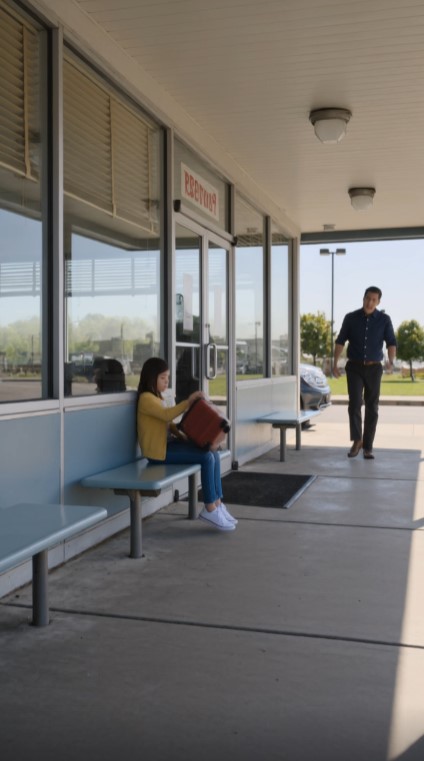
I thought the little girl was waiting for someone.
Then I noticed she’d been sitting beside the same red suitcase for almost an hour.
Alone.
Outside a small roadside diner.
No parents.
No car.
Nobody seemed to know her.
When I approached, she immediately wrapped both arms around the suitcase.
“Sweetheart, is your mom or dad nearby?”
She shook her head.
Then whispered:
“Daddy said I’m only allowed to open it for the person with the blue watch.”
I looked at my wrist.
My watch was blue.
My stomach dropped.
I’d never seen this child before.
“What’s your father’s name?”
She told me.
I stopped breathing.
I knew that name.
Years earlier, her father had been the stranger who pulled me from my wrecked car before emergency crews arrived.
I hadn’t seen him since.
The girl slowly unlocked the suitcase.
Inside were clothes.
A stuffed rabbit.
And one sealed wooden box.
On top was a note with my first name.
But before I could touch it…
the girl looked toward the diner window.
Her face changed.
“There.”
I turned around.
An elderly man inside had been watching us the entire time.
And when he saw me notice him…
he stood up.
His name was Walter.
At least that was what he told me later.
At that moment, all I knew was that he was moving toward us slowly with both hands visible.
The girl stood.
“Grandpa.”
That word changed everything.
I looked at her.
“This is your grandfather?”
She nodded.
Walter stopped a few feet away.
“I’m sorry.”
That was the first thing he said to me.
Not hello.
Not who are you.
I’m sorry.
I felt my hand tighten around the suitcase handle.
“For what?”
Walter looked at the little girl.
“Because she wasn’t supposed to be alone this long.”
I crouched beside her.
“What’s your name?”
“Lily.”
“How old are you?”
“Eight.”
Then I looked at Walter.
“Why was an eight-year-old sitting outside by herself?”
He didn’t argue.
He looked ashamed.
“I was inside watching the door.”
“That’s not the same thing.”
“I know.”
That answer mattered.
He wasn’t pretending it was okay.
Then Lily said:
“Daddy said Grandpa had to make sure the blue-watch man came.”
I stared at her.
The note on top of the wooden box had my name.
Michael.
Written in handwriting I recognized.
Daniel’s.
The man who had pulled me from my car thirteen years earlier.
I looked at Walter.
“Where is Daniel?”
He closed his eyes.
“Hospital.”
My stomach dropped.
“Alive?”
“Yes.”
That word came quickly.
Thank God.
But Walter’s face told me there was more.
Daniel had a serious heart condition.
He had known about it for months.
Surgery was scheduled for that morning.
Not emergency surgery.
Planned.
But risky enough that he had begun making arrangements.
Lily was supposed to spend the day with Walter.
The suitcase contained clothes in case the hospital stay became longer than expected.
Nothing dramatic so far.
Then came the strange part.
Daniel had told Walter:
“If Michael comes to the diner, give him the box.”
Walter asked:
“Which Michael?”
Daniel answered:
“He’ll be wearing a blue watch.”
I almost laughed.
I had worn the same blue watch for fifteen years.
Cheap rubber strap.
A gift from my brother.
It survived the crash.
Daniel remembered it.
That was how he identified me.
Lily asked:
“Are you really the man Daddy saved?”
I looked at her.
“Yes.”
Her eyes widened.
“Did he pull you out of a burning car?”
“No.”
She looked disappointed.
Walter smiled faintly.
“Daniel improves the story.”
Of course he did.
The car had not been on fire.
I had lost control on a wet back road.
Hit a guardrail.
The driver’s side jammed.
I was conscious but disoriented.
Daniel happened to be driving behind me.
He stopped.
Called emergency services.
Then saw smoke from under the hood.
Nothing explosive.
Probably coolant and steam.
But neither of us knew that then.
He got my passenger door open.
Helped me crawl out.
Stayed with me until paramedics arrived.
Then disappeared before I got his full contact information.
I remembered his first name.
Daniel.
A work jacket.
Old pickup.
That was it.
For years, I tried to find him.
Eventually I stopped.
Now his daughter was sitting beside me.
I looked at the wooden box.
“Why me?”
Walter said:
“That’s in the note.”
I opened the envelope.
Daniel’s handwriting.
Michael,
If this reached you, then Dad managed not to ruin the plan.
Walter sighed.
“He always did that.”
I continued.
You probably remember me as the guy from the crash.
I remember you as the man who came back.
I frowned.
Came back?
I kept reading.
Three months after the accident, I had returned to the road.
I brought a thank-you card and a gift certificate.
I left them at a gas station nearby because someone told me Daniel stopped there regularly.
I assumed he never got them.
He did.
Daniel wrote:
Most people say thank you once and move on. You drove forty miles back just in case somebody knew me.
I had forgotten that.
To me it had been nothing.
To Daniel, apparently, it mattered.
Then the letter changed.
I need a favor.
I looked at Walter.
He nodded toward the box.
I opened it.
Inside were photographs.
Lily as a baby.
Daniel holding her.
A woman I assumed was her mother.
Then more recent photos.
School pictures.
Birthdays.
A fishing trip.
Underneath was a second envelope.
This one said:
For Lily, if I don’t come home.
I stopped.
Walter said:
“That’s why he wanted you here.”
I stared.
“No.”
“Michael—”
“No.”
I wasn’t family.
Not close.
Not even a friend.
Daniel had saved my life once.
That did not make me the right person to carry a child’s goodbye letter.
Walter knew exactly what I was thinking.
“He didn’t ask you to raise her.”
That would have been absurd.
Lily had family.
Walter.
An aunt.
Her mother’s sister.
People who knew her.
Daniel’s request was smaller.
And stranger.
He wanted me to be the person who handed Lily the second envelope if the surgery went badly.
I asked:
“Why?”
Walter took a long breath.
“Because of her mother.”
Lily went quiet.
Her mother, Sarah, had died four years earlier.
Cancer.
She had written Lily letters before she died.
Birthday letters.
One for age eight.
One for ten.
One for sixteen.
One for graduation.
Daniel had promised to give them to Lily when the time came.
But after Sarah died, Daniel became terrified of turning every milestone into grief.
He delayed the first letter.
Then another.
He could not bring himself to hand Lily a note from someone she missed every day.
Walter said:
“Daniel thought he was protecting her.”
I looked at the box.
“Was he?”
Walter shook his head.
“No.”
Eventually Daniel realized he was doing exactly what grief often makes people do.
Waiting for the perfect moment.
There wasn’t one.
Then his own heart diagnosis arrived.
He panicked.
What if he died too?
What if Walter kept delaying?
What if the letters stayed sealed for years?
So Daniel chose someone outside the family history.
Someone who owed him nothing.
Someone whose only connection to him began with one moment of showing up.
Me.
I hated the logic.
But I understood it.
I asked Lily:
“Do you know what’s in here?”
She nodded.
“Letters from Mom.”
Walter looked surprised.
“She knows?”
Lily rolled her eyes in the way only an eight-year-old can.
“Dad hides things badly.”
That made me laugh.
Good.
The tension needed somewhere to go.
Then I asked:
“Why did your dad tell you to wait for me?”
Lily shrugged.
“He said you always wear that watch.”
“Did he show you a picture?”
“No.”
“Then how would you know?”
She pointed at my wrist.
“It’s very blue.”
Fair.
Walter said Daniel had shown her one old newspaper clipping from the crash.
A local article had included a photo of me after the accident.
Blue watch visible.
I had never seen that picture.
Daniel kept it.
That unsettled me in a good way.
A person I had spent years trying to find had remembered me too.
Then Walter said:
“There’s more.”
Of course there was.
The photos in the box were not only of Lily.
At the bottom was one of Daniel and me.
Taken the day of the crash.
I stared.
I had no memory of it.
A paramedic must have taken it.
I was sitting on the roadside.
Blanket around my shoulders.
Daniel beside me.
His hand on my back.
I looked terrible.
He looked exhausted.
On the back, someone had written:
Two strangers. One bad day.
Then below that, newer handwriting:
Maybe that’s enough to matter.
Daniel.
I sat down.
The diner noise continued behind us.
Plates.
Coffee cups.
People talking.
Meanwhile my whole understanding of one event was changing.
I had spent thirteen years thinking Daniel disappeared from my life because that was what strangers do.
They enter.
Help.
Leave.
Maybe sometimes they think about you too.
I asked Walter when Daniel’s surgery would be over.
“Couple hours.”
I said:
“Then we’re going to the hospital.”
Walter shook his head.
“Daniel told me not to bring Lily until after.”
Lily immediately protested.
“I want to go.”
Walter looked at me.
This was not my decision.
I said that.
Clearly.
“You’re her grandfather.”
He nodded.
“And Daniel is her father.”
“Yes.”
“Then follow what he and the doctors arranged.”
Walter looked relieved.
Lily did not.
I sat beside her.
“Waiting is terrible.”
She crossed her arms.
“I know.”
“Want to know what I do when I’m scared?”
“What?”
“Pretend I’m not.”
She frowned.
“That’s dumb.”
“Very.”
That made her smile.
We stayed at the diner.
I bought her pancakes.
She ate half.
Walter drank coffee he didn’t need.
I read Daniel’s letter again.
The final paragraph said:
If I wake up, burn all the dramatic instructions and tell me I’m an idiot.
I showed Walter.
He laughed.
“That sounds like him.”
Three hours later, the hospital called.
Daniel was out of surgery.
Stable.
Walter cried before the nurse finished the sentence.
Lily jumped out of her chair.
I felt something in my chest loosen that I hadn’t realized was tight.
We drove to the hospital.
This time Lily was not alone.
Walter drove.
I followed.
The red suitcase sat in my passenger seat because there wasn’t room in Walter’s small car.
At the hospital entrance, I stopped.
Thirteen years earlier, Daniel had stayed with me until paramedics arrived.
Now I was carrying his daughter’s suitcase into a hospital.
Life can make patterns without meaning to.
Daniel was awake when we were finally allowed in.
Tired.
Pale.
But awake.
Lily ran carefully to his bedside.
“You’re not dead.”
Daniel laughed weakly.
“Good morning to you too.”
Then he saw me.
His face changed.
“Blue watch.”
I held up my wrist.
“You’re an idiot.”
He smiled.
“You read the letter.”
“Every dramatic word.”
“Sorry.”
“No, you’re not.”
“No.”
I stepped closer.
For a moment, neither of us knew what to say.
Then I held out my hand.
Daniel ignored it.
He hugged me.
Carefully.
Hospital tubes made it awkward.
I didn’t care.
“You came back,” he whispered.
I knew what he meant now.
Not from the accident.
From everything after.
The thank-you card.
The search.
The fact that I walked into the diner when I saw a child alone.
But I told him:
“You came back too.”
He looked confused.
I explained how long I had tried to find him.
He laughed.
“You were terrible at it.”
“Apparently.”
Walter showed him the wooden box.
Daniel groaned.
“I was hoping Dad would lose it.”
Walter looked offended.
“I lose normal things.”
Everyone laughed.
Then Lily pointed at the envelope for her.
“I know about Mom’s letters.”
Daniel went pale.
Walter turned away so he could laugh privately.
Daniel asked:
“How?”
“You hide things badly.”
Daniel closed his eyes.
“Apparently the whole family is against me.”
The surgery recovery took weeks.
During that time, I visited more than once.
Not because I suddenly became family.
Because Daniel and I finally had something we had missed for thirteen years.
Time.
We talked.
He told me about Sarah.
I told him about my own family.
He admitted he kept the crash clipping because that day changed him too.
Before the accident, Daniel had been driving home after quitting a job.
Angry.
Defeated.
He had decided he was done helping people who never helped him.
Then my car hit the rail.
He could have kept driving.
He didn’t.
Later, my attempt to find and thank him embarrassed him.
But it also challenged the story he had been telling himself.
That nobody noticed.
Nobody cared.
Daniel said:
“That stupid card showed up at exactly the right time.”
I remembered the gift certificate.
“Did you use it?”
“Yes.”
“For what?”
“Steak.”
“At least my gratitude was practical.”
He laughed.
Months later, Daniel returned home.
The red suitcase went back into Lily’s closet.
The wooden box came out of hiding.
This time, the letters from Sarah were handled differently.
Daniel spoke with a grief counselor first.
Then with Lily.
Together they decided when she wanted to read the first one.
Not based on a perfect birthday.
Based on when she was ready.
Lily chose that night.
Daniel sat nearby.
Walter too.
I was not there.
I did not need to be.
Some moments belong to family.
But the next morning Lily called me.
“Mom wrote that Dad burns toast.”
I smiled.
“Accurate?”
“Very.”
That was the kind of thing the letters gave her.
Not only grief.
Ordinary memory.
Her mother complaining about toast.
Laughing at Daniel’s dancing.
Remembering Lily’s first tooth.
The letters became less frightening once they were no longer treated like sacred objects that could destroy someone if opened at the wrong time.
Years passed.
Daniel’s health stabilized.
He changed jobs.
Worked less.
Spent more time with Lily.
Walter got older.
Still misplaced everything.
The wooden box never returned to the suitcase.
It stayed on a shelf in Daniel’s house.
Visible.
One afternoon, Lily asked me why her father chose me.
I gave the honest answer.
“I’m still not completely sure.”
She was thirteen then.
Old enough to understand complexity.
I said:
“Maybe because we were strangers once.”
She frowned.
“That makes no sense.”
“It might.”
Daniel needed someone who had no stake in the old family grief.
Someone who would not decide the letters should stay closed because of fear.
Someone whose relationship with Daniel began with action rather than history.
Maybe that was all.
Lily said:
“Dad trusted you because he saved you?”
I shook my head.
“No.”
“Then why?”
“Maybe because I came back to say thank you.”
She thought about that.
Then nodded.
Daniel died many years later.
Not from that surgery.
He got more time.
A lot more.
Enough to see Lily graduate high school.
Enough to walk beside her when she married.
Enough to become the kind of embarrassing father who cried over everything.
At his memorial, Lily placed three things on a small table.
The wooden box.
The red suitcase.
And my blue watch.
Not the actual one.
A photograph of it.
I was still wearing it.
She told the story.
Not of a hero who rescued a stranger from a burning car.
She corrected that exaggeration immediately.
“My dad helped one injured guy get out of a wreck.”
Then that man tried to find him.
Years later, her father needed someone.
And through a strange chain of choices, the same man appeared again.
Lily ended with:
“My dad used to say kindness isn’t a bank account.”
“You don’t help people because you expect repayment.”
“But sometimes kindness circles back anyway.”
I understood what she meant.
Daniel didn’t save me so I would someday help his daughter.
He couldn’t possibly have known.
I didn’t approach Lily outside that diner to repay him.
I didn’t know who she was.
I thought she was a child who might need help.
That was the important part.
The story only connected afterward.
Years later, when Lily had children, she kept the red suitcase.
Not because of the clothes.
Those were gone.
Not because it was valuable.
It wasn’t.
Because one day her daughter asked:
“Why is that old thing still here?”
Lily smiled.
“That suitcase once introduced me to someone my dad met before I was born.”
Then she told her the story.
A roadside diner.
An eight-year-old girl.
A blue watch.
A sealed box.
An elderly grandfather pretending everything was under control.
A father in surgery.
And a stranger who stopped because something didn’t look right.
Her daughter asked:
“Was Grandpa Daniel trying to make Michael part of the family?”
Lily shook her head.
“No.”
“He was just trusting him with one job.”
That was exactly right.
Sometimes stories get bigger in the telling.
People become heroes.
Objects become symbols.
Coincidences become fate.
But the truth was simpler.
Thirteen years earlier, Daniel stopped his truck when he saw my wrecked car.
Years later, I stopped when I saw his daughter sitting alone beside a red suitcase.
Neither of us knew what would come next.
We just stopped.
And sometimes that’s enough to change everything that follows.