
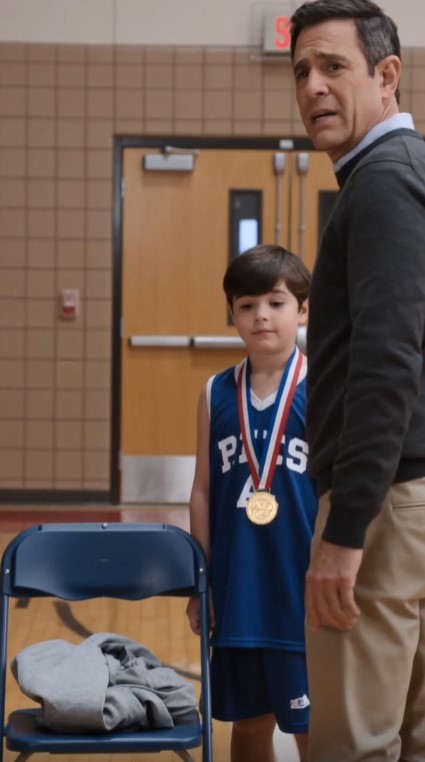
The championship gym was packed.
Every seat was taken…
except one.
Eleven-year-old Caleb had placed his jacket across it.
People kept asking:
“Is someone sitting there?”
Caleb always gave the same answer.
“Yes.”
His team was minutes away from the biggest game of their season.
His father was there.
His grandparents were there.
But Caleb kept staring at the entrance.
Then the coach finally said:
“Caleb, we have to start.”
Caleb slowly removed his jacket.
The seat stayed empty.
His team won.
Everyone rushed onto the court.
But Caleb didn’t celebrate.
He walked back to that empty chair…
and placed his medal on it.
His father followed.
“Son?”
Caleb looked at him.
“Mrs. Rosa never missed one game.”
Rosa was the elderly crossing guard outside Caleb’s school.
For three years, she had stood in rain, snow and heat making sure the children crossed safely.
When Caleb’s parents worked late…
she stayed a few extra minutes so he was never waiting alone.
And whenever Caleb had a game…
Rosa somehow found a seat in the back.
But that morning, Rosa had unexpectedly been moved into a rehabilitation center after a fall at home.
Caleb had promised her:
“If we win, this medal is yours.”
Then the gym doors opened.
Everyone turned.
Rosa was there safely in a wheelchair…
with a family member beside her.
Caleb ran toward her.
“You came!”
Rosa smiled.
“I made you a promise too.”
Caleb placed the medal around her neck.
The entire gym stood.
But Rosa reached into her bag.
She pulled out a tiny pair of worn children’s basketball shoes.
Caleb’s father saw them…
and stopped breathing for a second.
“Where did you get those?”
Rosa looked at him.
“You really don’t remember me, do you?”
Caleb’s father, Daniel, stared at the shoes.
They were faded blue.
The rubber soles were cracked with age.
One lace had been replaced with a piece of white cord.
And on the inside tongue of the left shoe, written in black marker, were two letters:
D.M.
Daniel slowly sat down.
“Those were mine.”
Rosa nodded.
Caleb looked between them.
“Dad?”
Daniel picked up one shoe carefully.
“I haven’t seen these since I was about your age.”
Rosa smiled.
“I know.”
Daniel looked at her again.
Then something changed in his face.
Not recognition exactly.
More like an old memory trying to come into focus.
“You worked at Jefferson Elementary?”
“Long before I became a crossing guard.”
Daniel stared.
Rosa continued.
“I worked in the cafeteria.”
Daniel covered his mouth.
“Oh my God.”
Rosa smiled.
“There you are.”
Caleb frowned.
“What happened?”
Daniel looked down at the shoes.
For a moment, he seemed embarrassed.
Then Rosa answered for him.
“Your father loved basketball.”
Daniel laughed weakly.
“That part hasn’t changed.”
“But when he was eleven, his family didn’t have much money.”
Daniel’s own father, Robert, shifted uncomfortably from several seats away.
Caleb noticed.
“Grandpa?”
Robert looked down.
Those had been difficult years.
The factory where Robert worked had closed.
Daniel’s mother, Margaret, picked up extra shifts at a grocery store.
There was food on the table.
The bills were mostly paid.
But there was nothing extra.
When Daniel made the school basketball team, he needed shoes.
Real basketball shoes.
His old sneakers were splitting at the sides.
He never told his parents.
He knew they couldn’t afford another expense.
So he tried practicing in what he had.
One afternoon, the sole peeled loose during gym class.
Rosa had seen him sitting alone outside the cafeteria afterward.
She asked what happened.
Daniel told her:
“Nothing.”
Rosa had heard that word from enough children to know it often meant the opposite.
The next morning, a pair of used basketball shoes appeared beside Daniel’s backpack.
No note.
No explanation.
Just shoes.
A little too big.
But usable.
Daniel looked everywhere for whoever had left them.
Nobody admitted it.
He wore them through the entire season.
Then, after his final game, he left them in his locker.
When he returned Monday, they were gone.
Daniel assumed the school had thrown them away.
He never knew Rosa had kept them.
Caleb stared at her.
“You gave Dad the shoes?”
Rosa shook her head.
“Not exactly.”
Daniel looked surprised.
“What do you mean?”
Rosa pointed toward the man standing behind her wheelchair.
Her son, Michael.
Michael stepped forward.
He was in his fifties now.
Daniel looked at him without recognition.
Michael smiled.
“They were mine.”
Daniel stared.
Michael continued.
“I was a freshman in high school.”
Rosa had gone home that afternoon and told Michael about the boy with broken sneakers.
She never used Daniel’s name.
She simply asked:
“Do you still need those old basketball shoes?”
Michael had recently outgrown them.
He said no.
Rosa cleaned them.
Replaced the damaged laces.
And left them where Daniel would find them.
Daniel looked at Michael.
“You gave up your shoes for me?”
Michael shrugged.
“They didn’t fit anymore.”
Rosa immediately corrected him.
“You liked keeping everything.”
Michael laughed.
“That part is true.”
Caleb looked at his father.
“Why did you never tell me this?”
Daniel shook his head.
“I didn’t know who did it.”
Then he turned toward Rosa.
“Why keep them?”
Rosa held the shoes in her lap.
“Because you brought them back.”
Daniel frowned.
“I did?”
“You don’t remember?”
He shook his head.
After Daniel’s final game that year, he had cleaned the shoes as best he could.
Then placed them beneath Rosa’s cafeteria desk with a folded piece of notebook paper inside.
Rosa reached into her bag again.
This time, she removed a small plastic sleeve.
Inside was an old note.
The handwriting was clearly a child’s.
Daniel read it aloud.
Thank you to whoever gave me these.
We won four games.
I scored six points once.
Caleb smiled.
“Six?”
Daniel pointed at him.
“That was impressive then.”
Rosa laughed.
Daniel continued.
I don’t need them anymore because my feet got bigger.
Maybe another kid can use them.
Then one final sentence:
Please don’t throw them away. They helped me stay on the team.
Daniel stopped reading.
The gym had become completely quiet.
Rosa said:
“I couldn’t throw them away after that.”
She kept the shoes in a box.
Not because she believed Daniel would ever see them again.
Because the note meant something to her.
She had spent most of her life in jobs people rarely noticed.
Cafeteria worker.
School aide.
Crossing guard.
She never thought of herself as someone important in a child’s life.
Then that note reminded her that small things could travel farther than expected.
Years passed.
Daniel grew up.
Went to college.
Got married.
Had Caleb.
Rosa changed schools.
Then eventually began working as a crossing guard.
She had no idea the boy she helped decades earlier was Caleb’s father.
Not until three years earlier.
Caleb had been waiting after school one rainy afternoon.
Daniel arrived late from work.
He jumped from the car and apologized.
Rosa looked at him.
Something about his face seemed familiar.
But she couldn’t place it.
Then Daniel called:
“Caleb Miller, let’s go!”
Miller.
Rosa remembered.
Daniel Miller.
The boy with the shoes.
She went home that evening and opened the old box.
There they were.
The shoes.
The note.
She considered telling Daniel.
Then decided not to.
Michael asked why.
Rosa said:
“It was a long time ago.”
Then she added:
“Maybe it doesn’t matter anymore.”
Michael disagreed.
But Rosa kept the secret.
For three years, she watched Caleb grow.
She stood at the crossing every morning.
Caleb always said:
“Good morning, Mrs. Rosa.”
Every single day.
He told her about games.
Tests.
Bad lunches.
New sneakers.
Everything.
One afternoon, Rosa asked:
“Does your dad still like basketball?”
Caleb laughed.
“He thinks he could’ve gone pro.”
Daniel shouted from the car:
“I could have!”
Rosa smiled.
That was the moment she knew for certain.
Same Daniel.
Same confidence.
Same exaggeration.
But she still said nothing.
Then, several weeks before the championship, Caleb had found Rosa sitting on a bench after school.
She looked tired.
He asked if she was okay.
She told him her hip had been bothering her.
Caleb said:
“You better come to my championship.”
Rosa smiled.
“I’ll try.”
“No trying.”
“Bossy.”
“Promise.”
So she promised.
Then came the fall.
Rosa slipped at home.
Nothing catastrophic.
But enough to require a short rehabilitation stay.
When Caleb heard she might miss the championship, he became quiet.
He called her that evening.
“If we win, I’m bringing you the medal.”
Rosa laughed.
“You earned that medal.”
“Not yet.”
“Then earn it first.”
He did.
Now Rosa sat in the packed gym with Caleb’s medal around her neck.
And Daniel held the shoes she had saved for decades.
Robert approached slowly.
Daniel’s father looked at Rosa.
“You did that for him?”
Rosa nodded.
Robert’s eyes filled.
“I couldn’t buy those shoes.”
Daniel immediately stood.
“Dad.”
Robert shook his head.
“No.”
He looked at Caleb.
“You should know.”
Robert had carried shame about those years for decades.
He remembered Daniel asking vaguely whether they could “maybe get new sneakers sometime.”
Robert told him:
“Next month.”
Then next month came.
There still wasn’t money.
Daniel stopped asking.
Robert had always believed his son simply made do.
He never knew someone else quietly stepped in.
Robert looked at Rosa.
“Thank you.”
Rosa shook her head.
“Your family was doing its best.”
“I should have known.”
“You were trying to keep a roof over him.”
Robert wiped his eyes.
Rosa continued:
“A family needing help for a while isn’t failure.”
Daniel looked at his father.
The sentence seemed to loosen something that had stayed tight for years.
He hugged him.
Caleb watched.
Then said:
“This birthday got weird.”
Everyone laughed.
“It isn’t anyone’s birthday,” Daniel said.
“Still weird.”
The team gathered around Rosa.
Coach Marcus had heard the whole story.
He asked:
“Mrs. Rosa, can I see those shoes?”
She handed them over.
Marcus inspected them.
“These things are ancient.”
Daniel looked offended.
“They were elite.”
“They have cardboard in the heel.”
“Performance technology.”
Caleb laughed.
Then Coach Marcus looked at the team.
“You boys know why this matters?”
One player said:
“Because Caleb’s dad had terrible shoes?”
Daniel pointed.
“I’m remembering all of you.”
Coach Marcus smiled.
“No.”
He held up the shoes.
“Because somebody gave away something they didn’t need, and it kept another kid playing.”
Then he looked at Caleb’s medal.
“And decades later, that kid’s son gives away something he earned to the same woman.”
Rosa immediately protested.
“I’m giving the medal back.”
Caleb shook his head.
“No.”
“Yes.”
“No.”
Rosa looked at Daniel.
“Do something.”
Daniel smiled.
“He gets the stubbornness from his mother.”
The medal stayed with Rosa.
But she made Caleb promise something.
“When you win another one, keep it.”
Caleb thought.
“What if you come to that game too?”
Rosa smiled.
“Then I’ll clap.”
After the gym emptied, Daniel helped Michael load Rosa’s wheelchair into the car.
The two men talked.
Daniel asked what Michael remembered from those years.
“Not much.”
“You really didn’t mind giving me the shoes?”
Michael shrugged.
“I remember Mom asking.”
“And?”
“I remember being annoyed.”
Everyone laughed.
Michael continued.
“I was fourteen. I was annoyed by everything.”
Then his expression softened.
“But Mom told me there was a kid who might have to quit the team.”
Michael had played basketball too.
He understood immediately.
So he handed over the shoes.
Daniel reached out and shook his hand.
“Thank you.”
Michael smiled.
“You already returned them.”
The next week, Daniel visited Rosa at the rehabilitation center.
Caleb went with him.
They brought flowers.
Rosa complained.
“Flowers die.”
Caleb held up a second bag.
“We brought cookies too.”
“Better.”
Daniel carried the old shoes.
“Why do you still have these?”
Rosa smiled.
“I was waiting for you to remember.”
Daniel laughed.
“No, you weren’t.”
“No.”
She admitted the real reason.
The shoes had become a reminder.
Not of Daniel specifically.
Of a rule she had tried to live by.
If a child needed something small and she could help without humiliating them, she helped.
Sometimes it was food.
Sometimes a phone call home.
Sometimes waiting ten minutes after school.
Sometimes shoes.
Daniel looked at her.
“You’ve been doing this your whole life.”
Rosa shrugged.
“Most people do more than they realize.”
Caleb looked at his father.
“Dad.”
“What?”
“We should do something.”
Rosa immediately said:
“No plaques.”
Caleb frowned.
“I wasn’t going to say plaque.”
“No building names.”
“I wasn’t going to say that either.”
“No giant photograph.”
Caleb smiled.
“Now I kind of want one.”
Rosa pointed at him.
“No.”
Caleb had a different idea.
His team had younger players who sometimes struggled to afford equipment.
Shoes were expensive.
So were uniforms, travel fees, and tournament costs.
Caleb suggested a shelf at the community gym.
Families could donate clean, usable sports gear their children had outgrown.
Other families could take what they needed discreetly.
No forms.
No public list.
No embarrassment.
Daniel loved it.
Coach Marcus loved it.
Rosa hated one part.
They wanted to call it Rosa’s Locker.
“No.”
Caleb negotiated.
Eventually they called it:
THE EXTRA PAIR
Underneath was a small line:
Keep another kid in the game.
Rosa approved.
Michael donated the first pair of shoes.
Daniel donated the second.
Caleb donated three old jerseys.
Within a month, shelves filled.
Basketball shoes.
Soccer cleats.
Gloves.
Shin guards.
Equipment bags.
Some items were nearly new.
Others were well used but still safe.
The program partnered with coaches to make sure equipment was appropriate and in good condition.
Nobody had to stand in front of a crowd and say:
“My family can’t afford this.”
That mattered to Rosa.
One afternoon, a mother came in with her nine-year-old son.
He needed basketball shoes.
They found a pair.
The boy put them on.
Perfect fit.
He ran across the gym.
His mother quietly wiped her eyes.
Rosa happened to be visiting.
Caleb whispered:
“See?”
She smiled.
“See what?”
“This is because of you.”
“No.”
She pointed at the donated shelves.
“This is because people had extra shoes.”
Caleb shook his head.
“You’re impossible.”
Rosa laughed.
“So I’ve been told.”
Her rehabilitation went well.
Within months, Rosa returned to the crossing.
The first morning back, students lined the sidewalk.
She immediately became suspicious.
“What did you people do?”
Caleb stood at the front.
“Nothing.”
That was obviously false.
Every child held a small paper sign.
Not expensive.
Just handwritten.
WELCOME BACK, MRS. ROSA
WE MISSED YOU
THANK YOU FOR KEEPING US SAFE
Rosa covered her face.
“You children are exhausting.”
Caleb hugged her.
“You love us.”
“Unfortunately.”
Daniel watched from the car.
Then remembered himself at eleven.
Broken sneakers.
Embarrassed.
Pretending nothing was wrong.
He wondered how many adults had helped him in small ways he had never understood.
It changed him.
Daniel began volunteering with The Extra Pair.
At first, only occasionally.
Then every month.
He cleaned donated shoes.
Replaced laces.
Checked sizes.
One afternoon, Caleb walked in and found his father sitting with a pair of worn sneakers.
“What are you doing?”
Daniel smiled.
“Replacing the laces.”
Caleb stared.
“That’s exactly what Mrs. Rosa did.”
Daniel looked down.
“I know.”
The old pair stayed with Rosa.
Eventually she gave them to Caleb.
He refused.
“They’re Dad’s.”
Daniel shook his head.
“No.”
He handed them back.
“They’re yours now.”
Caleb kept them in a box.
Not as a trophy.
As a reminder.
Years passed.
Rosa finally retired from crossing-guard duty at seventy-eight.
On her last morning, no championship gym was involved.
No television cameras.
Just children and families standing near the crosswalk.
Caleb was fifteen.
He waited until everyone else left.
Then gave Rosa a small box.
Inside was another medal.
Rosa frowned.
“What did I tell you?”
“This isn’t mine.”
The medal had been made specially.
On the front:
32 YEARS OF HELPING KIDS CROSS
On the back:
AND A LIFETIME OF HELPING THEM KEEP GOING
Rosa stared.
“Who paid for this?”
“Dad.”
She looked at Daniel.
He immediately blamed Caleb.
Rosa cried anyway.
At home, she placed it beside Caleb’s championship medal.
The two medals remained together.
Years later, Caleb graduated high school.
Rosa attended.
She walked with a cane by then.
No wheelchair.
When Caleb saw her, he ran over.
“You got a seat?”
“Yes.”
“Good.”
“I can find my own seat.”
“I know.”
“You don’t need to save one.”
Caleb smiled.
“I always will.”
Rosa hugged him.
Caleb went to college.
He eventually became a physical therapist.
Part of that decision came from seeing Rosa recover after her fall.
He worked with older adults.
Athletes.
Children.
People learning how to trust their bodies again.
On the wall of his first office was a framed photograph.
Not the shoes.
Not the medals.
A picture someone had taken during the championship.
Caleb, eleven years old.
Kneeling beside Rosa’s wheelchair.
Putting his medal around her neck.
Daniel stood behind them.
Rosa was laughing.
Underneath, Caleb placed a simple sentence:
Remember who showed up before everyone was watching.
Rosa lived long enough to see it.
She stared at the frame.
“You made me look sentimental.”
“You are sentimental.”
“I am not.”
“You saved Dad’s shoes for thirty years.”
“Evidence storage.”
Caleb laughed.
Eventually, after Rosa died peacefully in her eighties, her son Michael brought Caleb a box.
Inside were the two medals.
The old shoes.
Daniel’s childhood note.
And dozens of small cards from children Rosa had helped over the years.
One said:
Thank you for waiting when my mom was late.
Another:
Thank you for remembering my name.
Another:
I was scared to cross the street until you helped me.
Caleb sat on the floor reading them.
Then found one he had written as a child.
He didn’t remember it.
Mrs. Rosa,
Thank you for coming to all my games.
If I ever win something big, I’ll give you one.
— Caleb
He had kept his promise.
But Rosa had kept hers first.
She showed up.
Again.
Again.
Again.
Rain.
Snow.
Heat.
Ordinary school mornings.
Little league games.
Championships.
Nobody applauded a crossing guard for most of those days.
That was never why she came.
Years later, The Extra Pair program expanded to several local schools.
One day Daniel and Caleb visited.
A boy around eleven was trying on basketball shoes.
The first pair didn’t fit.
Neither did the second.
The third did.
The boy stood.
Jumped twice.
Smiled.
Caleb looked at Daniel.
Daniel was already crying.
“Dad.”
“I’m fine.”
“You’re absolutely not.”
Daniel laughed.
Then he looked at the shoes.
Different color.
Different decade.
Same idea.
Someone had something extra.
Someone else needed it.
A small act kept a child in the game.
That was Rosa’s real legacy.
Not the medals.
Not the photograph.
Not even the old shoes.
It was the belief that help didn’t have to be enormous to matter.
Sometimes it was waiting five extra minutes after school.
Sometimes sitting in the back row of a basketball game.
Sometimes giving away shoes that no longer fit.
And sometimes it was saving one empty seat in a packed championship gym because an eleven-year-old boy couldn’t imagine celebrating without the woman who had quietly shown up for him for years.
Caleb thought that seat was for Rosa.
Years later, he understood something else.
It represented all the people whose names never appeared on scoreboards.
The crossing guards.
Cafeteria workers.
Bus drivers.
Custodians.
Neighbors.
People standing just outside the spotlight…
making sure someone else safely reaches it.
And when Caleb placed his medal around Rosa’s neck that afternoon, he wasn’t giving away something he had won.
He was finally recognizing someone who had been part of the victory long before the game began.