
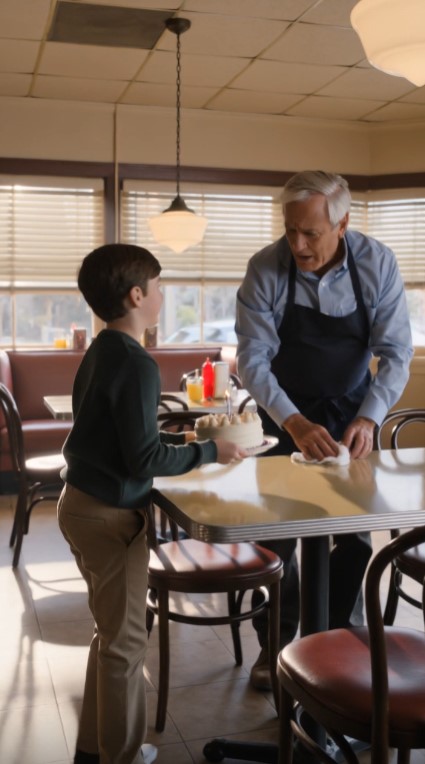
An 11-year-old boy walked into a nearly empty diner carrying a birthday cake.
He didn’t sit with his mother.
Instead, he walked toward an elderly dishwasher clearing tables in the back.
“Mr. Henry?”
The old man turned around.
The boy placed the cake in front of him.
“Mom said nobody should work on their birthday without a cake.”
Henry smiled.
Then his eyes filled with tears.
“How did you know?”
The boy pointed toward his mother.
For almost a year, Henry had quietly saved untouched packaged food from the diner’s staff meals for her when money was tight.
He never embarrassed her.
Never told anyone.
He simply left a small bag near the counter and said:
“Take it home for your boy.”
Now she had a new job.
They were doing better.
But her son had never forgotten the stranger who helped them.
Henry whispered:
“I didn’t do anything special.”
The boy shook his head.
“You made sure I ate.”
Then the diner door opened.
Henry looked up.
Former employees began walking inside.
One after another.
A nurse.
A mechanic.
A teacher.
A young father carrying his daughter.
Every one of them had once been helped by Henry.
Within minutes, the forgotten dishwasher had an entire room standing for him.
But then the boy’s mother placed an old photograph beside the cake.
Henry looked at it…
and his hands started shaking.
“That’s my brother.”
She nodded.
“My father.”
For several seconds, Henry didn’t speak.
He picked up the photograph with both hands.
The picture was faded and bent at one corner.
Two teenage boys stood outside a small gas station.
One was Henry.
The other was his older brother, Samuel.
Henry looked toward the woman.
“What’s your name?”
“Rachel.”
He swallowed.
“Samuel had a daughter named Rachel.”
She nodded.
“I know.”
Henry sat down.
The room went silent.
Rachel’s son, Noah, looked from his mother to Henry.
“Mom?”
Rachel placed a hand on his shoulder.
“This is your grandfather’s brother.”
Noah stared.
“My great-uncle?”
Henry closed his eyes.
He had not heard Samuel’s name spoken by family in nearly forty years.
Not like this.
Not by someone standing in front of him.
He looked at Rachel again.
“How did you find me?”
Rachel glanced at the photograph.
“I didn’t.”
Henry frowned.
She smiled sadly.
“You found us first.”
That confused him even more.
Rachel explained.
A year earlier, when she first started coming to the diner, she had no idea who Henry was.
She had recently separated from her husband.
Money was tight.
She was working part-time while trying to find something more stable.
Some evenings, dinner meant whatever she could stretch.
Henry noticed.
Not because Rachel asked.
Because Henry noticed things.
When staff meals had sealed sandwiches, fruit cups, crackers, or unopened portions that would otherwise be discarded under the diner’s rules, Henry sometimes set aside what could appropriately be taken home.
He never announced it.
Never asked questions.
He simply said:
“Take it for the boy.”
Rachel resisted at first.
Henry insisted.
One night, Noah came with her.
Henry gave him a carton of milk and a packaged muffin.
Noah thanked him.
Henry said:
“Always save something for tomorrow.”
Rachel froze.
Her father used to say exactly that.
Not just similar words.
The same words.
Always save something for tomorrow.
She thought it was coincidence.
Then Henry laughed.
That laugh sounded familiar too.
Rachel went home and opened a box she had inherited after Samuel died.
Old photographs.
Letters.
Military papers.
Receipts.
One photograph stopped her.
Two teenage boys.
Samuel.
And a younger boy she had never met.
On the back, in Samuel’s handwriting:
Henry and me — 1966. Always save something for tomorrow.
Rachel sat on the floor for almost an hour.
She had grown up knowing her father had a younger brother.
But Samuel never talked about him.
When Rachel asked as a child, he always said:
“We lost each other.”
She assumed Henry had died.
Or moved overseas.
Or simply disappeared.
She never imagined he was washing dishes less than fifteen miles from her home.
Henry stared at the photograph.
“Your father kept this?”
“All his life.”
Henry’s eyes filled.
“Then why didn’t he call?”
Rachel sat beside him.
“I was hoping you could tell me.”
Henry looked down.
There was no simple answer.
The brothers had been inseparable as children.
Their father died when Henry was fourteen.
Samuel was eighteen.
Suddenly Samuel became half-brother, half-parent.
He worked.
Paid bills.
Tried to keep Henry in school.
But they handled grief differently.
Samuel became serious.
Responsible.
Controlling, sometimes.
Henry became restless.
Angry.
At nineteen, Henry wanted to leave town with friends.
Samuel told him it was a mistake.
Henry accused him of trying to run his life.
Samuel said:
“If you walk out that door, don’t expect me to clean up after you.”
Henry walked out.
He expected the fight to last a week.
Maybe a month.
Instead, pride stretched it into years.
Henry moved around.
Worked kitchens.
Factories.
Construction.
He wrote Samuel once.
No answer.
Samuel wrote too.
But that letter never reached Henry.
By the time Henry returned to town years later, Samuel had moved.
Henry asked around.
Nobody knew exactly where.
There was no internet.
No easy search.
Then marriage and children filled Samuel’s life.
Work filled Henry’s.
The distance hardened.
Each assumed the other had chosen silence.
Rachel listened.
“My dad said he looked for you.”
Henry looked up.
“When?”
“For years.”
Henry shook his head.
“No.”
“He did.”
Rachel opened her bag.
She pulled out an envelope.
Inside were photocopies of old letters.
One began:
Henry,
I was angry when you left. I was more afraid than angry. I didn’t know the difference then.
Henry covered his mouth.
Rachel continued.
“Dad wrote these.”
“How many?”
“Seven.”
Henry stared.
“I never got one.”
Rachel nodded.
“They came back.”
Some had old addresses crossed out.
One had RETURN TO SENDER stamped across the front.
Another had been mailed to a factory where Henry worked for only three months.
Samuel had kept every returned letter.
Henry looked around the diner.
Dozens of people were watching.
He seemed suddenly embarrassed.
“Can we…”
Rachel understood.
“Of course.”
They moved to a booth near the back.
Noah carried the cake.
The former employees stayed nearby but gave them space.
Henry read the first letter.
Then another.
Then another.
Samuel had written about Rachel being born.
About buying his first house.
About their mother dying.
About regret.
One line made Henry stop.
I keep thinking I’m waiting for you to apologize, but I think maybe I’m waiting because I’m afraid you won’t.
Henry stared at that sentence.
“I was waiting for him.”
Rachel nodded.
“He was waiting for you.”
Henry laughed once.
A sad little sound.
“Two idiots.”
Rachel smiled through tears.
“Probably.”
Noah leaned over the table.
“Why didn’t one of you just call?”
Henry looked at him.
“Because grown-ups can be very stupid.”
Noah nodded seriously.
“I know.”
Everyone laughed.
Even Henry.
Then Rachel gave him the final letter.
It was dated only months before Samuel died.
Henry unfolded it carefully.
Henry,
If this finds you, I don’t care whose fault it was anymore.
Henry stopped.
His hands shook.
Rachel whispered:
“Keep going.”
He did.
I have a daughter named Rachel.
She has your stubbornness even though she’s never met you.
Rachel smiled.
If you ever come back, don’t waste time explaining where you’ve been. Just sit down.
We can eat first.
We always did better after we ate.
Henry started crying.
No attempt to hide it.
No apology.
He lowered the letter.
“I came back too late.”
Rachel reached across the table.
“You came back before I did.”
Henry looked at her.
She pointed at Noah.
“You helped us before you even knew who we were.”
That broke him.
For almost a year, Henry had quietly made sure Rachel and Noah left the diner with food when they needed it.
He thought he was helping strangers.
Instead, he had been helping Samuel’s daughter.
Samuel’s grandson.
Family.
Without knowing.
Noah pushed the cake closer.
“So technically Grandpa sent you a birthday cake.”
Henry laughed through tears.
“That’s a stretch.”
“I think it counts.”
Henry looked at the boy.
Same dark eyes Samuel had as a child.
Same habit of leaning forward when curious.
For the first time, Henry saw it.
“You look like him.”
Noah grinned.
“Was he handsome?”
Henry pretended to think.
“No.”
Rachel laughed.
“My dad would disagree.”
“He always did.”
The birthday gathering changed after that.
People began telling stories.
Maria, now a nurse, remembered working nights at the diner while attending community college.
Henry used to save her a plate when she missed meal break.
Daniel, the mechanic, said Henry once loaned him forty dollars for a certification exam.
Henry had refused repayment.
A teacher named Angela said she came to work crying after failing a college class.
Henry sat beside the dish station and told her:
“One bad grade doesn’t know your whole life.”
She retook the course.
Passed.
Years later, she became a teacher.
The young father, Marcus, had once been homeless for several weeks while working at the diner.
Henry quietly let him store a clean uniform in his locker.
No questions.
No announcements.
Henry listened to all of them as if they were talking about someone else.
“I barely remember doing half of that.”
Maria smiled.
“That’s because it was small to you.”
Then she looked around.
“It wasn’t small to us.”
Noah cut the cake.
He insisted Henry get the first slice.
Henry complained that birthday people traditionally cut their own cake.
Noah ignored him.
Rachel watched them.
Something about the scene hurt and healed at the same time.
Her father should have been there.
Samuel should have seen this.
But he wasn’t.
That fact couldn’t be rewritten.
Still, Rachel realized something.
Samuel had spent years trying to find Henry.
And somehow, years after his death, his daughter had.
Not through an investigator.
Not through records.
Through kindness.
If Henry had ignored Rachel’s struggles, she might never have noticed him closely.
If he had not used Samuel’s old phrase, she might never have opened the box.
If Noah had not remembered Henry’s birthday, Rachel might have waited longer to reveal the photograph.
The reunion existed because Henry had done what he always did.
He noticed someone who needed help.
After the diner emptied, Rachel stayed.
Henry washed the last few plates.
She laughed.
“You’re seriously working?”
“They’re dirty.”
“It’s your birthday.”
“Dishes don’t celebrate birthdays.”
Noah grabbed a towel.
“I’ll dry.”
Henry looked at Rachel.
“Is he allowed?”
Rachel smiled.
“Apparently.”
They worked together.
Henry washed.
Noah dried.
Rachel stacked.
It was ordinary.
That made it feel strangely precious.
Before leaving, Rachel asked:
“Can we see you again?”
Henry looked surprised.
“Why?”
Rachel laughed.
“Because you’re family.”
He stared at her.
The word seemed difficult for him.
Finally:
“Sunday?”
Rachel nodded.
“Sunday.”
The first Sunday dinner was awkward.
Henry lived in a modest apartment.
His table had only two chairs.
Rachel brought a folding one.
Noah sat on a milk crate and declared it more comfortable anyway.
Henry cooked spaghetti.
Too much garlic.
Noah loved it.
Rachel noticed an old photograph on the refrigerator.
Henry and Samuel as children.
She touched it.
“You had one too.”
Henry looked over.
“Of course.”
She smiled.
“All these years you both kept the same pictures.”
Henry sat down.
“Pride is expensive.”
Rachel looked at him.
“That sounds like something Dad would say.”
Henry smiled.
“He stole most of his good lines from me.”
Sunday dinner became routine.
Henry told Noah stories about Samuel.
Not grand stories.
Better ones.
How Samuel hated tomatoes.
How he once fell asleep during church and snored.
How he secretly fed a neighborhood cat despite claiming to dislike animals.
How he took Henry fishing and forgot the bait.
Rachel heard versions of her father she had never known.
Not Dad.
Samuel.
A teenager.
A brother.
A boy who made mistakes.
That mattered.
Henry heard about Samuel too.
How he became a maintenance supervisor.
How he taught Rachel to drive.
How he cried when she graduated.
How he became an embarrassing grandfather for the three years he had with Noah.
Henry asked questions constantly.
“What did he die from?”
“Did he suffer?”
“Was he afraid?”
Rachel answered honestly.
Then one evening Henry asked:
“Did he still hate me?”
Rachel immediately said:
“No.”
“How do you know?”
“Because he kept your letters.”
“My letters?”
Henry had written more than one.
He had assumed none survived.
Rachel brought another box the following week.
Samuel had kept three letters Henry sent decades earlier.
One said:
I’m not coming home until I have something to show for leaving.
Another:
Tell Mom I’m fine.
The last:
I’m still mad. I just don’t remember exactly what I’m mad about anymore.
Henry laughed painfully.
“That sounds like me.”
Rachel asked:
“Why didn’t you come back then?”
“I thought he should answer first.”
They both shook their heads.
Noah listened.
Then said:
“I’m making a family rule.”
Rachel smiled.
“What?”
“If you’re mad, you have three days.”
Henry laughed.
“Three?”
“After that you have to talk.”
Rachel looked at Henry.
“I support this.”
“So do I.”
Noah wrote it on a piece of paper.
FAMILY RULE: YOU CAN BE MAD FOR THREE DAYS. THEN TALK.
Henry taped it to the refrigerator.
Months passed.
Rachel introduced Henry to more relatives.
Some had heard his name.
Others hadn’t.
Nobody blamed him.
Nobody turned Samuel into a saint either.
The brothers had both failed.
Both waited too long.
That was the truth.
Henry slowly became part of family gatherings.
At Christmas, Noah gave him a framed copy of the gas-station photograph.
On the back, he wrote:
WE FOUND EACH OTHER.
Henry stared at it for a long time.
Then he placed it beside Samuel’s old letters.
The diner changed too.
After Henry’s birthday, the owner learned how many workers Henry had quietly helped over the years.
He wanted to create an award in Henry’s name.
Henry refused.
“No plaques.”
“A scholarship?”
“No.”
“A free meal program?”
Henry paused.
That was different.
The diner already threw away some safe, untouched packaged items under approved procedures.
Henry suggested something more organized.
Instead of depending on one dishwasher quietly noticing people, the owner partnered with a local food program.
Employees experiencing temporary hardship could access meals discreetly.
No questions shouted across a kitchen.
No embarrassment.
The program was called The Extra Plate.
Henry refused to have his name attached.
Noah suggested the slogan:
Always save something for tomorrow.
Henry agreed.
Years later, that phrase appeared on small cards inside meal bags.
Rachel saw one and cried.
Her father’s words.
Henry’s words.
Now helping strangers neither man would ever meet.
Henry eventually retired.
For real this time.
On his last shift, the diner was full again.
Noah was sixteen.
He brought another cake.
Henry saw him and laughed.
“Not again.”
“Tradition.”
“You people need new hobbies.”
Former employees returned.
Some brought children.
One woman introduced Henry to her teenage son.
“This is the man I told you about.”
Henry immediately looked uncomfortable.
“I washed dishes.”
She smiled.
“You also made sure I ate while I studied for nursing school.”
Henry shrugged.
“People need food.”
She replied:
“Exactly.”
After retirement, Henry spent more time with Rachel and Noah.
He taught Noah basic cooking.
Noah was terrible.
He burned rice.
Overcooked pasta.
Once forgot to turn the oven on.
Henry said:
“Your grandfather would be ashamed.”
Noah answered:
“He’s your brother, so technically this is your fault too.”
Henry had no response.
When Noah graduated high school, Henry sat in the front section with Rachel.
Noah found them afterward.
He handed Henry an envelope.
Inside was a photograph.
Noah at eleven.
Holding the birthday cake.
Henry beside him in his diner apron.
On the back:
YOU MADE SURE I ATE.
Henry cried.
Noah hugged him.
Then whispered:
“Three-day rule.”
Henry laughed.
“That doesn’t apply to crying.”
“I know.”
Years later, Noah studied social work.
Partly because he had grown up watching what small, private help could do.
During college, he volunteered at a community food pantry.
Rachel asked if Henry had influenced him.
Noah said:
“Obviously.”
Henry pretended not to hear.
He heard.
By then Henry was in his eighties.
Slower.
Still stubborn.
Still convinced everyone else needed help more than he did.
When grocery shopping became difficult, Rachel began bringing food.
Henry complained.
She used his own words against him.
“Take it home.”
He frowned.
“For what?”
“For the old man.”
Henry laughed so hard he nearly dropped the bag.
“You waited years to say that.”
“Yes.”
Eventually, Henry’s health declined.
Nothing dramatic.
Age.
A collection of ordinary problems.
His final months were peaceful.
Rachel visited often.
Noah visited whenever he came home.
One afternoon, Henry asked Rachel to bring Samuel’s photograph.
The gas station.
Two teenage brothers.
She placed it in his hands.
Henry smiled.
“I wasted a lot of years.”
Rachel sat beside him.
“Yes.”
He looked surprised.
“You’re supposed to tell me I didn’t.”
“I’m not lying to you.”
Henry laughed.
“Definitely Samuel’s daughter.”
Then Rachel squeezed his hand.
“You lost years with him.”
She pointed toward herself.
“But you didn’t lose all of us.”
Henry looked at her.
“No.”
“And Dad didn’t either.”
Henry nodded.
That mattered.
After Henry died, the diner closed for three hours on the morning of his memorial.
The owner taped a sign to the door.
CLOSED UNTIL NOON
WE’RE SAYING GOODBYE TO A MAN WHO NEVER LET ANYONE LEAVE HUNGRY.
At the service, Rachel placed the old photograph beside Henry’s picture.
Two brothers together again.
Noah placed Henry’s birthday card nearby.
Then former diner workers began arriving.
Nurse.
Mechanic.
Teacher.
Parents.
People Henry had helped in ways he barely remembered.
The room filled.
Just like his birthday.
Noah stood at the front.
He was nervous.
Then he unfolded a small piece of paper.
“I was eleven when I brought Mr. Henry a cake.”
He paused.
“Back then, I thought I was thanking a stranger for helping my mom.”
He looked toward Rachel.
“Then we found out he wasn’t a stranger.”
Noah looked at the photograph.
“But I think the important part is that he helped us before he knew that.”
The room went silent.
“He didn’t feed us because we were family.”
“He fed us because we needed it.”
“And then we found out we were family.”
Noah smiled through tears.
“That feels like something Henry would think was funny.”
People laughed softly.
Then Noah read the line printed on every Extra Plate card:
Always save something for tomorrow.
The program continued after Henry died.
So did Sunday dinners.
Rachel kept inviting people.
Noah brought friends home.
Eventually, he had children of his own.
Every year on Henry’s birthday, the family ate chocolate cake.
Not because Henry liked chocolate especially.
He actually preferred lemon.
But the first cake had been chocolate.
Tradition won.
One year Noah’s daughter asked:
“Who was Uncle Henry?”
Noah took out the old photograph.
Then the picture from the diner.
He told her.
Not just about the family connection.
About the bags of food.
The quiet help.
The birthday cake.
The room full of people.
Then his daughter asked:
“Did he know Grandpa Samuel was your grandpa?”
“No.”
“Then why did he help you?”
Noah smiled.
“That’s exactly the point.”
Henry spent most of his life believing kindness had to be small enough not to embarrass the person receiving it.
A bag by a counter.
Forty dollars slipped into a hand.
Crackers in a locker.
An extra plate.
Nothing announced.
Nothing performed.
And because those things were quiet, Henry assumed they disappeared.
They didn’t.
People carried them.
For years.
Sometimes decades.
Until one birthday, an eleven-year-old boy walked into a nearly empty diner carrying a cake.
He handed it to an elderly dishwasher.
Then the doors opened.
One person came back.
Then another.
Then another.
Thirty years of kindness walked into the room.
And finally, a woman placed an old photograph beside the cake.
Henry looked down.
Saw the brother he thought he had lost forever.
And learned that the mother and child he had been quietly feeding for a year…
were Samuel’s daughter and grandson.
Henry once told Noah:
“I didn’t do anything special.”
Noah never agreed.
Because sometimes the most important thing a person can do is also the simplest.
Notice.
Help.
And never make someone feel ashamed for needing it.
Henry had spent a lifetime doing exactly that.
And in the end, the kindness he gave strangers…
brought his own family home.