
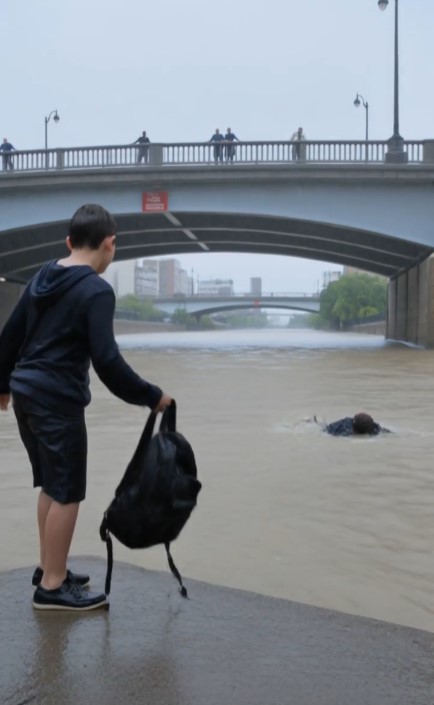
The river had been rising all morning.
Heavy rain had fallen through the night, turning the calm city river into a violent brown current that slammed against the concrete walls and swallowed the lower walking paths. Police had already blocked the stairs leading down to the water, but people still gathered along the bridge, staring at the flood below.
Then someone screamed.
A man had slipped from the flooded riverwalk.
For a moment, he fought against the current, arms breaking through the water as he tried to grab anything he could reach. But the river was too strong. It pulled him away from the wall and spun him toward the center, where the water moved faster.
People shouted from the bridge.
“Call 911!”
“Throw something!”
“Help him!”
But nobody jumped.
Nobody could blame them.
The current was brutal. The water was freezing. Anyone who entered it might not come back out.
Then a boy pushed through the crowd.
His name was Leo.
He was twelve years old, thin from too many nights without enough food, wearing a torn hoodie and carrying a small backpack that held everything he owned.
He looked over the bridge railing and saw the man disappear beneath the water.
Adults were shouting.
Phones were recording.
Sirens were still far away.
Leo did not wait.
He dropped his backpack.
Then he climbed over the barrier.
A woman screamed, “No! Don’t!”
But Leo was already gone.
He jumped.
The river swallowed him instantly.
For several seconds, nobody saw him.
The crowd went silent.
Then Leo broke through the surface, gasping, fighting the current with one arm while reaching toward the drowning man with the other. The stranger surfaced just ahead of him, already unconscious, his body turning with the flood.
Leo grabbed the back of his coat.
The current pulled them both under.
People on the bridge screamed again.
Then, somehow, Leo surfaced.
He kicked hard, using every bit of strength he had, dragging the man toward the muddy riverbank where the water hit a cluster of broken branches. Twice, the current nearly tore the man from his grip. Twice, Leo held on.
By the time he reached the bank, he could barely breathe.
Two men from the crowd finally ran down the side path and helped pull them from the water.
Leo collapsed on the mud beside the stranger.
His hands were shaking.
His lips were blue.
But the man was alive.
Paramedics arrived minutes later. They rushed to the riverbank, wrapped the boy in a blanket, and began working on the unconscious man.
One paramedic looked at the man’s face and suddenly froze.
“Wait,” she whispered.
Another paramedic turned.
His eyes widened.
“That’s Doctor Carter.”
The crowd went quiet.
Doctor James Carter was not just anyone.
He was one of the most respected heart surgeons in the city. He had saved thousands of lives, operated on children no one else would touch, and funded free clinics for families who could not afford medical care.
People knew his name.
They knew his face.
But Leo did not.
To Leo, he had only been a man in the water.
A man nobody was reaching.
A man who would die if someone did not move.
As paramedics gave Doctor Carter oxygen, his eyes slowly opened.
He looked confused at first.
Then his gaze landed on Leo.
The boy sat wrapped in a silver emergency blanket, soaked, shivering, and staring down at the mud as if he had done something wrong.
Doctor Carter reached out with a trembling hand and grabbed Leo’s wrist.
His voice was weak.
“Why did you jump?”
Everyone waited.
Leo looked at him, surprised by the question.
Then he answered quietly.
“Because nobody else did.”
The doctor’s eyes filled with tears.
Leo tried to pull his hand back, embarrassed by the attention.
“I didn’t know who you were,” he added. “I just saw you drowning.”
Doctor Carter held his wrist a little tighter.
“That makes it mean more.”
Leo did not understand.
He had spent most of his life being ignored. Adults walked past him on sidewalks. Store owners told him to move along. People looked through him like he was part of the street.
But now the entire bridge was staring at him.
Not with pity.
With awe.
A police officer recovered Leo’s backpack from the bridge. It was old, dirty, and nearly empty. Inside were a pair of socks, a broken pencil, a notebook wrapped in plastic, and a photo of a woman holding a baby.
Doctor Carter noticed the photo.
“Is that your mother?” he asked.
Leo looked down.
“She was.”
The doctor’s expression softened.
“Where do you live, Leo?”
The boy hesitated.
The answer was written all over his face before he spoke.
“Where I can.”
No one said anything.
The rain kept falling softly around them.
Doctor Carter closed his eyes for a moment, then opened them again.
“You saved my life,” he said. “Now let me save yours.”
Leo shook his head quickly.
“I don’t need anything.”
The doctor gave a weak smile.
“That’s what people say when they’ve needed everything for too long.”
At the hospital, both of them were treated.
Doctor Carter had swallowed water and suffered exhaustion, but he would recover. Leo had mild hypothermia, cuts on his hands, and bruises from being thrown against rocks in the river.
But the doctors said the same thing again and again.
If Leo had waited even one more minute, Doctor Carter might not have survived.
The next morning, the story was everywhere.
People called Leo a hero.
Videos from the bridge spread across the city.
But Leo hated the attention.
When reporters asked him why he did it, he shrugged.
“He was drowning,” he said. “That’s all.”
Doctor Carter watched the interview from his hospital bed.
For years, people had praised him for saving lives in operating rooms. But he knew those rooms had lights, teams, tools, and training.
Leo had nothing.
No safety rope.
No ambulance waiting.
No promise he would survive.
Just courage.
And a heart that still knew how to help, even after the world had not helped him.
When Doctor Carter was discharged, he asked to speak with Leo privately.
The boy stood near the door, ready to leave.
The doctor held out the plastic-wrapped notebook from Leo’s backpack.
“I read one page,” he said gently. “I hope that’s okay.”
Leo looked embarrassed.
“It’s just stuff.”
“It’s not just stuff.”
Inside the notebook, Leo had written names, dates, and little reminders to himself.
Find food before dark.
Stay away from the old tunnel when it rains.
Mom said never stop being kind.
Doctor Carter paused at that last line.
“Your mother taught you well.”
Leo looked away.
“She used to say being poor didn’t mean you had to be cruel.”
The doctor’s voice broke slightly.
“She was right.”
Then he made Leo an offer.
Not charity thrown from a distance.
Not a quick reward for cameras.
A real chance.
A safe place to stay while proper guardianship and social services were arranged. School enrollment. Medical care. Food every day. And if Leo wanted it, a path toward the kind of future his mother had once dreamed for him.
Leo stared at him.
“Why would you do that?”
Doctor Carter looked at the boy who had dragged him from a flooded river.
“Because you jumped when everyone else watched.”
Leo’s eyes filled with tears, but he tried to hide them.
“I was scared.”
The doctor nodded.
“Bravery usually is.”
Months passed.
Leo went back to school.
He slept in a real bed.
He ate breakfast at a table.
At first, he kept his backpack beside him everywhere he went, afraid life might change again without warning. But slowly, he began to trust that he no longer had to disappear before morning.
Doctor Carter kept his promise.
He did not treat Leo like a headline.
He treated him like a person.
He helped him study. Took him to appointments. Sat beside him during meetings with social workers. And every Sunday, they visited the river—not the dangerous edge, but the bridge above it.
One day, Leo looked down at the water and said, “I thought I was going to die.”
Doctor Carter stood beside him.
“So did I.”
Leo smiled faintly.
“Good thing I’m stubborn.”
The doctor laughed.
“Very good thing.”
Years later, a framed photograph hung in the lobby of Doctor Carter’s hospital.
It showed a muddy riverbank, a soaked boy wrapped in a rescue blanket, and a doctor holding his hand.
Below it were Leo’s words:
Because nobody else did.
Patients stopped to read it.
Doctors stopped too.
Some saw it as a rescue story.
Others saw it as a lesson.
Because that day, a homeless boy saved the city’s most respected heart surgeon.
But the deeper truth was this:
Leo had no idea the man was important.
He did not jump for fame.
He did not jump for money.
He did not jump because anyone was watching.
He jumped because someone was drowning, and his heart would not let him stand still.
Sometimes the person everyone ignores is the one with the most courage.
Sometimes the smallest body carries the strongest soul.
And sometimes one child, with nothing but a torn backpack and a promise from his mother, reminds an entire city what humanity is supposed to look like.
Fantastic lesson learned and a reminder not to judge a book by its cover. Bless anyone who has the courage to do the right thing no matter the cost. Blessings to all who live life with love in their hearts and courage to display it.