
The scratching was so faint that most people never noticed it.
Cars passed along the wet street. Store doors opened and closed. Adults hurried by with shopping bags, coffee cups, and phones pressed to their ears. Nobody stopped near the alley behind the grocery store.
Nobody except a little girl named Mia.
She was eight years old, wearing a yellow raincoat and holding her mother’s hand. They had just left the store when Mia suddenly stopped walking.
Her mother looked down.
“Mia, come on. It’s starting to rain again.”
But Mia did not move.
She turned her head toward the alley.
There it was again.
Scratch.
Scratch.
Scratch.
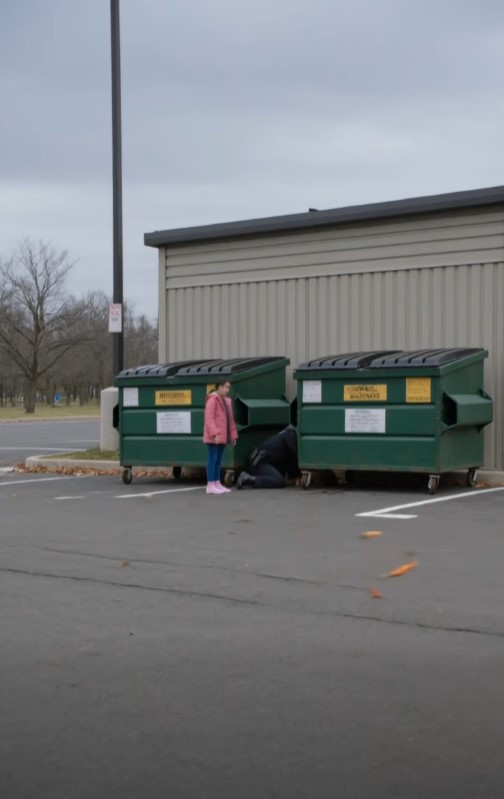
It came from behind the row of dumpsters near the brick wall.
“Mom,” Mia whispered, “something’s in there.”
Her mother glanced toward the alley and frowned.
“Probably a raccoon.”
“No,” Mia said. “It sounds hurt.”
A man walking past overheard her and laughed softly.
“Kids hear everything,” he said. “Best not go near dumpsters.”
Another woman shook her head.
“It’s probably trash shifting. Leave it alone.”
But Mia kept staring.
The scratching came again.
This time, weaker.
She pulled her hand away from her mother and took one step toward the alley.
“Mia, stop.”
That was when a police cruiser rolled slowly past the curb.
Officer Daniel Brooks had been finishing a routine patrol when he saw the child standing frozen in the rain, staring into the alley like she had seen something no one else could.
He parked.
“Everything okay?” he asked.
Mia’s mother looked embarrassed.
“She thinks she heard something in the dumpster.”
Mia turned to him quickly.
“I did hear something,” she said. “Please. It’s trapped.”
Officer Brooks looked toward the alley.
The adults nearby were already losing interest, but the little girl’s face stopped him.
She was not pretending.
She was not curious.
She was afraid.
So he listened.
He stepped into the alley, one hand resting near his radio, the other holding his flashlight. The rain tapped against the metal lids of the dumpsters. Water ran in dirty lines along the pavement.
For a moment, he heard nothing.
Then—
Scratch.
Brooks froze.
Mia whispered from behind him, “See?”
The officer raised his flashlight and moved toward the largest dumpster.
The sound came again.
Not from inside the trash.
From behind it.
Brooks pulled the dumpster away from the wall just enough to look behind.
Then his stomach turned.
A dirty black bag was wedged between the dumpster and the brick wall. It was tied at the top with rope, but something inside was moving weakly.
Brooks immediately grabbed his knife.
“Step back,” he ordered.
Mia’s mother pulled her daughter close.
The officer cut the rope and opened the bag.
A German Shepherd’s head slipped out.
For a second, nobody spoke.
The dog was painfully thin. His fur was soaked and matted with filth. His ribs showed beneath his skin. A dirty cord was tied around his neck, and his paws were scraped raw from trying to claw his way out.
Mia covered her mouth.
“Oh no…”
The dog tried to lift his head, but he barely had the strength.
Officer Brooks dropped to one knee.
“Easy, boy,” he said softly. “You’re safe now.”
The dog’s eyes moved toward him.
Tired.
Terrified.
Still alive.
Brooks gently freed the rest of his body from the bag. That was when he noticed the mark on the dog’s shoulder.
At first, he thought it was an injury.
Then he wiped away some mud.
His face hardened.
There was a number burned into the dog’s skin.
Mia’s mother gasped.
“What is that?”
Brooks did not answer.
He had seen cruelty before, but this felt different. This was not just abandonment. The number was too deliberate. Too controlled. Too much like someone had wanted the dog identified by a code instead of a name.
He reached for his radio.
“I need animal rescue and backup at my location. Possible abuse case. Dog is alive but critical.”
As he spoke, he looked down at the mud beside the dumpster.
Fresh boot prints.
Deep.
Recent.
Someone had been there not long before they arrived.
Brooks stood slowly.
Then he heard tires crunch against gravel.
A black SUV pulled up at the mouth of the alley.
The windows were dark.
The engine stayed running.
Mia’s mother pulled her daughter closer.
Officer Brooks turned, placing himself between them and the vehicle.
The driver’s door opened.
A man stepped out.
He wore a dark jacket, heavy boots, and no expression at all.
His eyes moved from Officer Brooks to the German Shepherd on the ground.
Then to Mia.
“Officer,” the man said calmly, “that dog belongs to me.”
The alley went silent.
Brooks narrowed his eyes.
“Funny. You didn’t report him missing.”
The man smiled.
“He ran off. I’ve been looking for him.”
The German Shepherd heard the voice.
His entire body changed.
The weak dog tried to rise.
His legs shook violently. His paws slipped on the wet pavement. He should not have been able to stand at all.
But somehow, he did.
A low growl came from his throat.
Mia took a step backward.
The dog moved too.
Not away from the man.
Between the man and the little girl.
Officer Brooks watched in disbelief as the starving, injured German Shepherd dragged himself in front of Mia, his body trembling, his head low, his eyes locked on the stranger.
The man’s smile disappeared.
“Control your animal,” Brooks said.
“He’s dangerous,” the man snapped. “You should put him down.”
The dog growled louder.
Brooks heard something in those words.
Not fear.
Convenience.
The man did not sound worried about being bitten.
He sounded worried the dog was still alive.
Backup arrived seconds later.
The man tried to leave, but Officer Brooks stopped him.
“Stay where you are.”
“For what?”
“Questions.”
The man laughed.
“Over a dog?”
Brooks looked at the burned number on the German Shepherd’s shoulder.
“No,” he said. “Over evidence.”
Animal rescue rushed the dog to an emergency clinic. Mia cried when they lifted him into the van, afraid she would never see him again.
Before the doors closed, the dog turned his head weakly toward her.
Mia pressed her small hand against the air.
“He saved me,” she whispered.
Officer Brooks looked at the dog, then at the black SUV, then at the boot prints disappearing into the alley mud.
He had a feeling this was much bigger than one abandoned animal.
He was right.
The number 4729 led investigators to a hidden illegal dog-fighting and breeding operation outside the city. Dogs were marked, moved, sold, and discarded when they became too injured, too weak, or too recognizable.
The German Shepherd had not been thrown away by accident.
He had escaped once before.
He had been seen by witnesses.
He had scars that could prove what had been done to him.
So someone tried to make sure he would never be found alive.
But they had not counted on one little girl hearing the scratching.
They had not counted on one officer listening.
And they had definitely not counted on the dog still having enough strength to protect a child.
At the clinic, the veterinary team worked through the night.
The German Shepherd was dehydrated, starving, infected, and exhausted. His body carried old scars and fresh wounds, but his heartbeat kept going.
One vet looked at Officer Brooks and said, “I don’t know how he survived.”
Brooks looked through the glass at the dog lying beneath warm blankets.
“He had something left to do.”
Mia visited three days later with her mother.
The dog was still weak, but when he saw her through the clinic window, his ears moved.
Mia smiled through tears.
“Hi, boy.”
The vet said they had started calling him Ranger.
Mia nodded seriously.
“That’s a good name. He was brave.”
When she was allowed to sit beside him, Ranger lifted his head and placed it gently on her knee.
Mia stroked his fur with both hands.
“You don’t have to protect me anymore,” she whispered. “You’re safe too.”
But Ranger’s eyes stayed on the door.
Always watching.
Always remembering.
Weeks passed.
The investigation grew.
The man from the SUV was arrested. More dogs were rescued from a property hidden behind locked gates and broken sheds. Some were too frightened to move. Some had never known a gentle hand. But because Ranger survived, police had the evidence they needed to find them.
Officer Brooks kept visiting the clinic.
At first, he told himself it was because the case was still open.
Then he stopped pretending.
Ranger trusted very few people, but he trusted Brooks.
And he adored Mia.
The little girl came every Saturday. She brought drawings, soft blankets, and one stuffed toy shaped like a police badge.
One afternoon, Mia asked the question everyone had been avoiding.
“What happens to him when he gets better?”
Her mother looked at Officer Brooks.
The vet smiled.
“That depends.”
Brooks looked at Ranger, who was now strong enough to stand and walk slowly around the room.
“He needs a home,” the vet said.
Mia’s eyes filled with hope.
Her mother hesitated.
Brooks crouched beside Ranger.
The dog leaned into him.
For the first time since the alley, Officer Brooks saw something in the German Shepherd’s eyes that looked almost peaceful.
He knew then.
“He already found one,” Brooks said.
Ranger went home with Officer Brooks two weeks later.
Mia was there when they walked him out of the clinic.
The dog’s burned number was still visible beneath the healing skin, but Brooks refused to see it as a mark of ownership.
To him, it was proof.
Proof of what Ranger survived.
Proof of what cruelty failed to destroy.
Proof that even when someone tried to erase him, he became the reason others were saved.
Months later, the police department held a small ceremony for the rescue team, the veterinarians, and Mia.
She stood shyly beside Officer Brooks while Ranger sat calmly at her feet.
The mayor called Mia a hero.
She shook her head.
“I just heard him.”
Officer Brooks smiled.
“And you made sure someone listened.”
Ranger looked up at her, his tail moving slowly against the floor.
The crowd applauded, but the loud sound made him nervous. Mia immediately knelt beside him and placed a hand on his neck.
“It’s okay,” she whispered.
Ranger relaxed.
The dog who had once dragged himself from a dirty bag to stand between a child and danger now sat safe beside the two people who refused to walk away.
Later, when Officer Brooks was asked why he took the case so personally, he gave a simple answer.
“Because everyone else heard trash,” he said. “A little girl heard a life.”
That was the part nobody forgot.
Not the black SUV.
Not the burned number.
Not even the arrest.
What people remembered most was the moment a starving dog, barely able to stand, still found the strength to protect the child who had saved him first.
Sometimes heroes are not found clean, strong, and ready.
Sometimes they are found broken.
Hungry.
Thrown away.
Marked by cruelty.
But still brave enough to stand between innocence and danger.
And sometimes the smallest voice on the street is the one that uncovers the truth everyone else ignored.