
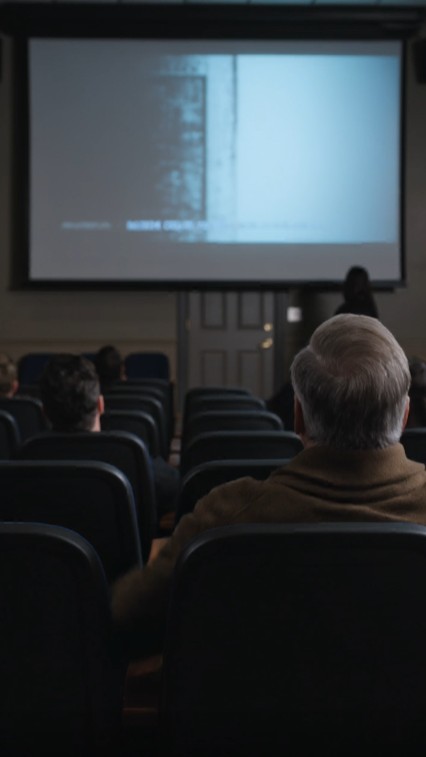
The movie had been playing for only twelve minutes…
When an elderly man suddenly stood up.
He wasn’t leaving.
He was staring at the projection booth.
Then he shouted:
“Stop the film!”
People turned around.
A theater employee hurried toward him.
“Sir, please sit down.”
But the man pointed at the screen.
“Where did you get that?”
The employee looked confused.
“Get what?”
“That sound.”
Nobody understood.
The movie had contained only a few seconds of ordinary background piano.
The manager stopped the film.
The theater went silent.
The elderly man asked:
“Can you play the last ten seconds again?”
They did.
Four quiet piano notes filled the room.
The man grabbed the seat in front of him.
“No…”
The manager asked:
“What’s wrong?”
The old man whispered:
“I’ve heard those notes before.”
“Where?”
He stared at the blank screen.
“In my kitchen.”
“Forty-one years ago.”
Now everyone was listening.
The manager checked the film information.
Then looked back at him.
“Sir… this music wasn’t part of the original movie.”
The man froze.
“What?”
“It was added specifically for tonight’s screening.”
“By who?”
The manager looked toward the projection booth.
The door slowly opened.
A woman in her 50s stepped out.
The elderly man saw her…
And stopped breathing for a second.
She looked directly at him.
Then played those same four notes on a small keyboard.
The man whispered:
“How do you know that melody?”
The woman answered:
“My mother taught it to me.”
The elderly man’s name was Henry Carter.
He was seventy-eight years old.
And the woman standing near the projection booth was someone he’d never seen before.
At least, he was certain he’d never seen her.
“Who is your mother?”
The woman didn’t answer immediately.
Instead, she walked slowly down the aisle.
The small keyboard remained in her hands.
“My mother’s name was Margaret Wilson.”
Henry sat down.
For several seconds, he didn’t move.
Then he whispered:
“Margaret?”
The woman nodded.
“My name is Emily.”
Henry looked at her face again.
This time more carefully.
There was something familiar about her eyes.
Not enough to recognize.
But enough to unsettle him.
The theater manager stepped closer.
“Would you like us to clear the room?”
Henry looked around.
Dozens of people were watching.
He suddenly seemed embarrassed.
“Yes.”
But Emily shook her head.
“No need. We can go outside.”
The manager announced that the screening would resume after a short technical delay.
Henry followed Emily into the lobby.
His hands were trembling.
“Margaret Wilson.”
“Yes.”
“Where is she?”
Emily looked down.
“She died three years ago.”
Henry closed his eyes.
“I’m sorry.”
“Thank you.”
He sat on a bench near the old movie posters.
Emily sat beside him.
For a while, neither spoke.
Then Henry asked:
“Why are you here?”
Emily looked toward the auditorium doors.
“Because she asked me to come.”
Henry frowned.
“You said she died three years ago.”
“She did.”
“Then how could she know I’d be here tonight?”
“She didn’t.”
That answer confused him even more.
Emily opened her handbag.
Inside was a small red notebook.
The cover was worn.
Henry recognized it immediately.
His expression changed.
“Where did you get that?”
“It belonged to Mom.”
“No.”
Henry reached toward it, then stopped himself.
“That was mine.”
Emily handed it to him.
Henry opened the cover.
On the first page were two initials.
H.C.
And underneath:
M.W.
Henry ran his thumb over them.
“I haven’t seen this in forty-one years.”
Emily smiled sadly.
“My mother kept it.”
Henry turned several pages.
Most were filled with music.
Not complete songs.
Fragments.
Three notes.
Six notes.
Small chords.
Ideas written down quickly.
Henry had forgotten many of them.
Then he found the page.
Four notes.
Nothing more.
Henry stared at them.
“That.”
Emily nodded.
“The melody from the film.”
“It isn’t a melody.”
“What is it?”
Henry looked toward her.
“It was supposed to become one.”
Forty-one years earlier, Henry had been thirty-seven.
He wasn’t a musician.
He repaired heating systems for schools and office buildings.
Margaret Wilson lived next door.
She was thirty-four.
She taught elementary school.
They had known each other for years.
Their spouses had known each other too.
Henry was married to Anna.
Margaret was married to Thomas.
The two couples became close friends after moving into neighboring houses.
They had backyard dinners.
Shared tools.
Watched one another’s children.
Henry and Anna had a son, Daniel.
Margaret and Thomas had a daughter.
Emily.
Henry looked at the woman beside him.
“You were a child.”
“Seven.”
“You lived next door?”
“For two years.”
Henry shook his head.
“I don’t remember you.”
“You probably wouldn’t.”
Emily smiled.
“I spent most of my time at my grandmother’s because Mom was helping care for my father.”
Henry’s expression changed.
Thomas had been ill.
Cancer.
It progressed quickly.
During the final months, Margaret spent almost every day moving between work, the hospital and home.
Henry and Anna helped however they could.
One evening, Margaret came into Henry’s kitchen.
She was exhausted.
She sat at the table while Anna made tea.
Henry had recently bought Daniel a small secondhand keyboard.
Nobody in the family could play properly.
Henry liked pressing keys until something sounded pleasant.
That night, while Margaret and Anna talked, Henry pressed four notes.
Margaret looked up.
“Do that again.”
Henry repeated them.
She smiled.
“That sounds like waiting.”
Henry laughed.
“How can four notes sound like waiting?”
“Play them again.”
He did.
Margaret closed her eyes.
“See?”
“No.”
“You’re hopeless.”
Anna laughed from the sink.
Henry wrote the notes in his red notebook.
Then handed it to Margaret.
“Fine. You finish it.”
Margaret looked at the page.
“I don’t write music.”
“Neither do I.”
“Then why do you own a notebook?”
“To look professional.”
For the first time in weeks, Margaret laughed.
She took the notebook home.
Henry expected her to return it the next morning.
She didn’t.
A week later, Thomas’s condition worsened.
Two months after that, he died.
Margaret was devastated.
Henry and Anna tried to help.
But grief changed the neighborhood.
Margaret sold the house less than a year later.
She moved with Emily to another state to be closer to family.
Henry remembered standing beside the moving truck.
Margaret hugged Anna.
Then Henry.
“I still have your notebook.”
“Keep it.”
“I’ll send it back.”
“No rush.”
Then she left.
They exchanged Christmas cards for a few years.
Then addresses changed.
Life moved forward.
Henry never saw Margaret again.
Until tonight, in a way.
Emily pointed toward the notebook.
“Turn to the last page.”
Henry did.
There was an envelope taped inside.
On it:
FOR HENRY CARTER, IF EMILY EVER FINDS HIM
Henry looked up.
“She was looking for me?”
“Not exactly.”
Emily explained.
After Margaret died, Emily began sorting through boxes in her mother’s house.
Most were ordinary.
Tax documents.
School photographs.
Recipes.
Old birthday cards.
Then she found a box marked:
MUSIC / THOMAS / HENRY
Inside was the red notebook.
A cassette tape.
Several letters.
And instructions.
Margaret had written:
Emily, if you ever happen to find Henry Carter, give him this. Don’t turn it into a mission. People are allowed to move on. But if life puts him in front of you, give it back.
Henry read the sentence twice.
“Then how did you find me?”
Emily smiled.
“The movie.”
Henry frowned.
Emily worked as an archivist for a small regional film-preservation organization.
The theater was hosting a restored screening of a forty-five-year-old film.
Emily’s organization had helped prepare the presentation.
The surviving film print had several damaged audio sections.
For the restored screening, organizers had chosen to recreate a few seconds of missing incidental background music.
Nothing important to the story.
Just a small transition.
Emily had been reviewing possible music cues when she remembered her mother’s cassette.
On it, Margaret had played several unfinished melodies.
One contained the four notes.
Emily had always liked them.
So she created a brief piano arrangement based on those notes for the transition.
She had no idea Henry would attend the screening.
“You didn’t put them there for me?”
“No.”
“You didn’t know I was coming?”
“I didn’t even know you lived here.”
Henry looked toward the auditorium.
“Then how did you know who I was?”
“When you stood up and said you’d heard those notes in your kitchen forty-one years ago…”
Emily smiled.
“There weren’t many possibilities.”
Henry laughed softly.
“That’s why you came out.”
“Yes.”
“And the notebook?”
“It was in my bag because I had planned to show the theater manager the original notation after the screening.”
Henry stared at her.
“So this really was an accident.”
“A coincidence.”
“Your mother didn’t arrange it.”
Emily smiled.
“Mom was organized, but not that organized.”
Henry laughed.
The tension finally broke.
Then he remembered the envelope.
He carefully opened it.
Inside was a letter.
Henry recognized Margaret’s handwriting.
Dear Henry,
If you’re reading this, Emily found you somehow.
First, I’m sorry I never returned your ridiculous red notebook.
Henry smiled.
Emily leaned closer.
“What?”
“She called it ridiculous.”
“That sounds like Mom.”
Henry continued.
You probably don’t remember the four notes you played in the kitchen that night.
I do.
You asked me to finish them.
I tried.
Henry turned the page.
Behind the letter was a sheet of handwritten music.
The four notes were at the beginning.
Then came more.
A complete piece.
Henry looked at Emily.
“She finished it.”
“Yes.”
“When?”
“Over many years.”
Margaret had never become a professional musician.
She didn’t publish music.
She didn’t perform publicly.
But she kept a piano in every home she lived in.
Whenever Emily asked about the piece, Margaret called it:
“The kitchen song.”
She changed it repeatedly.
After Thomas died, it became slower.
Years later, it became warmer.
When Emily graduated from college, Margaret added another section.
When her first grandchild was born, she changed the ending.
“She worked on the same song for forty years?”
“Not continuously.”
Emily smiled.
“Sometimes she didn’t touch it for five years.”
Henry continued reading.
You once asked how four notes could sound like waiting.
I think I finally figured it out.
They don’t.
They sound like the moment before something continues.
Henry stopped.
The next sentence was underlined.
I spent too much of my life confusing those two things.
Henry read silently now.
Margaret wrote about Thomas.
About grief.
About raising Emily.
About leaving the neighborhood.
She explained that for years she believed moving away meant abandoning the life she’d had with Thomas.
Eventually she understood that continuing her life didn’t erase him.
She remarried fourteen years after Thomas died.
A man named Robert.
They had twenty-two happy years together before Robert died.
Henry smiled when he read that.
“She remarried.”
Emily nodded.
“Dad would have liked Robert.”
“You believe that?”
“I do.”
Henry continued.
Near the end, Margaret wrote:
I don’t know where you are now.
I hope Anna is beside you.
Henry stopped.
Emily noticed.
“What?”
“Anna died eleven years ago.”
“I’m sorry.”
Henry nodded.
“Forty-six years married.”
Emily smiled.
“Mom would have been happy about that.”
Henry returned to the letter.
If Anna is still with you, tell her I never learned to make tea properly because she spoiled me.
Henry laughed.
Then his eyes filled.
And tell her I never forgot that during the worst year of my life, she never asked me to be cheerful in her kitchen.
Henry wiped his face.
There was one final paragraph.
As for the four notes—you gave them to me when I needed somewhere for my mind to go besides the hospital.
I kept them longer than I kept your notebook.
So I’m giving them back.
Do whatever you want with them.
But if you hear the finished piece someday, don’t call it mine.
It started in your kitchen.
—Margaret
Henry folded the letter.
For several minutes, neither spoke.
Then Emily asked:
“Do you want to hear it?”
“The whole thing?”
“Yes.”
Henry looked toward the auditorium.
“What about the movie?”
Emily laughed.
“There are about ninety people in there wondering why you stopped it.”
Henry covered his face.
“I forgot.”
The theater manager approached.
“Everything okay?”
Henry stood.
“I’m sorry.”
The manager smiled.
“It’s definitely the most interesting technical delay we’ve had.”
Henry insisted the screening continue.
Before returning to his seat, Emily said:
“Stay afterward.”
Henry nodded.
The film resumed.
When the four piano notes played again, Henry didn’t stand.
He closed his eyes.
This time, he smiled.
After the movie ended, most of the audience left.
A few people who had overheard the earlier conversation remained curious, but the manager politely gave Henry and Emily privacy.
They walked toward the front of the auditorium.
A piano sat near the stage.
It was normally used for silent-film events.
Emily sat down.
Henry took a seat in the front row.
“You play?”
“A little.”
“Your mother taught you?”
“She tried.”
Emily smiled.
“I wasn’t patient.”
“That sounds familiar.”
Emily placed Margaret’s sheet music on the piano.
Then she began.
Four notes.
The same four Henry had played absentmindedly in his kitchen forty-one years earlier.
But now they continued.
The next phrase rose gently.
Then returned.
The middle became darker.
Slower.
For a moment, Henry could almost hear the exhaustion Margaret had carried after Thomas died.
Then the music changed again.
It became lighter.
Not happy exactly.
But open.
The final section returned to the original four notes.
This time they didn’t stop.
They resolved into a quiet final chord.
Emily lifted her hands.
Henry remained completely still.
“Well?”
He couldn’t answer.
Emily waited.
Finally Henry whispered:
“She was right.”
“About what?”
“It doesn’t sound like waiting anymore.”
Emily smiled.
“No.”
“It sounds like continuing.”
Emily looked toward the sheet music.
“That’s what she eventually called it.”
Henry frowned.
“The piece has a name?”
Emily turned the page toward him.
At the top, Margaret had written:
CONTINUING
Henry laughed softly.
“Of course.”
For the next hour, Henry and Emily sat in the empty theater.
Henry told her about Margaret as a young teacher.
How she always forgot where she put her keys.
How she hated mushrooms.
How she once painted her entire kitchen yellow and regretted it before the paint dried.
Emily told Henry about the decades he’d missed.
Margaret became a school principal.
She retired at sixty-four.
She traveled.
She became a grandmother twice.
She volunteered at a literacy center.
She still hated mushrooms.
Henry laughed.
Then Emily asked:
“Why did you and Mom lose touch?”
Henry thought about it.
“There wasn’t a fight.”
“No?”
“No.”
“Then what happened?”
“Life.”
He hated how weak the answer sounded.
But it was true.
No betrayal.
No secret argument.
No dramatic misunderstanding.
Margaret moved.
Henry and Anna were raising Daniel.
Work became busier.
Christmas cards became occasional letters.
Letters became birthday messages.
Then one year nobody wrote.
And once enough time passed, reaching out began to feel strangely difficult.
“I always thought I’d do it next year.”
Emily nodded.
“Mom said the same thing.”
That was the sad part.
Neither had chosen to end the friendship.
They had simply allowed time to make the decision for them.
Henry asked:
“Did she ever regret it?”
Emily considered the question.
“She regretted losing touch.”
“That’s not the same thing.”
“No.”
“She didn’t spend forty years miserable about it.”
Henry smiled.
“Good.”
“She had a full life.”
“Good.”
“She just remembered you.”
That mattered more.
The next morning, Henry called his son Daniel.
“You remember Margaret Wilson?”
“The neighbor?”
“Yes.”
“Barely.”
“I found her daughter.”
Daniel paused.
“You what?”
Henry told him the story.
Daniel was silent.
Then:
“Dad, you stopped an entire movie?”
“That isn’t the important part.”
“It is definitely part of the story.”
Henry laughed.
A week later, Emily visited Henry’s house.
He still lived in the same neighborhood.
Not the same house.
The old home had been demolished years earlier.
But Henry had moved only a few streets away.
He showed Emily photographs.
One showed Margaret and Thomas standing beside Henry and Anna at a backyard barbecue.
Emily was in the corner of the picture.
Seven years old.
Holding a red balloon.
“You really were there,” Henry said.
“I told you.”
“I know.”
He handed her the photograph.
“You should have this.”
Emily shook her head.
“It’s yours.”
“I have others.”
She accepted it.
Then Henry brought out an old cardboard box.
Inside was the small keyboard.
The one from the kitchen.
Emily stared.
“No.”
“Yes.”
“That thing still works?”
“Probably not.”
Henry plugged it in.
Nothing happened.
He changed the batteries.
A light appeared.
Emily laughed.
“Forty-one years?”
“Things used to be built properly.”
“That’s exactly what an elderly man would say.”
Henry pressed the four notes.
The sound was thin and electronic.
But unmistakable.
Emily recorded it on her phone.
Later, she placed the recording beside her mother’s piano version.
Original.
Finished.
Four decades apart.
The film-preservation organization eventually asked Emily whether the completed piece could be performed at a future event.
She asked Henry.
He answered:
“It’s Margaret’s music.”
Emily reminded him what Margaret had written.
Don’t call it mine.
It started in your kitchen.
Henry shook his head.
“I pressed four keys.”
“And she spent forty years finishing them.”
“So?”
“So maybe it belongs to the story, not one person.”
Henry liked that.
The following year, the theater hosted another restoration event.
Before the film, Emily performed “Continuing.”
This time, Henry knew it was coming.
He sat in the front row.
Beside him was Daniel.
On Henry’s other side sat Emily.
Before playing, she gave a short introduction.
She didn’t turn it into a dramatic legend.
She told the truth.
Her mother Margaret had once heard a friend play four accidental notes on a small keyboard during a difficult period in her life.
She carried those notes with her.
Over decades, she turned them into a complete piece.
Forty-one years later, a brief arrangement based on those notes happened to be used during a film screening.
By coincidence, the man who had first played them was sitting in the audience.
Henry leaned toward Daniel.
“She left out the part where I yelled.”
Daniel whispered:
“Probably for your dignity.”
“I have plenty.”
“Debatable.”
Henry smiled.
Emily began playing.
Four notes.
Henry closed his eyes.
He pictured the old kitchen.
Anna making tea.
Margaret sitting at the table.
Thomas still alive.
Daniel upstairs.
A seven-year-old Emily somewhere next door or at her grandmother’s house.
Nobody in that kitchen knew what the next forty-one years would bring.
Thomas’s death.
Margaret moving away.
Children growing up.
New marriages.
Grandchildren.
Anna’s death.
Careers.
Retirement.
Loss.
Ordinary days.
Thousands of them.
Henry realized something.
When he’d first heard those notes again at the theater, he’d thought they were pulling him backward.
They weren’t.
They were connecting two moments.
A beginning he’d forgotten…
and an ending Margaret had finished without him.
After the performance, Emily handed Henry the red notebook.
“You should keep it.”
He shook his head.
“Your mother kept it forty-one years.”
“Exactly.”
“So it’s yours.”
Emily thought about it.
Then opened to the page with the original four notes.
“We’ll share it.”
“How?”
She had already arranged something.
The notebook would eventually be preserved with Margaret’s papers at the local historical archive where Emily worked.
Not because Margaret was famous.
She wasn’t.
But the organization maintained a small collection documenting local teachers, musicians and community history.
The notebook could remain connected to the finished composition and its story.
Henry agreed.
Before giving it up, he wrote one final line beneath the four notes.
Emily watched.
“What are you writing?”
Henry turned the notebook around.
Under Margaret’s original notation, he had written:
I finally heard the rest.
Emily’s eyes filled.
She added another line:
So did I.
Henry lived another six years.
He attended every performance of “Continuing” that he could.
Sometimes Emily played it.
Sometimes another pianist did.
The arrangement changed slightly over time.
Henry didn’t mind.
Margaret had spent forty years changing it herself.
After Henry died at eighty-four, Daniel found a small envelope among his father’s belongings.
On the front:
FOR EMILY
Inside was the old photograph of the four adults at the backyard barbecue.
Henry had made another copy.
On the back he wrote:
Your mother was right about the four notes.
They never sounded like waiting.
I just wasn’t old enough to understand what they sounded like.
Below that:
They sounded like something unfinished.
Daniel gave the photograph to Emily.
She placed it beside Margaret’s sheet music.
Years later, when people asked why the piece began with such a simple phrase, Emily told them:
“Because that’s how it actually began.”
Four notes.
Played without much thought.
In an ordinary kitchen.
On an inexpensive keyboard.
During a difficult year.
Nobody planned for those notes to survive.
Nobody planned for Margaret to keep them.
Nobody planned for Emily to use them in a restored film decades later.
And certainly nobody planned for Henry Carter to be sitting in the theater when they played.
That was coincidence.
Nothing supernatural was required.
But coincidence can still matter.
Because when Henry stood up twelve minutes into a movie and shouted:
“Stop the film!”
He thought he had recognized four notes from his past.
He had.
What he didn’t know was that Margaret Wilson had carried those notes through the rest of her life.
She had changed them as her own life changed.
She had finished what Henry had started accidentally.
And she had left the finished piece behind for her daughter.
Forty-one years after Henry first played those notes in his kitchen, he finally heard what came next.
Not from Margaret.
He was three years too late for that.
But from Margaret’s daughter.
And when Emily finished playing, Henry understood why Margaret had changed the title.
The four notes weren’t about waiting for the past to return.
The past doesn’t return.
People leave.
People die.
Families move.
Friends lose touch.
Years pass whether anyone is ready or not.
But sometimes something small survives.
A photograph.
A notebook.
A sentence.
Four notes.
And if someone carries them long enough…
they can become the beginning of something that continues.