
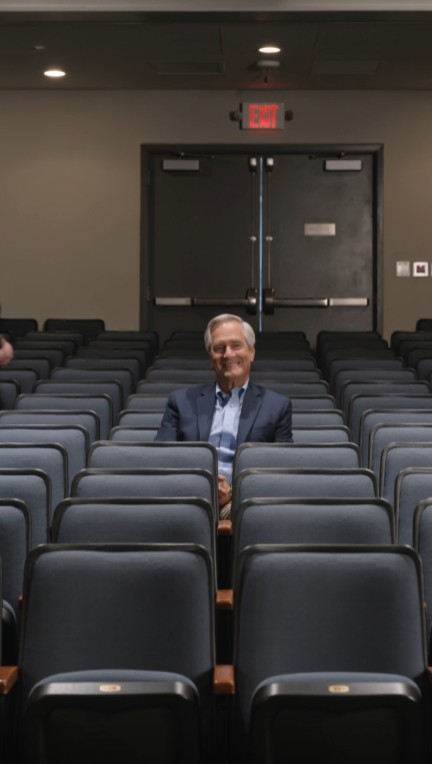
The elderly man bought every seat in the front row.
Twelve seats.
Then he walked into the auditorium…
And sat in the very back.
The usher thought he’d made a mistake.
“Sir, your seats are down front.”
“I know.”
“Then why are you sitting here?”
The man smiled.
“Those seats aren’t for me.”
The performance was about to begin.
Five minutes passed.
The front row remained empty.
The usher became even more confused.
Then the elderly man checked his watch.
“They’re late.”
“Who?”
Before he could answer…
The auditorium doors opened.
A woman in her 40s walked in.
Then another person.
Then another.
Twelve adults.
None of them seemed to know each other at first.
The elderly man stood.
One woman saw him…
And immediately stopped.
“Mr. Carter?”
He smiled.
“You remembered.”
She covered her mouth.
The other eleven people looked toward him.
One by one…
Their expressions changed.
The usher whispered:
“Who are these people?”
The old man answered:
“I taught them.”
The woman shook her head.
“No.”
“You did more than that.”
Then all twelve walked toward the front row.
But one seat remained empty.
The usher counted again.
“Twelve people. Twelve seats.”
The elderly man shook his head.
“There should’ve been thirteen.”
The woman turned around.
“You don’t know?”
His smile disappeared.
“Know what?”
She looked toward the auditorium entrance.
The doors opened again.
Someone stepped inside.
The elderly man saw the person…
And had to grab the seat beside him.
The woman whispered:
“We found the thirteenth.”
His name was Henry Carter.
He was seventy-eight years old.
For thirty-six years, Henry had taught music and drama at Riverside High School.
He wasn’t famous.
He had never performed professionally.
He hadn’t written a Broadway show or trained movie stars.
Most years, his students were ordinary teenagers who took drama because they needed an elective or joined the school play because a friend convinced them.
But the thirteen people Henry remembered most came from his first year teaching.
Henry was twenty-six.
Nervous.
Underpaid.
And completely convinced he knew how to teach.
Within approximately three days, he realized he didn’t.
His first after-school theater group consisted of thirteen students.
Emily Wilson was sixteen and painfully shy.
Daniel Reed could make everyone laugh but couldn’t remember three consecutive lines.
Rachel Miller wanted to design costumes.
Thomas Harris wanted to build sets.
Marcus Walker joined because he was failing another elective and needed something after school.
There were eight others.
And then there was Michael Bennett.
Michael was fifteen.
Quiet.
Always early.
Always carrying the same battered notebook.
Henry remembered the first afternoon Michael entered the auditorium.
“You here for auditions?”
Michael shook his head.
“Then what do you need?”
“Can I just watch?”
Henry should probably have said no.
Instead:
“Sit in the back.”
Michael did.
The following afternoon, he returned.
Then again.
By the end of the week, Henry handed him a script.
Michael stared at it.
“I didn’t audition.”
“Congratulations. You passed.”
“For what?”
“Showing up.”
Michael smiled.
That was how thirteen teenagers became Henry Carter’s first theater group.
The school auditorium was terrible.
Several lights didn’t work.
The curtain jammed.
One section of the stage floor creaked so loudly that Henry eventually incorporated it into rehearsals.
The costume budget was almost nonexistent.
Their first production used furniture borrowed from teachers.
But the students stayed.
Henry taught them acting.
Or at least tried.
He taught them how to project their voices.
How to enter on cue.
How to listen to the person sharing the stage instead of waiting impatiently for their own line.
But there was one rule Henry cared about more than any of that.
Nobody performed to an empty front row.
The rule began accidentally.
At their first performance, ticket sales were terrible.
The front row was almost completely empty.
Henry saw his students looking at those seats before the curtain opened.
They were nervous enough already.
So Henry disappeared into the hallway.
He convinced teachers, custodians and two parents waiting for another school event to come inside.
He put them in the front row.
“Why?” Emily asked afterward.
Henry answered:
“Because when you’re brave enough to stand on a stage, somebody should be close enough to see you.”
The students never forgot it.
Neither did Henry.
By spring, all thirteen had become close.
Then, only days before their final performance, Michael stopped coming to school.
No warning.
No goodbye.
Henry called the number on his emergency contact form.
Disconnected.
He went to the address.
The apartment was empty.
A neighbor said Michael’s family had left.
Henry asked where.
Nobody knew.
The school had little information.
Michael’s mother had been struggling financially.
The family had apparently moved to stay with relatives.
Records were transferred later, but privacy rules and the limitations of the era meant Henry never learned much more.
He wrote a letter to the forwarding address the school had on file.
It came back.
He sent another.
Same result.
Michael disappeared from Henry’s life.
The remaining twelve students performed without him.
On opening night, Henry placed an empty chair at the end of the front row.
Emily asked:
“Who’s that for?”
Henry answered:
“Michael.”
“He’s not coming.”
“I know.”
“Then why leave it?”
Henry looked at the chair.
“Because he was supposed to be here.”
The students understood.
Years passed.
The thirteen became twelve.
Graduation came.
Then college.
Jobs.
Marriages.
Children.
Divorces.
Moves.
Life scattered them.
Henry kept teaching.
Every few years, a former student returned.
Some brought children to school performances.
Some sent Christmas cards.
Some simply approached him in a grocery store and said:
“Mr. Carter?”
Henry usually remembered the face before the name.
But he never forgot that first group.
When Henry retired at sixty-five, several former students attended the celebration.
Emily was there.
Rachel.
Thomas.
Marcus.
But not all twelve.
And never Michael.
By then, Henry had tried searching online.
There were hundreds of Michael Bennetts.
None he could confidently identify as his former student.
Eventually Henry stopped searching.
Not because he’d forgotten.
Because he had no useful trail left to follow.
Then, thirteen years after retirement, Henry learned that Riverside High’s old auditorium was about to close.
A new performing arts center had been built.
The original auditorium would be renovated into classrooms and meeting spaces.
Before construction began, the community planned one final performance.
Former students.
Current students.
Teachers.
Local musicians.
Anyone with a connection to the auditorium could participate.
Henry bought twelve front-row tickets.
The ticket clerk looked at him strangely.
“All twelve?”
“Yes.”
“Large family?”
Henry smiled.
“Something like that.”
He had recently found Emily through a former colleague.
Emily found Rachel.
Rachel found Thomas.
One person found another.
Within weeks, they had located all twelve members of the old group.
They hadn’t been together in forty-two years.
Henry invited them to the final performance.
But he didn’t tell them who else was coming.
He wanted to sit in the back and watch them discover one another.
Just as he’d watched them become friends decades earlier.
There was only one person missing.
Michael.
Henry told Emily about the search.
“I never found him.”
Emily became curious.
“What was his full name?”
“Michael James Bennett.”
“Birthday?”
“I don’t remember.”
“Where did he move?”
“No idea.”
“What did his mother do?”
“Emily, I’ve tried.”
She smiled.
“You taught us not to give up after one bad rehearsal.”
“That was theater.”
“Same principle.”
Henry laughed.
“Do whatever you want.”
Emily did.
She contacted the others.
Together they searched old yearbooks.
School programs.
Archived newspapers.
Publicly available alumni notices.
Thomas remembered that Michael had once mentioned an uncle named Robert who lived near Cleveland.
Rachel remembered something else.
“He drew airplanes.”
Emily frowned.
“What?”
“In his notebook. Airplanes.”
Marcus remembered it too.
“He wanted to be a mechanic.”
Those tiny memories finally produced a lead.
A Michael Bennett with the right approximate age had worked for an aircraft maintenance company in Ohio.
Emily sent a letter to the company’s retirement association.
She expected nothing.
Three weeks later, her phone rang.
“Is this Emily Wilson?”
“Yes.”
“My name is Michael Bennett.”
Emily sat down.
He remembered her.
He remembered all of them.
And he remembered Mr. Carter.
Michael was now seventy-three.
He lived nearly six hundred miles away.
Emily asked the question everyone had wondered about.
“What happened?”
Michael became quiet.
His mother had been evicted from their apartment.
She didn’t tell him until the day they left.
They packed what they could into a borrowed car and drove to her brother’s home in Ohio.
Michael thought they’d return within weeks.
They never did.
His mother was embarrassed.
She didn’t want people in Riverside knowing how bad things had become.
Michael enrolled in another school.
Then his mother became ill.
By the time life stabilized, months had passed.
Michael wrote Henry a letter.
But he mailed it to the school without Henry’s first name.
It was returned because Henry had temporarily been reassigned to another building during renovations.
Michael tried once more.
That letter also came back.
Then he stopped.
“I was sixteen,” Michael told Emily.
“I thought if nobody answered, maybe they didn’t care.”
Emily closed her eyes.
“We cared.”
“I know that now.”
“Mr. Carter looked for you.”
There was silence.
“For how long?”
“Years.”
Michael didn’t answer.
Emily told him about the final performance.
Then she said:
“We have twelve front-row seats.”
Michael laughed softly.
“Then you’re full.”
“No.”
Emily looked at the seating chart.
“We were always supposed to be thirteen.”
Michael hesitated.
“I don’t have a ticket.”
“That’s the easy part.”
But Emily didn’t tell Henry.
Neither did the others.
They wanted Michael’s return to be a surprise.
The night of the performance, Henry arrived early.
He sat in the last row.
The usher reminded him his tickets were in front.
Henry explained.
Then the twelve arrived.
Emily saw him.
“Mr. Carter?”
“You remembered.”
As the group gathered, Henry couldn’t stop smiling.
Faces had changed.
Hair had grayed.
Some walked more slowly.
But every few seconds, he recognized a gesture.
A laugh.
A voice.
Thomas still rubbed his hands together when nervous.
Rachel still tilted her head before asking a difficult question.
Marcus still laughed before reaching the punchline.
For a moment, Henry was twenty-six again.
Then he counted.
Twelve.
The old ache returned.
“There should’ve been thirteen.”
Emily turned.
“You don’t know?”
Henry’s smile disappeared.
“Know what?”
The auditorium doors opened.
A man stepped inside.
He was thin.
White-haired.
He wore glasses.
Henry didn’t recognize him immediately.
Then the man stopped beneath the aisle light.
And smiled.
Henry grabbed the seat beside him.
Not because he felt faint.
Because suddenly his legs didn’t seem trustworthy.
Michael walked down the aisle.
He stopped several feet away.
For a moment, neither spoke.
Then Michael said:
“Sorry I’m late, Mr. Carter.”
Henry stared at him.
Forty-two years disappeared in six words.
“You always were.”
Michael laughed.
Henry covered his face.
Then Michael hugged him.
The entire front row stood.
The usher watched without understanding why several grown adults were crying in an auditorium that hadn’t even started its final performance.
Henry pulled back.
“Where have you been?”
“Ohio.”
“For forty-two years?”
“Mostly.”
“You couldn’t call?”
Michael smiled.
“I didn’t have your number.”
Henry laughed through tears.
“That is a terrible excuse.”
“I know.”
Then Henry noticed something in Michael’s hand.
A battered black notebook.
Henry stared.
“No.”
Michael held it out.
“You remember this?”
Henry took it carefully.
The cover was worn.
The corners were bent.
But he remembered.
Michael’s notebook.
The one he’d carried every afternoon.
Henry opened it.
Inside were sketches.
Airplanes.
Stage designs.
Notes.
Then he found a page dated 1984.
At the top, Michael had written:
THINGS MR. CARTER SAYS TOO MUCH
Henry started laughing.
Emily leaned over.
“Read it.”
Henry did.
Speak louder.
Stop stepping on each other’s lines.
Daniel, that is not the script.
Daniel shouted from the front row:
“I stand by my choices.”
Everyone laughed.
Henry continued.
Then he reached the final line.
Nobody performs to an empty front row.
Henry stopped.
Michael looked toward the twelve seats.
“I remembered.”
Henry closed the notebook.
“Why didn’t you come to my retirement?”
“I didn’t know about it.”
“Why didn’t you find me online?”
Michael smiled.
“Why didn’t you find me?”
Henry opened his mouth.
Then closed it.
“Fair.”
Michael had built a life in Ohio.
He became an aircraft mechanic, just as Rachel vaguely remembered.
He married.
Had two daughters.
Lost his wife five years earlier.
He rarely thought about high school consciously.
But he kept the notebook.
Through every move.
Every house.
Every job.
His daughters had tried to convince him to throw away old boxes.
The notebook always survived.
Emily asked:
“Did you ever do theater again?”
Michael shook his head.
“Never.”
Henry looked disappointed.
Michael smiled.
“But I did something else.”
“What?”
For twenty-seven years, Michael had volunteered with a youth aviation program.
Teenagers learned basic mechanics, engineering and maintenance skills.
Some were from families that couldn’t afford specialized programs.
Some struggled in school.
Some simply needed somewhere useful to be after classes.
Henry listened.
Michael continued.
“The first year I volunteered, there were eight kids.”
“What does that have to do with theater?”
“Nothing.”
“Then why are you looking at me like that?”
Michael smiled.
“Because the first day, they were standing around waiting for somebody to tell them whether they belonged there.”
Henry went quiet.
“So I gave them jobs.”
Michael pointed toward him.
“Because that’s what you did with me.”
Henry looked confused.
“I gave you a script.”
“You gave me a reason to come back the next afternoon.”
That was what Michael remembered.
Not acting lessons.
Not applause.
Not the school production.
He remembered being fifteen, uncertain and embarrassed by what was happening at home.
He remembered walking into an auditorium because it was warm and he didn’t want to go back to the apartment yet.
Henry could have asked him to leave.
Instead, he said:
“Sit in the back.”
The next day:
“Show up again.”
Then:
“Take this script.”
Michael looked at Henry.
“You thought you were teaching theater.”
“I was.”
“You were.”
Michael smiled.
“But sometimes you were teaching something else without knowing it.”
The lights dimmed.
The performance was about to begin.
An usher approached Emily.
“We need everyone seated.”
Henry looked toward the front row.
Twelve seats.
Thirteen former students.
Emily had anticipated the problem.
She produced another ticket.
Row two.
Seat one.
Michael laughed.
“So I’m still not in the front row?”
Emily shook her head.
“No.”
She took Henry’s front-row ticket.
“You are.”
Henry frowned.
“I bought those for you.”
Rachel stood.
“You’re coming down front.”
“No.”
“Mr. Carter.”
“I want to watch from here.”
Thomas smiled.
“Remember what you used to say?”
Henry knew immediately.
Nobody performs to an empty front row.
“But it isn’t empty.”
“There’s one seat.”
Henry looked.
The twelfth seat.
He’d bought twelve because he believed only twelve students could be found.
Now Michael was there.
The group rearranged themselves.
Eleven former students took the remaining front-row seats.
Michael sat in row two.
Henry took the last seat in front.
He protested the entire way.
Nobody listened.
The final performance began.
Current Riverside students performed first.
Then former students.
A choir sang.
A retired band director conducted one last piece.
Old photographs appeared on a screen.
Then came a photograph Henry hadn’t seen in decades.
Thirteen teenagers on the Riverside stage.
Henry stood behind them.
Twenty-six years old.
Too much hair.
Terrible tie.
Thirteen students.
Including Michael.
Henry stared at the screen.
“Where did you find that?”
Emily whispered:
“Yearbook archive.”
Michael sat behind him.
“I look ridiculous.”
Henry turned.
“You still do.”
Michael laughed.
Near the end of the program, the host invited former teachers to stand.
Henry refused.
The twelve students around him stood instead.
Then Michael stood behind them.
The audience applauded.
Henry looked up at the thirteen adults surrounding him.
He understood what they were doing.
“Sit down.”
Nobody did.
Emily leaned toward him.
“You made us stand on that stage.”
Henry shook his head.
“You did that yourselves.”
“That sounds familiar.”
Henry frowned.
“What?”
“You always said the work belonged to us.”
“It did.”
“And the opportunity?”
Henry didn’t answer.
Emily smiled.
“That part belonged to you.”
After the performance, the group remained in the auditorium.
Nobody wanted to leave.
They walked onto the stage.
Thomas found the exact section of floor that used to creak.
It had been repaired decades earlier.
Daniel tried to remember one of his old lines.
He got it wrong.
Everyone agreed some things never changed.
Then Michael walked to the back row.
Henry followed.
“This where you sat that first day?” Henry asked.
“Approximately.”
“You remember?”
“I remember thinking you were going to throw me out.”
“I considered it.”
“You did not.”
“I was a new teacher. I considered throwing everyone out.”
Michael laughed.
Then he became serious.
“I thought you forgot me.”
Henry turned.
“Never.”
“I know.”
“No. Michael.”
Henry looked directly at him.
“I didn’t forget you.”
Michael nodded.
“I believe you.”
Henry sat beside him.
For several minutes, they watched the others onstage.
Then Michael asked:
“Why did you leave a chair for me at that last performance?”
Henry stared.
“How do you know about that?”
“Emily told me.”
Henry shrugged.
“You were part of the group.”
“I was gone.”
“That’s not the same thing.”
Michael looked toward the stage.
For forty-two years, he’d remembered himself as the kid who disappeared.
Henry had remembered him as the student who was missing.
There was a difference.
One suggested he’d been erased.
The other meant someone noticed the empty place.
Michael wiped his eyes.
“You know what the worst part was?”
“What?”
“When we left Riverside, I thought nobody at school would notice.”
Henry’s voice softened.
“We noticed.”
“I know that now.”
That night, the thirteen former students exchanged phone numbers.
They created a group chat.
Henry objected immediately.
“I don’t want whatever this is.”
Emily ignored him.
Daniel named it:
THE FRONT ROW
Within twenty-four hours, Henry had sent eleven messages.
Most were complaints about everyone sending too many messages.
Michael became one of the most active members.
The group began meeting once a year.
Not everyone could attend every time.
Health problems happened.
Family responsibilities intervened.
Distance mattered.
But they tried.
Henry insisted there would be no empty-chair tradition.
“If somebody can’t come, they can’t come.”
Emily smiled.
“You’re the one who started the empty chair.”
“I was twenty-six. I made mistakes.”
Michael replied:
“You were twenty-six?”
Henry looked offended.
“What did you think?”
“Forty.”
The table erupted.
Three years after the auditorium closed, Henry visited Michael in Ohio.
Michael took him to the youth aviation workshop where he’d volunteered for decades.
Teenagers were working around an old training aircraft.
One boy stood off to the side.
New.
Uncertain.
Watching everyone else.
Michael noticed him.
Henry noticed Michael noticing him.
Michael walked over.
“You here for the program?”
The boy shrugged.
“My mom signed me up.”
“Know anything about airplanes?”
“No.”
“Good.”
The boy frowned.
“Good?”
“Means we can’t blame you when something breaks.”
The boy laughed.
Michael handed him a small tool kit.
“Come on.”
Henry watched from across the room.
Michael looked back.
For a second, neither man said anything.
Then Michael smiled.
Henry understood.
Show up.
Here’s something to do.
Come back tomorrow.
The lesson had traveled farther than Henry ever knew.
Henry died six years after the reunion.
He was eighty-four.
All thirteen former students were notified.
Twelve attended the memorial in person.
Michael couldn’t.
He had undergone surgery two days earlier.
But before the service began, Emily received a package.
Inside was Michael’s old black notebook.
There was a letter for Henry’s family.
And one request.
“Put this on his chair.”
At the memorial, the family had reserved a front row for Henry’s former students.
Thirteen seats.
Michael’s remained empty.
On it sat the notebook.
After the service, Henry’s daughter opened it.
Michael had added one final page.
THINGS MR. CARTER SAID THAT TOOK ME FORTY YEARS TO UNDERSTAND
Below it:
Show up.
Listen to the person beside you.
Your mistake is not the end of the scene.
If you miss your entrance, come in when you can.
And finally:
Nobody performs to an empty front row.
Underneath, Michael had added:
You kept my seat longer than I knew. Thank you.
Years later, the original Riverside auditorium was gone.
The space had been rebuilt.
The old seats were removed.
But thirteen of them were saved.
The former students worked with the school to place them in a small rehearsal room in the new performing arts center.
Not as a grand memorial.
Just one row of thirteen old seats.
A small plaque beside them read:
THE FIRST GROUP — 1984
All thirteen student names were listed.
Michael Bennett included.
At the bottom was Henry Carter’s name.
New students occasionally asked why thirteen worn auditorium seats had been preserved when the rest had been discarded.
The drama teacher would tell them the short version.
A young teacher once gathered thirteen teenagers in a broken auditorium.
One disappeared before their final performance.
Forty-two years later, the teacher bought twelve front-row seats for the students he could still find.
Then he sat alone in the back.
He expected twelve people.
All twelve arrived.
But one seat remained empty.
Henry thought he knew why.
The thirteenth student had disappeared decades earlier.
No address.
No goodbye.
No contact.
Henry had searched and failed to find him.
Then the auditorium doors opened one final time.
An elderly man stepped inside carrying the same battered notebook he’d carried as a fifteen-year-old boy.
Henry looked at him.
Michael smiled.
And after forty-two years, he delivered the line he’d missed all those years before:
“Sorry I’m late, Mr. Carter.”
This time…
his seat was still waiting.