
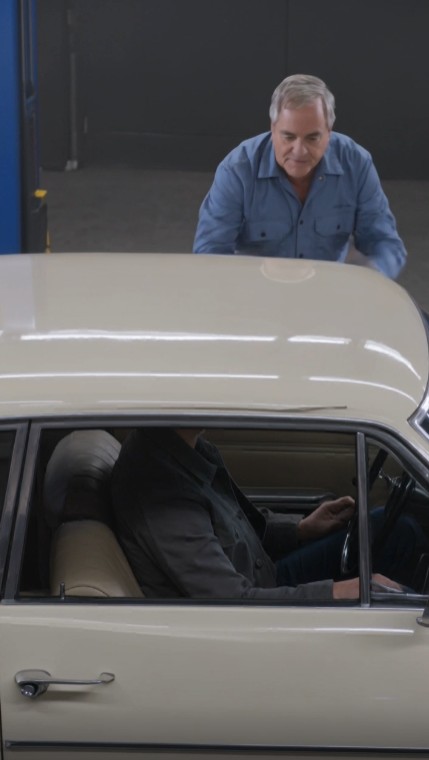
The customer started his old car.
The mechanic immediately yelled:
“Turn it off!”
The customer panicked.
“What’s wrong?”
The mechanic walked closer.
“Start it again.”
“You just told me to turn it off.”
“Please.”
The customer restarted it.
The engine made a strange little rhythm.
Three soft pulses…
A pause…
Then two more.
The mechanic went completely still.
“Where did you get this car?”
“My father left it to me.”
“What’s your father’s name?”
“Daniel Carter.”
The mechanic dropped the cloth in his hand.
“No way.”
“What?”
He opened the hood.
Looked at one harmless old repair marking…
Then closed it again.
“I worked on this car.”
The customer laughed.
“It’s thirty years old. Lots of mechanics probably did.”
The mechanic shook his head.
“No.”
“I worked on it once.”
“Twenty-seven years ago.”
The customer stared at him.
Then the mechanic asked:
“Did your father ever tell you why he stopped driving it?”
“No.”
The mechanic stepped backward.
“He told me never to repair one thing.”
The customer looked worried.
“Was it dangerous?”
“No.”
“Then why?”
The mechanic looked through the windshield…
Then toward the empty passenger seat.
His eyes filled with tears.
“Because he wanted it to keep making that sound.”
The customer frowned.
“Why would anyone want a broken car?”
The mechanic shook his head.
“It isn’t broken.”
His name was Michael Wilson.
He was sixty-eight years old and had spent nearly fifty years repairing cars.
The customer standing in front of him was Marcus Carter.
Forty-one.
And until three weeks earlier, Marcus hadn’t even known his father still owned the old blue sedan.
Daniel Carter had died at seventy-four after a short illness.
Marcus had been going through his father’s garage when he discovered the car beneath a gray cover.
It hadn’t been registered in years.
Dust covered the windshield.
The tires were nearly flat.
But inside, everything looked strangely preserved.
A pair of sunglasses in the console.
An old road map in the glove compartment.
Three coins in the ashtray.
And tied around the passenger-side sun visor…
a faded yellow ribbon.
Marcus didn’t understand any of it.
He’d seen photographs of the car when he was a child, but he barely remembered riding in it.
His father had bought newer cars over the years.
Yet he’d never sold this one.
Marcus found the key hanging inside a small cabinet.
Beside it was a handwritten note:
For Marcus.
Nothing else.
No explanation.
Marcus had the car transported to a garage and asked whether it could be made roadworthy again.
That’s how he ended up standing in front of Michael Wilson.
And that’s how Michael heard the sound.
Three pulses.
Pause.
Two pulses.
Marcus crossed his arms.
“So what’s making it?”
Michael hesitated.
“It’s easier if I show you something.”
He opened the driver’s door.
Then leaned inside and looked beneath the dashboard.
He found what he wanted almost immediately.
A tiny faded mark.
Barely visible.
Two letters scratched into an old metal bracket.
MW
Marcus looked at him.
“Your initials?”
Michael nodded.
“I put those there.”
“When?”
“1999.”
Marcus calculated.
“Twenty-seven years ago.”
“Exactly.”
Michael slowly stood.
“Your father came into the shop on a Tuesday afternoon.”
“You remember the day after twenty-seven years?”
“I remember him.”
“Why?”
Michael looked toward the passenger seat again.
“Because he asked me to fix the car.”
He paused.
“Then begged me to put it back the way it was.”
Marcus frowned.
“That makes no sense.”
“It didn’t to me either.”
Back then, Michael was forty-one.
The garage belonged to his older brother, Henry.
Michael had been working there for almost fifteen years.
Daniel arrived driving the same blue sedan.
He said the car had developed an unusual vibration at idle.
Michael inspected it.
Nothing immediately dangerous was happening, but there was a minor issue that made the idle feel uneven in a distinctive repeating pattern.
Michael corrected it.
The car ran smoothly.
Exactly as it was supposed to.
Daniel paid.
He left.
Twenty minutes later…
he came back.
Michael remembered Daniel walking through the garage door almost breathless.
“What happened?”
Michael asked.
Daniel pointed toward the car.
“You fixed it.”
Michael laughed.
“That was the general idea.”
“No.”
Daniel shook his head.
“I need you to undo it.”
Michael thought he’d misheard.
“You want the car to run badly?”
“I want that sound back.”
“Why?”
Daniel didn’t answer.
Michael refused at first.
“If there’s a mechanical problem, I’m not deliberately giving you the car back in an unsafe condition.”
Daniel shook his head.
“I’m not asking you to make it unsafe.”
“Then what are you asking?”
Daniel stood silently for several seconds.
Then he opened the passenger door.
On the seat was a photograph.
A woman.
Dark hair.
Wide smile.
Yellow scarf.
Michael picked it up.
“My wife,” Daniel said.
Her name was Rachel.
She had died four months earlier.
Thirty-eight years old.
Marcus’s expression changed.
“My mother.”
Michael nodded.
“You were fourteen.”
Marcus looked toward the old passenger seat.
He remembered very little about the months immediately after his mother’s death.
Mostly fragments.
Relatives filling the house.
Food arriving from neighbors.
His father trying to act normal.
Adults speaking quietly whenever Marcus entered a room.
And an empty chair at the kitchen table.
“What did Mom have to do with the car?”
Michael took a breath.
“Everything.”
Daniel and Rachel had bought the car used when Marcus was six.
They couldn’t afford much.
Daniel worked construction.
Rachel worked at a pharmacy.
The car wasn’t special.
It was transportation.
But Rachel loved driving.
She sang badly with the radio.
She kept candy in the glove compartment.
She complained whenever Daniel left the fuel tank below half.
And she had one strange habit.
Whenever they stopped at a red light and the car settled into its slightly uneven idle, Rachel would tap her fingers against the passenger door.
Three taps.
Pause.
Two taps.
At first, Daniel thought she was following the engine.
Then one evening he asked:
“Why do you always do that?”
Rachel smiled.
“Do what?”
“That.”
Three taps.
Pause.
Two.
She laughed.
“The car does it first.”
“So?”
“So I’m answering.”
Daniel stared at her.
“Answering what?”
Rachel made up an explanation on the spot.
Three pulses meant:
I love you.
Two meant:
Me too.
Daniel told her that made absolutely no sense.
“I love you is three words.”
“Exactly.”
“And me too is two.”
“Exactly.”
“The car isn’t saying I love you.”
“You don’t know that.”
“Rachel.”
“Daniel.”
From then on, it became a joke.
Every time the car made its little rhythm at a stop…
Three pulses.
Pause.
Two.
Rachel would tap back.
Sometimes Daniel joined her.
Sometimes Marcus did too.
Marcus suddenly interrupted.
“Wait.”
Michael stopped.
Marcus looked toward the dashboard.
“I remember that.”
Michael said nothing.
Marcus closed his eyes.
A memory he’d probably not thought about in thirty years came back.
He was sitting in the rear seat.
His mother was in front.
The car stopped.
Three pulses.
His mother tapped the door twice.
Then turned around and looked at Marcus.
“Your turn.”
Marcus tapped three times.
Rachel answered with two.
Marcus opened his eyes.
“Oh my God.”
Michael nodded.
“That was the sound.”
Marcus walked toward the passenger side.
The faded yellow ribbon tied around the visor suddenly made sense.
“My mother’s scarf?”
“Part of it, I think.”
Marcus touched it.
After Rachel died, Daniel stopped driving the car for several weeks.
Then one morning, he had to move it.
He turned the key.
The engine started.
Three pulses.
Pause.
Two.
Daniel sat there alone.
For the first time, nobody tapped back.
Michael’s voice became quieter.
“Your father told me he sat in the driveway for almost an hour.”
Marcus looked down.
Eventually Daniel started using the car again.
The sound remained.
He never considered it anything supernatural.
He knew it was mechanical.
He knew Rachel hadn’t somehow remained inside an engine.
But grief doesn’t always attach itself to important things.
Sometimes it attaches itself to ridiculous things.
A coffee cup.
A grocery list.
A jacket.
A voicemail.
Or the uneven idle of an old car.
The sound reminded Daniel of Rachel tapping the passenger door.
Three.
Pause.
Two.
For months, Daniel never had it checked.
Then one afternoon, a friend heard it.
“You should get that looked at.”
Daniel became concerned.
He had a fourteen-year-old son.
Sentiment didn’t matter if the car wasn’t safe.
So he brought it to Michael’s garage.
Michael found the minor problem.
Corrected it.
And Daniel drove away.
The car was smoother.
Quieter.
Better.
Daniel hated it.
At the first red light, he waited.
Nothing.
No three pulses.
No pause.
No two.
Just a normal idle.
He drove around the block.
Still nothing.
Then he returned to the garage.
“I need you to undo it.”
Michael initially thought grief was making Daniel irrational.
Maybe it was, a little.
But Daniel wasn’t asking Michael to ignore a dangerous defect.
He asked whether there was a safe way to preserve the characteristic feel and sound he remembered.
Michael inspected everything again.
He explained what could and couldn’t responsibly be left alone.
Then he found a harmless adjustment that allowed the old car to retain a faint version of its familiar rhythm without deliberately leaving a safety-critical fault unresolved.
Michael warned Daniel:
“If anything changes, you bring it back.”
Daniel agreed.
Before leaving, he asked:
“Will it stay like this?”
“For a while.”
“Forever?”
Michael laughed.
“Nothing on a car lasts forever.”
Daniel looked toward the passenger seat.
“I know.”
Michael regretted the words immediately.
Daniel didn’t become angry.
He simply nodded.
Then he told Michael the story of Rachel’s tapping.
Three.
Pause.
Two.
Michael thought it was one of the strangest things a customer had ever told him.
Before Daniel drove away, Michael scratched his initials beneath the dashboard near the work he’d done.
Not because he normally signed repairs.
Because Daniel said:
“If another mechanic gets under there someday, I want somebody to know this wasn’t forgotten.”
Michael laughed.
“That’s not how mechanics communicate.”
“Do it anyway.”
So Michael did.
MW
Marcus stared at those initials twenty-seven years later.
“Dad never told me any of this.”
Michael smiled sadly.
“Maybe he thought you remembered.”
“I didn’t.”
“Now you do.”
Marcus sat in the driver’s seat.
Michael remained outside.
“Start it.”
Marcus turned the key.
The old engine came alive.
Then:
Three soft pulses.
A pause.
Two more.
Marcus gripped the steering wheel.
Suddenly he wasn’t forty-one.
He was eight years old in the back seat.
His mother was laughing.
His father was pretending to be annoyed.
Rachel tapped the passenger door.
Three times.
Daniel answered twice.
Marcus whispered:
“I remember.”
Michael stepped away to give him privacy.
Marcus stayed inside the car for several minutes.
Then he noticed something on the passenger-side door.
A faint scratch.
Three tiny vertical marks.
A space.
Two more.
He ran his finger over them.
“Michael?”
The mechanic leaned in.
“Did you make these?”
Michael looked.
“No.”
Marcus photographed them.
That evening, he showed the picture to his aunt Emily, Rachel’s younger sister.
She immediately laughed.
“Your mother.”
“You recognize this?”
“Of course.”
Emily explained that Rachel used to draw the same pattern everywhere.
Birthday cards.
Lunch notes.
Letters to Daniel.
Three lines.
Then two.
It became their private shorthand.
Three:
I love you.
Two:
Me too.
Marcus sat quietly.
“Why did nobody ever tell me?”
Emily looked surprised.
“We thought you knew.”
Apparently, Marcus had participated in the game constantly as a child.
But after Rachel died, nobody continued it with him.
Daniel stopped using the car regularly.
Life moved forward.
And childhood memories blurred.
Emily opened an old box.
Inside were photographs and letters Rachel had written.
On the back of one family photograph were five little marks.
Three.
Space.
Two.
Marcus laughed.
“There it is.”
Emily nodded.
“Your parents did that for years.”
Then she found another photograph.
Daniel stood beside the blue car.
Rachel was sitting on the hood.
Marcus, about nine, stood between them.
On the back Rachel had written:
Our unreliable fourth family member.
Marcus smiled.
“The car?”
“The car.”
“She hated it?”
“Constantly.”
“But she did the tapping thing.”
“That doesn’t mean she liked the car.”
Emily laughed.
“She threatened to push it into the river at least once a month.”
That made Marcus laugh harder.
The story became even better once he realized nobody had treated the car as sacred while Rachel was alive.
It was simply an old car.
The meaning came later.
Marcus returned to Michael’s garage the following morning.
Michael was surprised.
“Problem?”
“No.”
Marcus handed him a photograph.
The old family picture.
Michael looked at it.
“That’s her.”
“You remember Mom?”
“Only from the picture your father showed me.”
Marcus pointed toward Daniel.
“He looks young.”
“We all did once.”
Then Marcus asked:
“Why did Dad stop driving the car?”
Michael’s expression changed.
“I don’t know.”
“You asked me yesterday if he’d ever told me.”
“Yes.”
“So you know something.”
Michael leaned against his workbench.
Daniel had returned to the garage one more time.
Not in 1999.
In 2012.
Thirteen years later.
By then, the car was already old.
Daniel had maintained it carefully.
But age was catching up with it.
Michael had moved to another garage.
Daniel somehow found him.
“He came here?”
“Yes.”
“What did he want?”
“To ask whether he should keep driving it.”
Michael inspected the vehicle.
It needed significant work.
Nothing impossible.
But Daniel had a newer car.
There was no practical reason to keep putting money into the old sedan.
Michael told him:
“If you’re asking me financially, stop.”
Daniel nodded.
Then asked:
“If I park it, will the sound still be there someday?”
Michael laughed.
“I can’t promise that.”
Daniel looked disappointed.
Michael asked:
“Why does it still matter?”
By then Rachel had been gone seventeen years.
Daniel had rebuilt his life.
He had friends.
A career.
A grown son.
He wasn’t trapped in grief.
He didn’t sit in the garage listening to an engine every night.
But once or twice a year, he’d take the old car out.
He’d reach a red light.
The rhythm would begin.
Three.
Pause.
Two.
And for a few seconds, he remembered the ordinary part of marriage.
Not the hospital.
Not the funeral.
Not losing Rachel.
Just Rachel alive.
Tapping on the door.
Complaining about his driving.
Laughing because Daniel insisted engines couldn’t talk.
Daniel told Michael:
“Most photographs remind me that she’s gone.”
“This reminds me she was here.”
Michael never forgot that sentence.
He advised Daniel to preserve the car rather than continue using it regularly.
Daniel followed the advice.
The sedan went into the garage.
He started it periodically and maintained it.
But he rarely drove it again.
Marcus swallowed.
“So Dad kept a thirty-year-old car because of five little pulses.”
Michael shook his head.
“No.”
Marcus looked at him.
“He kept it because of what happened between the pulses.”
“What do you mean?”
Michael tapped the workbench.
Three times.
Then waited.
For one second, nothing happened.
Then Michael tapped twice.
“The answer.”
Marcus understood.
The car’s rhythm had become the beginning of a tiny ritual.
The meaningful part wasn’t the engine.
It was that somebody always answered.
Marcus looked toward the empty passenger seat.
For twenty-seven years, Daniel had protected that sound because it gave him a doorway into an ordinary memory.
And ordinary memories become precious when there can never be another ordinary day with the person who created them.
Marcus asked Michael:
“What do I do with the car?”
Michael laughed.
“You’re asking a mechanic?”
“Yes.”
“Then I’m going to give you boring mechanic advice.”
“Go ahead.”
“We inspect everything.”
Marcus smiled.
“And the sound?”
“If preserving it is safe and practical, we’ll preserve it.”
“And if it isn’t?”
“Then we don’t.”
Marcus looked surprised.
Michael continued.
“Your father wasn’t protecting a mechanical defect at the expense of safety. Don’t turn the story into that.”
Marcus nodded.
“If something needs repairing, we repair it.”
“Exactly.”
“And if the sound disappears?”
Michael pointed toward Marcus’s head.
“You already got the important part back.”
That was what they did.
The old car received a thorough inspection.
Several components needed replacement.
Brakes.
Rubber hoses.
Tires.
Fluids.
A few electrical repairs.
Michael refused to compromise on any of them.
Marcus agreed.
When the work was finished, they started the engine.
For several seconds…
normal idle.
Marcus looked disappointed.
Then:
Three faint pulses.
Pause.
Two.
Michael smiled.
“Still there.”
Marcus laughed.
“You look happier than I do.”
“I haven’t heard that thing in twenty-seven years.”
Marcus sat behind the wheel.
Then did something he hadn’t done since childhood.
Three pulses came from the engine.
Marcus tapped the steering wheel twice.
Michael watched.
“That’s backwards.”
“What?”
“You’re supposed to answer three with two.”
“I did.”
“No, the engine already did three and two.”
Marcus laughed.
“Now you’re arguing about the grammar of a car.”
“Your father started it.”
Marcus drove the sedan home that afternoon.
Not fast.
Not far.
He stopped at the first red light.
Three pulses.
Pause.
Two.
The passenger seat was empty.
Marcus looked at it.
Then tapped twice against the door.
He felt foolish.
He also smiled.
Over the next several months, Marcus learned more about his parents than he had expected.
The car became a reason to ask questions.
His aunt found old photographs.
His father’s friend Thomas remembered road trips.
A former neighbor remembered Rachel washing the car while Marcus sprayed everyone with the hose.
Marcus found an old cassette in a storage box labeled:
RACHEL’S CAR MUSIC — DO NOT TOUCH
He had it digitized.
The songs were terrible.
At least Marcus thought so.
Emily strongly disagreed.
“Your mother had excellent taste.”
“She has three versions of the same song.”
“Exactly.”
Michael became part of the story too.
Marcus occasionally stopped at the garage.
Sometimes with the car.
Sometimes just coffee.
One afternoon Marcus asked:
“Did Dad ever tell you what the five pulses meant when he came back in 2012?”
Michael nodded.
“Three words. Two words.”
“Did you think it was strange?”
“Absolutely.”
Marcus laughed.
“But I’ve repaired cars for almost fifty years.”
Michael looked around his garage.
“People keep strange things.”
“What do you mean?”
“One customer kept a dent because his daughter made it learning to drive.”
“Seriously?”
“Another refused to replace a cracked radio knob because his wife had glued it twenty years earlier.”
Michael shrugged.
“Machines collect stories because people spend their lives around them.”
Then he pointed at Marcus’s sedan.
“That doesn’t make the machine magical.”
“It makes the people important.”
Marcus liked that explanation.
A year later, Marcus’s daughter Lily turned sixteen.
She’d heard the story of the blue car.
But Marcus had never let her drive it.
On her birthday, he brought her to an empty parking area.
Lily stared at him.
“No way.”
“Don’t get excited.”
“You’re letting me drive Grandma’s car?”
“For approximately six minutes.”
“Dad.”
“Seven if you don’t hit anything.”
She climbed behind the wheel.
Marcus sat in the passenger seat.
That felt strange.
For most of his childhood, Rachel had occupied that seat.
Now he did.
Lily started the engine.
Three pulses.
Pause.
Two.
She looked at him.
“That’s it?”
Marcus laughed.
“What were you expecting?”
“I don’t know. Louder.”
“Nope.”
“So Grandma really used to answer it?”
“Every time.”
Lily waited.
The rhythm repeated.
Then she tapped the steering wheel.
Three.
Pause.
Two.
Marcus corrected her.
“No. The car says three.”
“And?”
“You answer two.”
Lily stared at him.
“That is incredibly cheesy.”
“Your grandmother invented it.”
“Still cheesy.”
“She would’ve liked you.”
Lily smiled.
“I know.”
They drove slowly around the lot.
Before getting out, Lily looked at the faded yellow ribbon.
“Was this hers?”
“Yeah.”
“You going to leave it?”
Marcus nodded.
“As long as it lasts.”
Years passed.
The car wasn’t driven often.
Marcus never pretended it should remain unchanged forever.
Parts wore out.
Repairs happened.
The rhythm became less distinct.
Eventually, after another major service, it disappeared completely.
Marcus started the engine.
Smooth.
No pulses.
Michael was standing nearby.
By then he was in his seventies and working only a few days a week.
Marcus waited.
Nothing.
Michael asked:
“You okay?”
Marcus nodded.
“Yeah.”
“Want me to see if I can recreate it?”
Marcus thought for a moment.
Then shook his head.
“No.”
Michael smiled.
“Good.”
Marcus looked at him.
“Why good?”
“Because now you understand.”
“Understand what?”
“It was never the sound you needed to save.”
Marcus looked toward the passenger seat.
The yellow ribbon was still there.
He remembered his mother tapping the door.
His father laughing.
His aunt showing him the photographs.
Lily calling the entire tradition cheesy.
He remembered everything.
“No,” Marcus said.
“I guess it wasn’t.”
Michael retired the following year.
On his last day, Marcus visited the garage.
He brought a small framed photograph.
Michael opened it.
It showed Daniel and Rachel standing beside the blue sedan.
On the bottom of the frame Marcus had added five tiny marks.
Three.
Space.
Two.
Michael laughed.
“You’re becoming sentimental.”
“Your fault.”
“Absolutely not.”
Marcus turned to leave.
Then Michael called:
“Hey.”
Marcus looked back.
Michael tapped the counter three times.
Marcus smiled.
Then tapped twice.
Neither needed to explain it.
The old car eventually went to Lily.
Not as her daily vehicle.
By then it belonged more comfortably in a garage than on busy roads.
But she kept it.
Inside the glove compartment she placed a card explaining the story.
Not because she believed the engine had carried a message.
It hadn’t.
Not because Daniel had refused to repair something dangerous.
He hadn’t.
The truth was simpler.
Twenty-seven years earlier, a grieving widower drove into a repair shop because an old car wasn’t running smoothly.
A mechanic corrected the problem.
The widower drove away.
Then returned twenty minutes later and asked whether there was a safe way to preserve one harmless part of the old car’s familiar rhythm.
The mechanic thought the request was ridiculous.
Until Daniel explained.
For years, whenever Rachel heard that rhythm, she tapped back.
Three.
Pause.
Two.
I love you.
Me too.
After she died, Daniel couldn’t hear the sound without remembering her hand against the passenger door.
So he preserved it.
Not forever.
Nothing lasts forever.
But long enough.
Long enough for his son to inherit the car.
Long enough for an elderly mechanic to hear five faint pulses and recognize a repair he’d made twenty-seven years earlier.
Long enough for Marcus to remember something he didn’t know he’d forgotten.
And when Michael finally explained why Daniel had protected that strange little rhythm for all those years, Marcus stopped hearing a poorly running old car.
He heard a red light from his childhood.
His mother laughing in the passenger seat.
Three soft pulses.
A pause.
Two more.
And someone he loved…
always answering.