
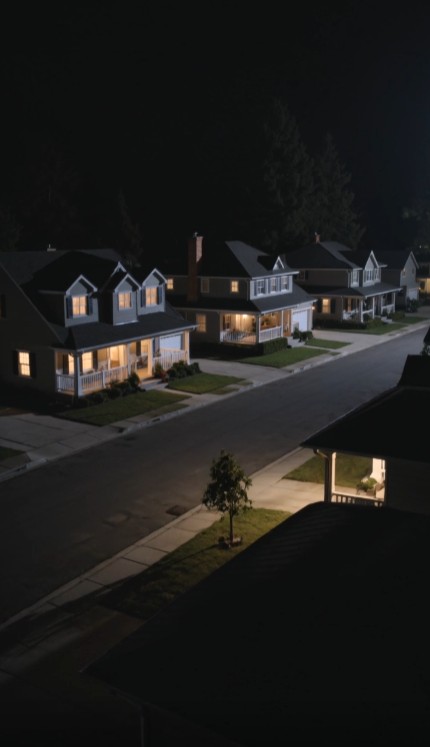
At exactly 9:00 PM…
An entire neighborhood went dark.
Not because of a power outage.
One by one…
Families deliberately switched off their lights.
Porch lights.
Living rooms.
Bedrooms.
Within seconds…
The whole street was black.
Except one house.
Rachel Carter was standing at her kitchen window when she noticed it.
“Daniel?”
Her husband looked up from the table.
“What?”
“Come here.”
Across the street, the Wilsons’ porch light had disappeared.
Then the Millers’ house went dark.
Then another.
And another.
Rachel frowned.
“Did the power go out?”
Daniel looked toward their ceiling light.
“Not here.”
Then something even stranger happened.
Front doors began opening.
People walked outside.
Nobody was talking.
Nobody carried signs.
They simply stood silently on their sidewalks…
Facing the Carter house.
Rachel’s stomach tightened.
“Why are they looking at us?”
Daniel didn’t know.
Then a tiny light appeared across the street.
A flashlight.
Another appeared farther down.
Then another.
Soon…
Dozens of tiny lights filled the darkness.
But they weren’t pointing at the house.
They were pointing up.
Rachel stepped onto the porch.
Her neighbors raised their lights together.
Daniel looked toward the sky.
And suddenly understood.
“Oh my God…”
Rachel turned.
“What?”
Then she heard something behind her.
Their sixteen-year-old daughter Emily had opened the front door.
She saw the darkened street.
She saw the flashlights.
And immediately started crying.
Her mother hurried toward her.
“Emily?”
The girl whispered:
“They remembered.”
Rachel looked back at the hundreds of tiny lights.
“Remembered what?”
Then Thomas Wilson, the neighbor across the street, called out:
“Emily! Look at the roof!”
Daniel looked up.
And what appeared above their house explained why the entire neighborhood had gone dark at exactly 9:00.
But to understand it…
Rachel had to go back one year.
To a handwritten note her daughter had quietly placed in every mailbox on the street.
It began with six words:
Can I borrow your darkness tonight?
A year earlier, Emily had been fifteen.
Her grandfather, Henry Carter, was seventy-nine and had been living with the family for several months.
Henry had spent most of his adult life as an electrician.
But electricity wasn’t what fascinated him.
Darkness was.
More specifically…
What became visible when artificial light disappeared.
Stars.
Henry loved astronomy.
Not professionally.
He couldn’t explain every equation.
He couldn’t name every distant galaxy.
But give him a clear night and a folding chair, and he could remain outside for hours.
When Emily was little, Henry used to babysit her on Friday evenings.
At exactly 9:00, he would switch off every light on the back of his house.
Then he’d carry two lawn chairs into the yard.
Emily would complain.
“Grandpa, I can’t see anything.”
Henry always gave the same answer.
“That’s the point.”
They’d sit.
Wait.
And slowly, as Emily’s eyes adjusted, stars that had been invisible moments earlier would begin appearing.
Henry called it:
“Giving the sky a chance.”
When Emily was eight, she asked:
“Do the stars turn on when we turn the lights off?”
Henry laughed.
“No.”
“Then where were they?”
“Right there.”
“Why couldn’t I see them?”
“Sometimes the brightest thing near you keeps you from seeing everything beyond it.”
Emily didn’t completely understand.
But she remembered the sentence.
As she grew older, Friday nights with Grandpa became less frequent.
School.
Friends.
Sports.
Teenage life.
Henry never complained.
Whenever Emily visited, however, he still asked:
“Nine o’clock?”
Sometimes she joined him.
Sometimes she didn’t.
Then Henry’s wife, Margaret, died.
After fifty-one years of marriage, Henry suddenly found his house painfully quiet.
Daniel convinced him to move in with the family.
Henry resisted.
“I can take care of myself.”
Daniel smiled.
“I know.”
“Then why do you keep asking?”
“Because being able to live alone doesn’t mean you have to.”
Henry eventually agreed.
He moved into the Carters’ downstairs guest room.
And something unexpected happened.
Emily and Henry became close again.
At fifteen, Emily was old enough to understand that her grandfather wasn’t simply the funny old man who knew constellations.
He had stories.
Regrets.
Opinions.
He missed Margaret constantly.
Some nights, Emily would find him sitting on the back porch.
At 9:00.
Lights off.
Looking up.
She began joining him again.
One evening, Henry pointed toward the sky.
“See that?”
Emily squinted.
“No.”
“Exactly.”
She laughed.
“What am I supposed to be seeing?”
“More stars.”
“We live in a neighborhood, Grandpa.”
“That is the problem.”
Streetlights.
Porch lights.
Security lights.
Windows.
The glow from the nearby shopping district.
Their sky was never truly dark.
Henry told her about places he’d visited when he was younger where the night sky looked completely different.
Thousands of stars.
The Milky Way faintly visible.
Emily looked up at their washed-out suburban sky.
“Could we ever see that here?”
“Not really.”
“Why?”
“Too much light.”
Emily thought about it.
“What if everybody turned their lights off?”
Henry laughed.
“Good luck convincing them.”
Emily looked down the street.
“How many houses?”
“Emily.”
“How many?”
“Probably sixty or seventy just around here.”
She smiled.
“That’s not that many.”
Henry immediately recognized the expression.
“Don’t.”
“Don’t what?”
“Whatever you’re thinking.”
The next afternoon, Emily printed seventy-two small notes.
Then she changed her mind.
Printed notes felt impersonal.
So she wrote them by hand.
Every one.
The message was simple.
Hi. My name is Emily Carter. I live at number 18.
My grandfather loves looking at the stars, but there is too much light in our neighborhood to see very many.
Tomorrow at exactly 9:00 PM, I’m asking everyone who is comfortable doing so to switch off unnecessary outdoor and indoor lights for just nine minutes.
You don’t need to come outside.
You don’t need to donate anything.
I just want to show my grandfather what our street looks like when we give the sky a chance.
Thank you.
At the bottom, Emily wrote:
9 minutes at 9:00.
She placed one in every mailbox she could legally reach by hand delivery to doors instead, after her father reminded her mailboxes had rules.
Daniel drove her around while she left the notes at front doors.
Rachel thought it was sweet.
Henry thought it was ridiculous.
“Nobody is turning off their house because a fifteen-year-old asked.”
Emily shrugged.
“We’ll see.”
The following night…
8:59 arrived.
Henry and Emily sat in the backyard.
Nothing happened.
Then 9:00.
The Wilsons switched off their porch light.
Henry noticed.
Then the house beside them went dark.
Then three more.
Across the street, curtains glowed for another few seconds.
Then those lights disappeared too.
House by house…
The neighborhood dimmed.
Not completely.
Some people kept necessary safety lighting on.
Streetlights remained.
A few houses didn’t participate.
That was fine.
But enough lights disappeared that the difference was immediate.
Henry stared upward.
Emily watched him instead of the sky.
After a minute, Henry whispered:
“You actually did it.”
Emily smiled.
“Look up.”
“I am.”
“No. You’re looking at the houses.”
Henry raised his eyes.
More stars were visible.
Not thousands.
Not some impossible transformation.
They still lived near a city.
But the sky was noticeably darker.
And for Henry…
that was enough.
Neighbors began stepping outside.
Someone brought binoculars.
A father carried his sleepy daughter onto the porch.
Two teenagers lay on a driveway.
Thomas Wilson came outside with a flashlight pointed downward.
Henry laughed.
“What are they doing?”
Emily shrugged.
“I only asked them to turn off the lights.”
For nine minutes, the street became unusually quiet.
At 9:09…
lights slowly returned.
Henry remained in his chair.
Emily looked at him.
“Well?”
He wiped beneath one eye.
“You’re a menace.”
“That’s your review?”
“I spent forty years telling people to turn lights on safely.”
Emily laughed.
“And your granddaughter convinced an entire street to turn them off.”
“Margaret would’ve loved this.”
That sentence changed Emily’s expression.
Henry noticed.
“You okay?”
She nodded.
Then he tapped her hand.
“Do it again next year.”
“What?”
“Nine minutes at nine.”
“You think people would do it again?”
“Probably not.”
“Thanks.”
“But ask anyway.”
Emily smiled.
“Will you sit out here with me?”
Henry looked at the sky.
“That’s the plan.”
But Henry wasn’t there the following year.
Four months later, he died unexpectedly after a brief hospitalization.
The family was devastated.
Emily took it especially hard.
She stopped sitting outside at 9:00.
The folding chair Henry had used remained against the garage wall.
Daniel once asked whether she wanted him to put it away.
“No.”
So he didn’t.
Spring came.
Then summer.
Emily became busy again.
School.
Driving lessons.
Friends.
College discussions.
From the outside, she seemed to be moving forward.
But every now and then, Rachel found her daughter holding one of Henry’s astronomy books.
Or wearing his old oversized sweatshirt.
Then, about a month before the anniversary of the neighborhood blackout, Emily found something.
Inside Henry’s favorite astronomy book was a folded piece of paper.
Her name was written on the front.
EMILY
She opened it.
Henry had apparently written it sometime after their nine-minute experiment.
It wasn’t a dramatic farewell letter.
He hadn’t expected to die.
It was simply one of the notes he frequently left around the house.
It said:
9 minutes at 9.
Next year, don’t let me do all the work.
Below that he’d drawn five terrible stars.
Emily laughed and cried at the same time.
For several days, she considered writing to the neighbors again.
But she couldn’t.
Without Henry, it felt different.
The first time had been for him.
Doing it again felt like admitting he wouldn’t be sitting beside her.
So Emily did nothing.
September passed.
Then came October.
On the morning of the anniversary, Daniel remembered.
He didn’t mention it.
Rachel had forgotten the exact date.
Emily certainly remembered.
But she said nothing.
What Emily didn’t know was that Thomas Wilson remembered too.
Thomas lived across the street.
He had been the first neighbor to switch off his porch light the previous year.
He had watched Henry sitting beside Emily.
He’d also attended Henry’s funeral.
A week before the anniversary, Thomas sent a message to several neighbors.
Does anyone remember Emily’s nine minutes at nine?
They did.
More people than he expected.
One neighbor still had Emily’s handwritten note.
Another had taken a photograph of the dark street.
A woman farther down remembered her seven-year-old son seeing more stars than he’d ever noticed before.
Then Thomas had an idea.
He contacted Daniel privately.
Not to ask permission for the blackout.
To ask about Henry’s old telescope.
Daniel explained that Henry’s telescope was still in storage.
It was small.
Old.
And needed repairs.
Thomas happened to know someone.
A retired science teacher named Evelyn Parker who volunteered with a local astronomy club.
Evelyn inspected the telescope.
“It can be restored.”
“How much?”
“Less than replacing it.”
The neighbors offered to pay.
Daniel initially refused.
“Emily would never want everyone spending money.”
Thomas answered:
“Then don’t make it about money.”
People contributed what they wanted.
Some gave five dollars.
Some gave nothing but time.
Evelyn’s astronomy club donated replacement parts.
A local carpenter donated weather-resistant wood.
Then the plan grew.
Henry had always complained that the Carter backyard had a poor viewing angle because of trees and nearby roofs.
But above the attached garage was a small flat section of roof with a clear view of the sky.
Nobody was going to put people on an unsafe roof.
Instead, with Daniel’s permission and proper professional installation, they built a small fixed mounting platform high along the garage roofline for Henry’s restored telescope, positioned so it could be safely operated from a reinforced upper balcony access point that already existed off the house.
Daniel knew about the work.
But he believed the project wouldn’t be finished for several more weeks.
Thomas deliberately told him that.
Because the neighbors wanted Daniel surprised too.
The final piece wasn’t the telescope.
It was the lights.
Evelyn’s astronomy club had small battery-powered points of light normally used during public astronomy events.
The neighbors arranged them across safe sections of neighboring yards and elevated poles, all directed upward rather than toward windows or drivers.
From Emily’s front porch, when raised together…
they would resemble a field of tiny stars beneath the real sky.
And mounted beside the restored telescope was a small metal plate.
Thomas had copied the words from Emily’s original note.
GIVE THE SKY A CHANCE
Below it:
9 MINUTES AT 9:00
Nobody told Emily.
Rachel wasn’t told at all.
Daniel knew only that Thomas and several neighbors were repairing Henry’s telescope as a surprise.
He didn’t know about the neighborhood-wide plan.
So at exactly 9:00 PM…
when the Wilson house went dark…
Daniel didn’t immediately understand.
Then another house went dark.
And another.
Rachel called him to the window.
“What is everyone doing?”
“I don’t know.”
That was true.
Then neighbors stepped outside.
Flashlights appeared.
Emily opened the front door.
She saw the darkness.
And knew immediately.
“They remembered.”
Rachel stared at her daughter.
“Remembered what?”
Then Thomas called:
“Emily! Look at the roof!”
Everyone looked up.
For several seconds, Emily couldn’t see anything.
Then a small covered shape near the garage roofline illuminated softly.
Thomas removed the protective cover from below using a cord.
Underneath…
was Henry’s telescope.
Restored.
Mounted safely.
Pointing toward the sky.
Emily covered her mouth.
Daniel whispered:
“Oh my God.”
Rachel finally understood.
But there was more.
Evelyn called from the sidewalk:
“Not yet!”
The neighbors lowered their flashlights.
The street became dark again.
Then Thomas counted.
“Three…”
Emily was already crying.
“Two…”
Daniel put his arm around her.
“One.”
Dozens of small lights rose together.
Not pointed at Emily.
Not pointed at the house.
Up.
Tiny beams and carefully positioned lights filled the dark street.
And above the Carter garage…
the restored telescope waited.
Emily walked down the steps.
Thomas crossed the street carrying something.
A framed piece of paper.
Emily recognized it immediately.
Her handwritten note from the previous year.
Can I borrow your darkness tonight?
She stared at him.
“You kept this?”
Thomas smiled.
“My wife keeps everything.”
His wife shouted from across the street:
“You’re welcome.”
People laughed.
Emily wiped her face.
“I didn’t ask anybody this year.”
“We know.”
“Then why did you do this?”
Thomas looked around.
“Because your grandfather wasn’t the only person who liked those nine minutes.”
A little boy from three houses down called out:
“I saw Saturn last year!”
Evelyn corrected him.
“That was probably Jupiter.”
The boy shouted:
“I still saw something!”
Everyone laughed again.
Then Emily looked toward the telescope.
“Is that Grandpa’s?”
Daniel nodded.
“Same one.”
“You knew?”
“Only part of it.”
“You lied to me.”
“I strategically failed to mention something.”
Rachel elbowed him.
“You didn’t tell me either.”
“I was told there would be consequences.”
Thomas raised his hand.
“My fault.”
Emily walked toward the side of the house.
At the safe observation point, Evelyn showed her how the restored telescope had been mounted.
Then Emily saw the plaque.
GIVE THE SKY A CHANCE
9 MINUTES AT 9:00
And beneath those words was one final line:
HENRY CARTER — STILL LOOKING UP
Emily stopped.
For several seconds, nobody spoke.
Then she touched the plaque.
“My grandpa used to say something.”
Rachel stood beside her.
“What?”
Emily looked upward.
“Sometimes the brightest thing near you keeps you from seeing everything beyond it.”
Rachel smiled.
“He said that?”
“When I was eight.”
“That sounds like him.”
Emily laughed through her tears.
“He was talking about light pollution, Mom. Don’t make it profound.”
From below, Daniel called:
“Too late!”
The neighborhood remained dark for nine minutes.
Exactly like the year before.
But this time, Henry’s chair was empty.
Emily had expected that emptiness to hurt.
It did.
But it wasn’t the only thing she felt.
Because all around her were people who remembered something she’d assumed belonged only to her and her grandfather.
At 9:09…
nobody immediately turned the lights back on.
Thomas checked his watch.
“Time.”
His wife answered:
“Give it another minute.”
Someone farther down shouted:
“Five more!”
Another voice:
“Ten!”
Emily laughed.
Eventually the neighborhood lights returned.
One by one.
But the following year…
nobody needed a reminder.
At 8:59 PM, Emily walked outside.
The folding chair was already on the porch.
Daniel had placed it there.
“You ready?”
Emily looked down the street.
“Let’s see.”
9:00.
Darkness.
House after house.
Not every home participated.
Nobody expected them to.
Safety lights remained where needed.
But enough people joined that the tradition continued.
Nine minutes.
At nine.
The local astronomy club began visiting once a year.
Children brought telescopes.
Parents brought blankets.
Older neighbors brought folding chairs.
Nobody turned it into a huge festival.
That would’ve defeated the purpose.
The point was quiet.
Darkness.
Looking up.
And remembering.
Emily eventually left for college.
She studied engineering.
Not astronomy.
Henry would probably have pretended to be disappointed.
But every year she could manage it, she returned home for the nine-minute tradition.
When she couldn’t, she called her parents at 8:55.
One year, Daniel positioned the phone beside Henry’s old telescope.
Emily laughed.
“Dad, I’m looking at my apartment ceiling.”
“Use your imagination.”
Years later, the telescope finally became too fragile for regular outdoor use.
The family donated it to the local astronomy club, where it was restored again and displayed during community events.
The little metal plaque remained with the Carter family.
Emily kept it.
But the tradition no longer depended on the telescope.
That was never what made it matter.
It began because a fifteen-year-old girl wanted to give her grandfather a darker sky for nine minutes.
She wrote seventy-two notes.
She expected maybe five houses to participate.
Instead, an entire street went dark.
Her grandfather looked up.
Saw a few more stars.
And told her:
“Do it again next year.”
Emily thought that promise ended when Henry died.
She was wrong.
Because exactly one year later…
at exactly 9:00 PM…
she stood inside the only illuminated house on the street.
One by one, her neighbors stepped outside.
Dozens of lights rose toward the sky.
Emily opened the door.
Saw them.
And cried.
“They remembered.”
Her mother didn’t understand.
Not yet.
Then someone shouted:
“Emily! Look at the roof!”
She looked up.
There was her grandfather’s old telescope.
Restored.
Waiting beneath the same sky they’d once watched together.
And beneath it were the words Henry had unknowingly left behind as a tradition for an entire neighborhood:
Give the sky a chance.