
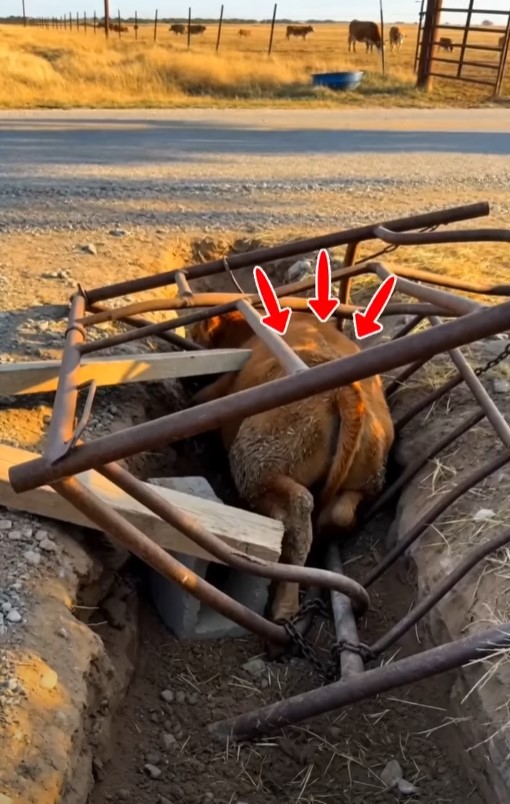
What began as a quiet morning on a farm suddenly turned into an urgent rescue when workers discovered a young calf trapped beneath a heavy metal drainage grate.
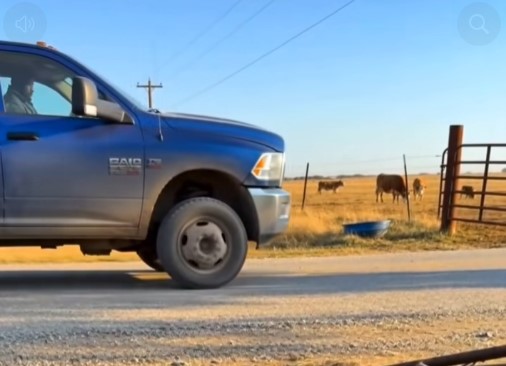
The calf had somehow managed to slip partially beneath the structure, leaving one of its legs caught between the bars while the rest of its body remained pressed close to the steel. The animal was conscious and responsive, but its rapid breathing and uneasy movements made it clear that it was frightened and uncomfortable.
The first worker who reached the area immediately recognized that pulling the calf free by force could make the situation worse.
The grate was heavy, the calf’s leg was trapped at an awkward angle, and any sudden movement could have caused additional injury.
Instead of rushing in, the worker called for help.
Other farm employees quickly arrived and began assessing the situation while keeping the area as calm as possible.
Nearby machinery was shut down to reduce noise.
Other livestock were moved farther away.
Workers avoided crowding the calf or making sudden movements that might cause it to struggle harder.
The animal occasionally tried to shift its body, but the trapped leg prevented it from moving very far.
Because nobody knew exactly how the limb was positioned beneath the grate, the workers avoided pulling on it.
A local large-animal rescue team and a veterinarian were contacted.
When they arrived, they examined the scene carefully from several angles.
The rescuers looked at the position of the calf, the surrounding soil, the weight of the grate, and the amount of space available for lifting equipment.
The veterinarian also performed an initial visual check.
Although the calf appeared frightened and uncomfortable, there were no obvious signs of a major external injury.
Still, the team knew that continued pressure from the steel structure could create problems if the animal remained trapped for too long.
The rescuers determined that the grate was too heavy to lift safely by hand.
Instead, they prepared hydraulic equipment that would allow them to raise the structure slowly and with much greater control.
Before beginning, they stabilized the ground around the drainage area so the lifting tools would not shift unexpectedly.
Protective padding was placed around the exposed parts of the calf’s body.
One rescuer remained close to the animal, speaking softly and trying to keep it calm while the rest of the team prepared the equipment.
The plan was simple but required patience.
Rather than lifting the grate all at once, the rescuers would raise it only a few centimeters at a time.
After each movement, they would stop and check the calf’s leg, body position, and the stability of the equipment.
Once everything was secured, the lift began.
The hydraulic tools applied steady pressure.
Slowly, the heavy steel grate began to rise.
The team paused after the first movement.
The veterinarian checked the trapped leg.
The rescuers made sure the grate remained balanced.
Then they lifted again.
As the structure moved upward, the pressure on the calf gradually eased.
A small amount of space opened around the trapped leg.
The rescuer nearest the calf gently guided its body into a safer position without pulling on the limb.
The grate was raised a little more.
Another pause followed.
Then another careful adjustment.
Eventually, the opening became wide enough for the calf to move its leg away from the bars.
The limb finally came free.
The rescue team immediately stopped lifting and held the grate securely in place while the calf moved away from the drainage channel.
For a brief moment, everyone watched to see whether the animal would be able to stand.
Its first movements were shaky.
After being trapped and unable to move normally, the calf appeared tired and uncertain.
Then it remained upright.
Relief spread through the group.
The veterinarian moved in for a closer examination.
The calf had some minor scrapes and pressure marks where its body had rested against the metal, but no serious injuries were found.
Fresh water was brought over, and the calf drank while workers continued monitoring it.
After the immediate rescue was complete, attention turned to the drainage grate itself.
The heavy structure was carefully lowered back into position, and farm workers inspected the area to determine how the accident had happened.
They discovered that part of the grate had shifted slightly out of alignment.
That movement created a narrow opening large enough for a curious young calf to get partially underneath.
The structure had originally been installed as a safety feature, but once it moved out of position, it became a potential hazard.
The farm staff decided not to simply put it back and continue as before.
Additional bolts were installed to secure the grate more firmly.
A protective barrier was also added to help prevent young livestock from getting too close to the drainage area.
Workers inspected the surrounding ground for other possible weak points or gaps that could create similar risks.
The goal was to make sure another animal would not become trapped in the same way.
The farm owner later thanked the workers, rescue team, and veterinarian for handling the situation carefully.
Their decision not to rush the rescue had likely prevented the incident from becoming much more serious.
Trying to lift the grate manually or pulling the calf before enough space was created could have caused the structure to shift or twisted the trapped leg.
Instead, patience and controlled equipment allowed the animal to be freed safely.
Once the veterinarian completed the examination, the calf was moved to a secure pen with other young livestock.
It remained tired at first, but gradually became calmer in the familiar environment.
Workers continued watching its movement and behavior.
The minor scrapes and pressure marks did not appear to stop it from standing or walking.
Within a relatively short period, the calf began placing more weight on its legs and moving with greater confidence.
Eventually, it returned to the herd and joined the other animals during feeding.
What started as an ordinary farm morning became a delicate rescue involving careful planning, specialized equipment, and veterinary supervision.
Most importantly, the calf walked away with only minor injuries.
The incident also left the farm with an important reminder.
Even structures designed to protect animals can become dangerous if they shift or wear over time.
Regular inspection, quick thinking, and patience can make all the difference when something goes wrong.