
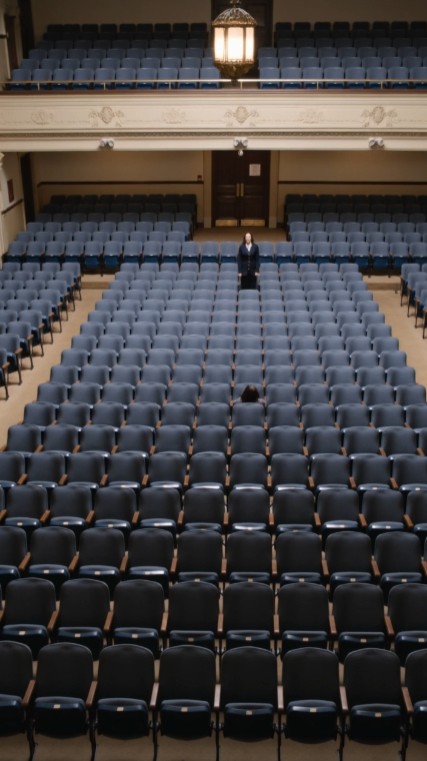
Fifty people entered the empty theater.
There was no movie playing.
No private event.
No screening.
Yet at exactly 6:00 PM, every person took a seat.
One man sat in Row 2.
Another in Row 7.
A woman climbed all the way to Row 14.
The theater manager, Daniel, watched from the aisle.
At first, he assumed the group had rented the room.
But nobody had told him about any booking.
He checked the schedule again.
Empty.
Finally, he walked toward the nearest person.
“Excuse me. What’s going on?”
The man smiled.
“You’ll see.”
Daniel frowned.
He asked another guest.
Same answer.
Then the side door opened.
An elderly usher named Walter stepped inside.
Walter had worked at the theater for more than three decades.
He knew every aisle.
Every broken armrest.
Every strange sound the old building made.
But the moment he looked across the audience, he stopped.
His face changed.
“No…”
Daniel walked over.
“You know these people?”
Walter shook his head.
“I’ve never seen most of them.”
A woman sitting in Row 5 stood.
“But we’ve all seen you.”
Walter stared at her.
She reached into her handbag and removed an old movie ticket.
Then another person stood.
He held up one too.
Then another.
Within seconds, dozens of faded ticket stubs were visible throughout the theater.
Different colors.
Different years.
Different movies.
Walter slowly sat down.
“What is this?”
The woman smiled.
“For thirty-two years, you did something nobody here forgot.”
Walter shook his head.
“I just showed people to their seats.”
“No, Walter.”
She pointed around the theater.
“You changed what happened after we sat down.”
Daniel took one of the tickets.
The date was from nearly thirty years earlier.
Another came from twenty-two years ago.
Another from eleven.
Different screenings.
Different customers.
Then he noticed something.
Each ticket carried the same handwritten symbol.
A small circle with two short lines beneath it.
Daniel turned toward Walter.
“Did you draw this?”
Walter stared at the symbol.
His hands began trembling.
“I haven’t drawn that in thirty years.”
The woman in Row 5 smiled.
“But you used to.”
Walter looked at her carefully.
Her name was Susan.
Thirty years earlier, she had been sixteen.
She came to the theater alone one afternoon.
Her parents were going through a difficult divorce.
Home had become a place of arguments.
So Susan started spending Saturday afternoons at the movies.
One day, Walter noticed her counting coins at the concession stand.
She had enough for the ticket.
Not enough for food.
Walter quietly marked her ticket with the small symbol.
Then he told the concession worker:
“That one’s covered.”
Susan thought it happened once.
The following week, the symbol appeared again.
Popcorn.
A drink.
No questions.
Walter never told her he paid for it himself.
Susan looked toward him.
“You made this place feel safe when I didn’t want to go home.”
Walter lowered his head.
Another man stood.
“My name is Marcus.”
His ticket was from 1998.
He had been fourteen.
His family didn’t have much money.
Marcus had saved for weeks to see a movie with friends.
When he arrived, he discovered he was short by two dollars.
He turned to leave.
Walter stopped him.
He marked the ticket.
Then waved him through.
Marcus remembered what Walter said.
“Next time you see someone short, help them instead.”
Years later, Marcus became a teacher.
He kept that ticket in his desk.
Whenever a student couldn’t afford a field trip or lunch, Marcus quietly paid.
Walter stared at him.
“You kept the ticket?”
“For twenty-eight years.”
Another person stood.
Then another.
Each had a story.
A young mother who came to the theater with her son because their apartment had no heating one winter.
Walter marked their tickets and let them stay for two consecutive showings.
A college student who had failed an exam and spent an evening crying alone in the back row.
Walter sat beside her after the credits and told her one bad day didn’t get to make decisions about the rest of her life.
A widower who attended the same movie every Friday after his wife died.
Walter stopped charging him after the third month.
A boy with a stutter who was nervous about ordering at the concession counter.
Walter waited patiently every time.
Never finished the sentence for him.
Never rushed him.
The stories kept coming.
Daniel looked around the theater.
Now the random seats made sense.
Every person was sitting in the exact seat connected to their memory.
Row 2.
Seat 6.
Row 7.
Seat 11.
Row 14.
Seat 3.
Walter stared across the auditorium.
“You remembered the seats?”
Susan smiled.
“Some of us remembered everything.”
Walter looked overwhelmed.
Then Daniel asked:
“What was the symbol supposed to mean?”
Walter looked at the old ticket.
He smiled faintly.
“It meant don’t ask.”
Daniel frowned.
Walter explained.
Years ago, employees sometimes brought him customers who couldn’t afford something.
A ticket.
Popcorn.
A drink.
Walter hated the idea of making someone explain their situation publicly.
So he created the symbol.
If he drew it on a ticket, employees knew not to ask questions.
The cost would be covered.
Sometimes by Walter.
Sometimes by another employee.
Eventually, a few regular customers learned what the symbol meant and started leaving extra money.
For a while, there was even a small envelope behind the counter.
Nobody called it a charity.
Nobody advertised it.
It was simply there.
Then the theater changed ownership.
New systems replaced paper tickets.
The old symbol disappeared.
Walter remained.
But he stopped drawing it.
“I assumed everyone forgot.”
Susan laughed.
“We didn’t.”
Then Daniel noticed something else.
There were fifty people in the theater.
But only forty-nine tickets had been raised.
One seat remained empty.
Front row.
Center.
Walter looked toward it.
His expression changed.
“Who is that for?”
Susan smiled.
“The person who started this before you did.”
Walter immediately stood.
“No.”
The theater doors opened.
An elderly woman entered.
Walter stared.
Then whispered:
“Mrs. Evans?”
The woman smiled.
“Hello, Walter.”
He began walking toward her.
Slowly at first.
Then faster.
Susan leaned toward Daniel.
“That’s why we chose today.”
Daniel looked confused.
“Who is she?”
Mrs. Evans had managed the theater when Walter was sixteen.
Long before he became an usher.
At the time, Walter’s family was struggling.
His father had lost his job.
Walter worked evenings cleaning the theater.
One night, he asked Mrs. Evans whether he could take home leftover popcorn for his younger brothers.
She said yes.
Then she began doing something Walter didn’t understand.
At the end of each week, she gave him an envelope.
Inside was a little extra cash.
Walter protested.
“You already paid me.”
Mrs. Evans answered:
“I’m not paying you twice.”
“Then what is it?”
“Something somebody once did for me.”
Walter used the money for groceries.
Bus fare.
School supplies.
Years later, after he became a full-time usher, he asked Mrs. Evans how he could repay her.
She gave him one instruction.
“Don’t repay me.”
Then she pointed toward the lobby.
“Notice somebody else.”
Walter had carried that sentence for the rest of his career.
Daniel looked around the theater.
“That’s what the symbol was.”
Walter nodded.
“It started because of her.”
Mrs. Evans walked toward the empty seat.
Front row.
Center.
The same seat she used to take during staff screenings decades earlier.
Walter sat beside her.
“You disappeared.”
She smiled.
“I moved.”
“I tried to find you.”
“I know.”
Walter looked confused.
“How?”
Susan answered.
“She found us first.”
Months earlier, Susan had posted a photograph of her old marked ticket online.
She wrote about Walter.
Other people recognized the symbol.
Comments appeared.
Then stories.
Soon dozens of former customers were sharing memories.
Someone eventually showed the post to Mrs. Evans.
She contacted Susan.
Together, they planned the reunion.
Walter looked around.
“So none of you came for a movie?”
Marcus laughed.
“No.”
Susan pointed toward the projector booth.
“We came for you.”
The lights dimmed.
Walter turned.
A film began playing on the screen.
But it wasn’t a movie.
It was a collection of photographs.
Old theater pictures.
Ticket stubs.
Employees.
Families.
Children who had grown up.
And short messages from people Walter had helped over the years.
Thank you for letting me stay when I had nowhere else to go.
Thank you for never embarrassing my mother.
Thank you for remembering my name.
Thank you for telling me to come back next week.
Walter wiped his eyes.
Then the final image appeared.
It was an old photograph of sixteen-year-old Walter standing beside Mrs. Evans in the theater lobby.
Underneath were the words:
NOTICE SOMEBODY ELSE.
The lights came back on.
Nobody spoke for several seconds.
Then Walter looked toward Mrs. Evans.
“You did all this?”
She shook her head.
“You did.”
Walter laughed through tears.
“I drew circles on movie tickets.”
Susan answered from Row 5.
“No.”
“You made people feel like they were allowed to stay.”
After the reunion, Daniel made a decision.
The old handwritten symbol returned.
Not on tickets.
The theater used digital systems now.
Instead, a small version was placed discreetly behind the concession counter.
Customers could choose to add a few dollars to their purchase.
That money went into a community ticket fund.
No public applications.
No embarrassing explanations at the counter.
Local organizations helped distribute passes quietly.
Walter insisted on one rule.
Nobody should ever be made to feel like they owed the theater anything.
Daniel asked:
“What do we call the program?”
Walter looked at Mrs. Evans.
She smiled.
“Don’t name it after us.”
So they didn’t.
A tiny circle with two lines became the only symbol.
Years later, most customers had no idea where it came from.
But Walter knew.
So did the fifty people who had once filled an empty theater and sat in seats that looked completely random.
They hadn’t returned because of the movies they watched.
They returned because of the man who noticed them after the lights came up.