
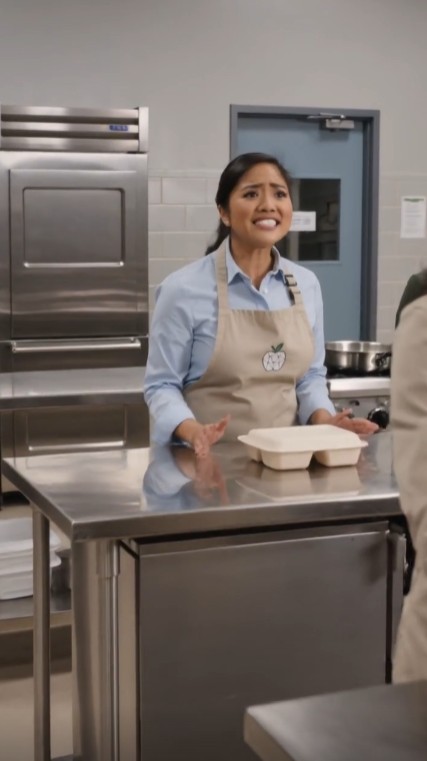
Forty people showed up for the same cooking class.
But nobody touched the food.
Everything was ready.
Ingredients had been measured.
Aprons were folded.
Cooking stations were prepared.
Yet all forty adults simply stood behind their tables.
The instructor looked around.
“Are we waiting for somebody?”
A woman in the front smiled.
“Yes.”
“For who?”
“You’ll see.”
A few minutes later, the kitchen doors opened.
An elderly man stepped inside carrying a small lunch container.
The entire room applauded.
He stopped immediately.
Then looked behind himself.
“I think I’m in the wrong place.”
The woman laughed.
“No, Mr. Lewis.”
She pointed toward the room.
“You’re exactly where you belong.”
The man looked confused.
His name was Henry Lewis.
For more than thirty years, he had worked in a public school cafeteria.
He had retired several years earlier.
Now, standing inside a modern community teaching kitchen surrounded by strangers, he had no idea why anyone was applauding.
Henry looked at the woman.
“Do I know you?”
Nobody answered.
Instead, everyone opened the containers sitting at their cooking stations.
Henry looked inside the nearest one.
Then froze.
Each container held the same simple meal.
A small serving of pasta.
Vegetables.
A piece of fruit.
And a bread roll.
Henry stared at it.
“I used to make that.”
The woman nodded.
“For us.”
Henry looked around again.
This time more carefully.
The woman introduced herself.
“My name is Sarah.”
Henry’s expression changed slightly.
“You fed me in fifth grade.”
A man behind her raised his hand.
“You always gave me an extra piece of fruit.”
Another person spoke.
“You knew when I didn’t have lunch money.”
Then another.
“You let me stay in the cafeteria after everyone left because I didn’t want to go home yet.”
Henry shook his head.
“That was my job.”
Sarah smiled.
“No.”
She pointed around the room.
“This is your job.”
Henry frowned.
Then all forty adults picked up their aprons.
They put them on at the same time.
On the front of every apron was a tiny symbol.
A small circle.
Inside it, a simple drawing of an apple.
Henry stared.
“Where did you get that?”
Sarah walked toward him.
She held out one final apron.
The same symbol was printed on the front.
Henry touched it.
His hands began trembling.
“I haven’t seen this in years.”
The symbol had started as something almost nobody knew about.
Back when Henry first began working in the school cafeteria, students paid for lunch differently.
Some had accounts.
Some carried cash.
Some received assistance.
And some arrived with nothing.
Henry hated watching children become embarrassed when they didn’t have enough money.
So he created a quiet system.
Whenever a child came through the line without lunch money, Henry drew a tiny apple beside their name on his paper sheet.
It meant:
Feed them.
Don’t ask questions.
Don’t make them explain.
No child was told what the symbol meant.
Most never even saw it.
The system was informal.
Henry sometimes covered meals himself.
Other cafeteria workers helped.
Eventually, a few teachers started leaving small amounts of money with the kitchen staff.
Nobody called it a program.
It was just something they did.
Sarah looked at him.
“You thought we didn’t notice.”
Henry smiled faintly.
“I hoped you didn’t.”
Sarah laughed softly.
“We noticed more than you thought.”
She remembered being ten years old.
Her father had left.
Her mother was working two jobs.
Some mornings there was no lunch money.
Sarah learned to dread the cafeteria line.
Then one day, she reached the register.
Henry looked at her tray.
Then at the account sheet.
He simply said:
“You’re good.”
Sarah thought someone had paid.
The next day, same thing.
Then again.
Weeks later, she saw Henry draw the tiny apple beside another student’s name.
She understood.
But she never said anything.
Another former student stepped forward.
His name was Daniel.
He had been one of six children.
Money was constantly tight.
Henry always slipped an extra banana onto his tray.
Daniel thought it was because the cafeteria had too many.
Years later, he learned Henry had been bringing extra fruit from home.
A woman named Lisa spoke next.
She remembered arriving at school after a terrible night at home.
She wasn’t hungry.
She sat alone.
Henry placed a carton of milk and a roll beside her.
He didn’t ask what was wrong.
He simply said:
“You can sit here as long as you need.”
Lisa became a school counselor.
Another man had become a chef.
Another owned a small restaurant.
One ran a bakery.
Several worked in education.
Some had careers completely unrelated to food.
But every one of the forty adults remembered Henry.
Not because the meals were extraordinary.
Most were simple.
Affordable.
Ordinary school lunches.
They remembered the way he served them.
Without embarrassment.
Without making anyone feel poor.
Without asking children to explain things they were too young to explain.
Henry looked around the room.
“I don’t remember all of you.”
Sarah nodded.
“We know.”
“That’s the point.”
He frowned.
She continued.
“You helped people without keeping score.”
Henry looked down at the apron.
Then asked:
“So why are we in a cooking class?”
Sarah smiled.
“This isn’t really a cooking class.”
The instructor stepped forward.
The kitchen belonged to a nonprofit community center.
Once a week, volunteers prepared meals for families dealing with short-term financial difficulties.
Sarah and the others had rented the kitchen for the evening.
But they weren’t there to learn how to cook.
They were there to launch something.
All forty former students had contributed.
Some donated money.
Some provided ingredients.
Restaurant owners donated equipment.
Teachers contacted local schools.
And the chefs in the group developed simple meals that could be prepared cheaply and safely in large quantities.
Henry listened silently.
Sarah pointed toward the apple symbol.
“We’re calling it the Apple Table.”
Henry immediately shook his head.
“No.”
Sarah laughed.
“You haven’t even heard what it does.”
“I know exactly what you’re doing.”
He looked embarrassed.
“Don’t name anything after me.”
“It isn’t named after you.”
Henry stopped.
Sarah smiled.
“It’s named after the mark.”
The Apple Table would provide free take-home meals to students and families through several community centers.
No complicated public application at the counter.
No child standing in line explaining why they needed food.
Partner organizations would quietly distribute meal vouchers.
Anyone presenting one simply received dinner.
No questions.
No visible distinction between paid and supported meals.
Henry stared at the symbol.
“You built this from something I scribbled on a cafeteria sheet?”
Daniel smiled.
“You built it.”
“We’re just making it bigger.”
Henry shook his head.
“I fed kids lunch.”
A former student near the back answered:
“Exactly.”
Henry looked toward him.
The man continued.
“You have no idea how big lunch can feel when you don’t know whether you’re getting dinner.”
The room became quiet.
Henry sat down.
He looked overwhelmed.
Then Sarah placed the final apron in front of him.
“Will you cook with us?”
Henry smiled through tears.
“I’m seventy-four.”
Daniel laughed.
“You’re not lifting anything heavy.”
Henry put on the apron.
For the next two hours, the forty former students cooked together.
Henry moved between the stations.
He corrected knife technique.
Complained that somebody was using too much salt.
Showed a restaurant owner a faster way to prepare vegetables.
Within minutes, he looked less like a guest and more like the cafeteria worker they all remembered.
Then Henry opened the lunch container he had carried into the room.
Sarah noticed.
“What did you bring?”
Henry laughed.
“My dinner.”
Inside was the same meal everyone else had recreated.
Simple pasta.
Vegetables.
Fruit.
Bread.
Sarah stared.
“You still eat this?”
“Sometimes.”
“Why?”
Henry smiled.
“Reminds me of work.”
Near the end of the evening, the group packed hundreds of meals.
Each container had a tiny apple symbol on the label.
Nothing else.
No charity message.
No explanation.
Just the apple.
Then Sarah revealed one final surprise.
She brought out an old cafeteria ledger.
Henry immediately recognized it.
“Where did you find that?”
The school had been renovating an old storage room.
A retired employee found the book inside a cabinet.
Most pages contained ordinary meal records.
But scattered throughout were Henry’s tiny apples.
Hundreds of them.
Sarah had counted.
Over the years covered by that one ledger alone, Henry had marked more than eight hundred meals.
He stared at the number.
“That can’t be right.”
“It is.”
“I couldn’t have paid for that many.”
“You didn’t.”
Henry looked confused.
Sarah explained.
After a while, other cafeteria workers had started contributing.
Teachers too.
Then parents who knew about the quiet system.
Henry’s tiny mark had already grown into something larger while he was still working.
He simply never realized it.
One teacher had written a note inside the back cover.
Henry opened it.
It said:
If there’s an apple, feed the kid. We’ll figure out the money later.
Henry laughed.
“That sounds like Mrs. Davis.”
Sarah smiled.
“She’s ninety-one.”
“Still alive?”
“Yes.”
Then the kitchen doors opened again.
An elderly woman walked in.
Henry stood immediately.
“Margaret Davis?”
She smiled.
“You still put too much pepper in the pasta.”
Henry laughed.
Mrs. Davis had been the teacher who first noticed his apple system.
Instead of stopping it, she helped fund it.
For nearly twenty years, the two had quietly made sure children ate.
The former students applauded again.
This time Henry didn’t protest.
Later, after the first Apple Table meals were delivered, Sarah sent Henry photographs.
Families picking up dinner.
Teenagers carrying containers home.
Children receiving meals without standing in a separate line.
Henry looked at every picture.
Then he called Sarah.
“You made one mistake.”
Sarah became worried.
“What?”
“The symbol.”
“What’s wrong with it?”
Henry laughed.
“My apple was much uglier.”
The program continued.
More restaurants joined.
More volunteers signed up.
Some of the former students brought their own children to help.
And every apron carried the same tiny apple.
Most people who received a meal never knew what the symbol meant.
They didn’t know about Henry.
They didn’t know about the old cafeteria ledger.
They didn’t know forty adults had once gathered in a kitchen because they remembered being children on the other side of a lunch counter.
They only knew dinner was available.
No questions.
No embarrassment.
No explanation required.
Exactly the way Henry had always believed it should be.