
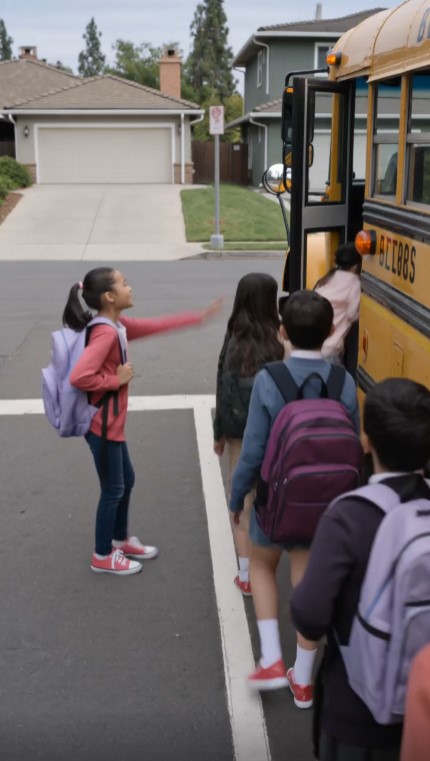
A little girl refused to get on the school bus.
It was a busy morning outside Maple Street Elementary. Parents were rushing to work, children were climbing onto the bus with backpacks bouncing against their shoulders, and cars were already lining up behind the yellow bus with impatient drivers tapping their horns.
The driver, Mr. Collins, opened the door and called out, “Come on, sweetheart. We have to go.”
But seven-year-old Emma did not move.
She stood on the sidewalk with her pink backpack hanging from one shoulder, her face pale, her eyes fixed on the back tire of the bus.
Behind her, classmates began to laugh.
“She’s scared of the bus,” one boy whispered.
Another child called from the steps, “Hurry up!”
A car horn blared behind them.
Mr. Collins leaned forward from his seat, trying to stay patient.
“Emma, we’re already late. Please get on.”
But Emma shook her head.
Then she lifted one trembling finger and pointed toward the rear wheel.
“There’s someone under there.”
The children went quiet for half a second.
Then a few of them laughed again.
One girl rolled her eyes and said, “There’s nobody under the bus.”
A parent nearby frowned, thinking Emma was just nervous. Another driver honked harder from behind, frustrated that the bus was blocking the street.
Mr. Collins sighed and unbuckled his seat belt.
At first, he thought maybe Emma had dropped something. A toy. A lunchbox. A shoe.
But the little girl did not look embarrassed.
She looked terrified.
And that made him stop.
He stepped down from the bus and walked slowly toward the back tire.
“Everyone stay where you are,” he said.
The noise around them faded.
Emma backed away, still pointing.
Mr. Collins bent down beside the wheel and looked underneath.
His face went white.
For one frozen second, he did not speak.
Then he shouted, “Nobody move!”
Parents turned.
The children on the bus stopped laughing.
Behind the back tire, hidden in the shadow under the bus, was a tiny hand.
A toddler was lying there, curled close to the wheel, reaching for a small blue toy car that had rolled beneath the bus.
He was so small that no one had seen him.
Not the driver.
Not the parents.
Not the children climbing up the steps.
Only Emma had noticed.
Mr. Collins dropped to his knees and carefully reached under the bus.
“Hey, buddy,” he said, his voice shaking. “Don’t move. I’m going to help you.”
A young mother screamed from the sidewalk.
“Leo!”
She ran forward, but another parent held her back so the driver could pull the toddler out safely.
The little boy was dusty, frightened, and crying, but alive.
His toy car was still clutched in his hand.
His mother fell to the ground and wrapped him in her arms, sobbing so hard she could barely speak.
“I only looked away for a second,” she cried. “I thought he was beside me.”
The street went silent.
The drivers who had been honking lowered their eyes.
The classmates who had laughed stared at Emma with wide, ashamed faces.
Mr. Collins stood slowly, one hand pressed against the side of the bus as if his legs could barely hold him.
If Emma had stepped onto the bus, he would have closed the doors.
He would have checked his mirror.
He would have pulled away like he did every morning.
And no one would have known until it was too late.
Emma stood frozen near the curb, clutching the strap of her backpack.
Her teacher knelt beside her and whispered, “How did you know?”
Emma swallowed hard.
“I saw his fingers move,” she said softly. “Everyone was looking at the door. I looked down.”
Mr. Collins walked over to her with tears in his eyes.
“I’m sorry I rushed you,” he said.
Emma looked at the toddler, still crying in his mother’s arms.
“I didn’t want him to get hurt,” she whispered.
Within minutes, police and paramedics arrived. They checked Leo carefully and confirmed he had not been injured. He had crawled away from his mother while she helped his older sister with a backpack. His toy car had slipped from his hand and rolled under the bus.
In the noise and rush of the morning, no one noticed.
Except one little girl who refused to ignore what she saw.
Later that day, the school principal called an assembly.
Emma sat in the front row, nervous and quiet, while Mr. Collins stood beside her. He told everyone what had happened, his voice breaking when he described the tiny hand behind the wheel.
Then he looked at the students.
“This morning, Emma taught us something more important than any lesson in a classroom,” he said. “When something feels wrong, speak up. Even if people laugh. Even if adults are rushing. Even if you are the only one who sees it.”
The room erupted in applause.
But Emma did not smile like someone who wanted attention.
She simply hugged her backpack and looked down.
That afternoon, Leo’s mother came to the school with a small bouquet of flowers. She knelt in front of Emma and held her hands.
“You saved my baby,” she said through tears.
Emma’s eyes filled.
“I just didn’t want the bus to move,” she said.
Sometimes heroes are not the loudest people in the crowd.
Sometimes they are not wearing uniforms.
Sometimes they are small, quiet, and scared — standing in front of a bus while everyone tells them to hurry.
And sometimes, the bravest thing a child can say is the one sentence every adult needs to hear before it is too late:
“There’s someone under there.”