
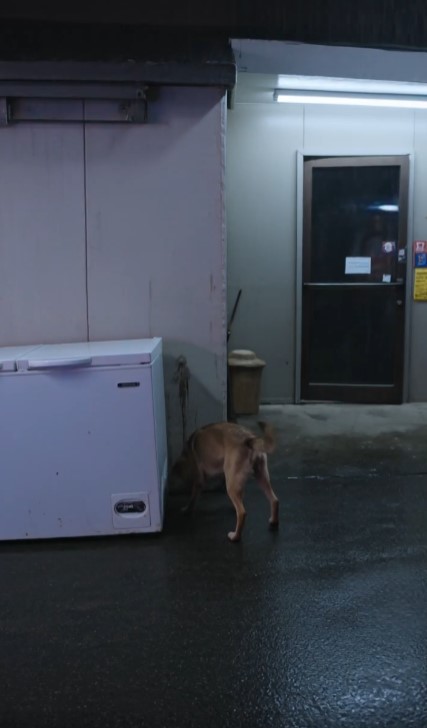
A stray dog kept barking behind the gas station.
At first, everyone thought he was just hungry.
He appeared near the dumpsters after sunset, soaked from the rain, ribs showing beneath his dirty fur, his paws muddy from the alley behind the building. Customers saw him pacing near the back wall and complained to the manager before they even paid for their gas.
“There’s a dog back there again,” one man said. “He won’t stop barking.”
The manager sighed and grabbed a broom.
“Not this again.”
He had chased the dog away three nights in a row. Every time, the animal would run toward the alley, disappear into the dark, then come back as soon as the station quieted down.
But he never went near the food bags.
He never touched the water bowl someone had left by the door.
He always returned to the same place.
An old broken freezer pushed against the wall near the dumpster.
The freezer had not worked in years. It was dented, rusted at the bottom, and too heavy for anyone to bother moving. Behind it was a narrow section of wall that led to an old storage extension nobody used anymore.
The dog stood in front of it every night.
Barking.
Whining.
Scratching.
The manager thought he was being a nuisance.
“Get out of here!” he shouted, waving the broom.
The dog backed away, but only a few steps.
Then he lowered his head and scratched the wall again.
Harder this time.
One cashier named Maria watched from the back door.
Something about the dog bothered her.
He did not look wild.
He looked desperate.
Later that night, when the station was almost empty, Maria heard him again.
Bark.
Bark.
Then a long, broken whine.
She stepped outside with a flashlight.
The dog was standing by the freezer, his body trembling, his nose pressed against the gap between the metal and the wall.
“Hey,” Maria whispered. “What are you doing?”
The dog looked at her, then scratched the wall again.
Maria frowned.
She expected to find trash, maybe a rat, maybe a kitten trapped behind the freezer.
But when she moved closer, the dog stopped barking.
The alley became quiet.
Then she heard it.
A tiny cough.
Maria froze.
At first, she thought it came from the street.
Then it came again.
Small.
Weak.
Muffled.
From behind the wall.
Her stomach dropped.
“Hello?” she called.
No answer.
Only another faint cough.
Maria ran inside and shouted for the manager.
“There’s someone back there.”
The manager looked annoyed.
“Maria, it’s probably an animal.”
“No,” she said, her voice shaking. “I heard a child.”
That changed everything.
The manager, another employee, and two customers rushed outside. Together, they pulled at the broken freezer. It scraped loudly against the concrete, heavy and stubborn, but finally shifted away from the wall.
Behind it was a narrow damaged panel, partly hidden by dirt and old cardboard.
The dog pushed forward, whining louder now.
Maria shined her flashlight through a crack.
Then she screamed.
Behind the wall, trapped in a narrow storage gap barely wide enough to move, was a little boy.
He was curled on the floor, pale and shaking, his shirt dusty, his cheeks streaked with tears. One hand rested against the inside of the wall, too weak to knock anymore.
For hours, people had walked past him.
Customers had filled their cars.
Employees had taken out trash.
The manager had chased away the only one trying to help.
But the dog had heard him.
Maria dropped to her knees.
“Sweetheart, can you hear me?”
The boy’s eyes opened slightly.
“I’m cold,” he whispered.
Someone called 911.
Within minutes, police and firefighters arrived. They carefully broke open the damaged panel and pulled the boy from the narrow gap. He was weak, dehydrated, and terrified, but alive.
His name was Noah.
He had gone missing earlier that afternoon after following a lost ball behind the gas station. Somehow, he had slipped through a damaged opening near the old storage extension. The panel had shifted behind him, trapping him where nobody could see him from the outside.
He had cried until his voice was almost gone.
He had tapped.
He had coughed.
He had waited.
But traffic, machines, music, and voices swallowed every sound.
Only the stray dog heard him.
As paramedics wrapped Noah in a blanket, the dog sat beside the broken freezer, watching quietly.
No longer barking.
No longer scratching.
Just waiting.
Noah’s mother arrived minutes later, running from the police car before it fully stopped. When she saw her son alive, she fell to her knees and held him so tightly the paramedic had to gently remind her to let him breathe.
Then Noah lifted one shaky hand and pointed.
“The dog stayed,” he whispered.
Everyone turned.
The same dog they had called annoying.
The same dog customers wanted removed.
The same dog the manager had chased into the rain.
He sat near the wall with his head lowered, as if he still did not understand that the job was done.
Maria walked over slowly and knelt in front of him.
“I’m sorry,” she whispered.
The dog sniffed her hand, then rested his tired head against her palm.
The manager stood behind her, silent.
His broom was still leaning against the dumpster.
He looked at the broken wall, then at the child wrapped in a blanket, then at the dog.
“I thought he wanted food,” he said quietly.
Maria shook her head.
“He wanted someone to listen.”
The next day, the gas station looked different.
The broken freezer was gone.
The damaged wall was sealed.
And near the back door, there was a new bowl of water, a warm blanket, and a handwritten sign.
His name is Buddy. He is not a nuisance. He is a hero.
Noah’s family returned that afternoon with a small red collar.
The moment Buddy saw the boy, his tail began to move.
Slowly at first.
Then faster.
Noah wrapped his arms around the dog’s neck and whispered, “You found me.”
Buddy closed his eyes and leaned into him, as if he had been waiting all along for that one voice to be safe again.
Sometimes heroes do not arrive clean.
Sometimes they do not arrive welcome.
Sometimes they bark, scratch, and refuse to leave until someone finally understands.
And sometimes, the life everyone missed is saved by the one everyone tried to chase away.