
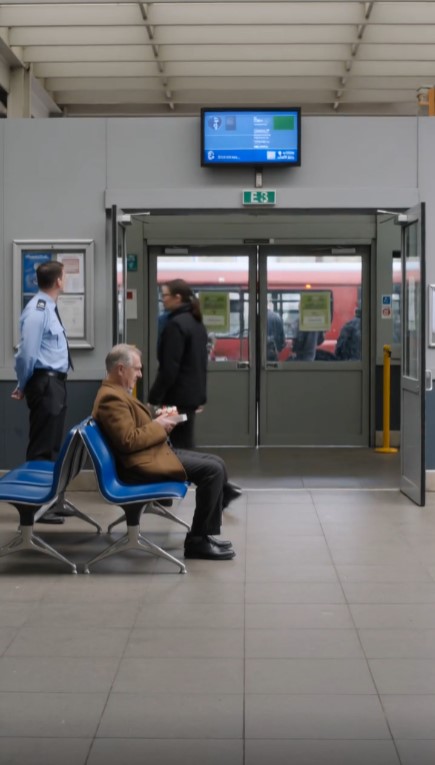
An old man sat at the bus station every day with a birthday cake.
At first, people smiled.
He looked harmless enough, sitting on the same wooden bench near the arrival gate with a white cake box resting carefully on his knees. His coat was old, his shoes were worn, and his hands trembled slightly as he held the box like it was something precious.
Every few minutes, he looked up at the doors where passengers stepped off the buses.
Then he looked down at the cake again.
“My daughter is coming,” he told anyone who asked.
Some people nodded politely.
Others walked away.
A few laughed.
By the second day, workers at the station began to notice him.
By the third day, passengers started whispering.
By the fourth day, people were calling him confused.
“He’s been here all week,” one man said.
“With a cake?” a woman asked.
“Same cake box every day.”
The security guard finally approached him.
“Sir,” he said gently, “you can’t keep sitting here all day.”
The old man looked up, startled, as if he had forgotten where he was.
“I’m waiting for my daughter,” he said.
The guard softened a little.
“What time is she arriving?”
The old man smiled faintly.
“Soon. It’s her birthday.”
The guard looked at the cake box.
On top, written in blue marker, was one name.
Emily.
The guard sighed.
“Sir, do you have someone I can call?”
But the old man only looked back at the arrival gate.
“She promised she’d come,” he whispered.
The same thing happened for six days.
Morning after morning, the old man arrived before the first bus.
He sat on the same bench.
He held the same cake box.
He watched every passenger step through the gate.
And every evening, when the station emptied, he stood slowly and walked away with the cake untouched.
No daughter came.
Some people felt sorry for him.
Some grew annoyed.
Some laughed behind his back.
But one young cleaner named Rosa did not laugh.
She worked the early shift, sweeping near the benches and emptying trash bins before the station became crowded. She had seen grief before. She had seen loneliness. And something about the old man’s eyes stayed with her.
He was not just waiting.
He was holding on.
On the seventh morning, Rosa noticed something strange.
The cake box had shifted slightly on his lap, and the blue writing on top was clearer than before.
Happy Birthday, Emily Carter.
Rosa froze.
She knew that name.
Years earlier, a woman named Emily Carter had died in an accident near the old bus route outside town. Rosa remembered because her mother had talked about it for weeks. Emily had been young, kind, and traveling with a child at the time.
Rosa’s heart began to pound.
She walked closer to the old man.
“Sir,” she asked softly, “is Emily Carter your daughter?”
The old man looked up.
His eyes filled immediately.
“Yes,” he whispered. “My Emily.”
Rosa swallowed.
“Do you know what happened to her?”
The old man looked confused.
“She’s coming today,” he said. “She said she would bring my granddaughter.”
Rosa’s hands went cold.
Granddaughter.
She crouched beside him.
“What was your granddaughter’s name?”
The old man closed his eyes, trying to remember.
“Lily,” he said. “She was only a baby.”
Rosa stood up quickly and went to the security office.
“Call the police,” she said.
The guard frowned.
“For what?”
Rosa pointed toward the old man.
“Because I think he’s been waiting for someone everyone thought was gone.”
When officers arrived, the old man was still sitting on the bench, holding the cake box.
They spoke to him gently. His name was Arthur. He had memory problems now, but he remembered one thing clearly: his daughter had promised to come to the bus station on her birthday with her little girl.
But she never arrived.
Years ago, Emily Carter had disappeared from Arthur’s life after a terrible accident. Records said she had died, but the report about the child had always been unclear. Some documents listed the baby as deceased. Others mentioned an unidentified child transferred to a hospital in another county.
No one had followed the trail far enough.
Until Rosa noticed the name on the cake.
Police reopened the old missing-person file.
They checked hospital records.
They searched adoption documents.
They compared dates, names, and old photographs.
And then they found something nobody expected.
Arthur’s granddaughter was alive.
Her name was Lily, just as he remembered.
She had survived the accident but had been too young to identify herself. Because of paperwork errors and confusion after the crash, she was placed into foster care under a different last name. She grew up knowing almost nothing about her mother’s family.
But she had been searching too.
For years, Lily had tried to find her biological relatives. She only had one faded hospital record, one old photograph of her mother, and a memory passed down through paperwork that mentioned a grandfather named Arthur.
She thought he had died.
He thought she was gone.
Both had been looking for a family that was still alive.
Two days later, Rosa came to the bus station on her day off.
Arthur was already there.
Same bench.
Same cake box.
Same eyes fixed on the arrival gate.
But this time, the security guard did not ask him to leave.
This time, police stood nearby.
And when the noon bus arrived, a young woman stepped through the gate holding a small photograph in her hand.
She looked around nervously.
Then she saw the old man.
“Grandpa?” she whispered.
Arthur looked up.
For a moment, his face was blank.
Then his eyes dropped to the photograph in her hand.
It was Emily.
His daughter.
Holding a baby.
Arthur’s hands began to shake.
“Lily?” he whispered.
The young woman covered her mouth and nodded.
The cake box slipped slightly on his knees, but Rosa caught it before it fell.
Lily ran to him.
Arthur stood as fast as his weak legs allowed, and the moment she reached him, he wrapped his arms around her and began to sob.
“I waited,” he cried. “I waited for you.”
Lily cried into his shoulder.
“I looked for you too.”
The bus station went silent.
The same people who had laughed now watched with tears in their eyes. The security guard turned away, wiping his face. Rosa stood nearby, holding the cake box carefully, unable to stop crying.
Arthur opened the box with trembling hands.
The cake was simple.
White frosting.
Blue letters.
Happy Birthday, Emily.
Lily touched the writing and cried harder.
“She was my mother,” she whispered.
Arthur nodded.
“And she loved you.”
That day, they did not cut the cake for a party.
They cut it for a memory.
For Emily.
For the years stolen by mistakes.
For the grandfather who never stopped waiting.
For the granddaughter who finally came home.
After that, Arthur no longer sat alone at the bus station every day.
But once a year, on Emily’s birthday, he returned with Lily.
They sat on the same bench near the arrival gate, shared a small cake, and talked about the woman who had connected them even after death.
Rosa always stopped by with flowers.
The security guard always saved the bench.
And nobody laughed anymore.
Sometimes people are not confused.
Sometimes they are holding onto the last promise they remember.
Sometimes a name on a cake box is not just a name.
It is a clue.
A prayer.
A bridge between two broken hearts.
And sometimes, the person everyone thinks is waiting for someone who will never come is actually waiting for the one miracle still on its way.