
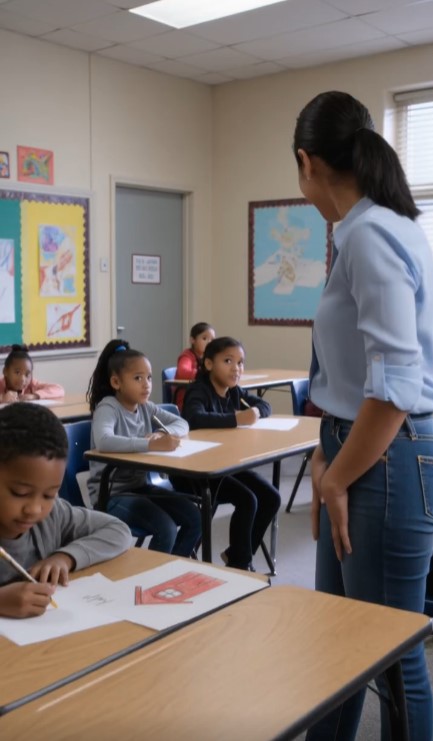
A teacher almost threw away a little boy’s drawing.
At first, it looked like scribbles.
Dark lines covered most of the page. A red house stood in the middle, crooked and uneven. Beside it was a tiny figure near an upstairs window, drawn so small that most people would have missed it.
The other children laughed when they saw it.
“That’s not a house,” one boy whispered.
“It looks scary,” another child said.
Mrs. Parker gently asked the class to be kind, then picked up the drawing from the desk.
She was about to place it with the other papers when something made her stop.
She had seen this picture before.
Not once.
Not twice.
Every day for a week.
The same red house.
The same dark lines.
The same tiny figure at the upstairs window.
And always, one window circled again and again until the paper nearly tore.
Mrs. Parker looked closer.
In the bottom corner, almost hidden beneath the black crayon marks, was one small word.
Help.
Her hand tightened around the page.
The little boy who drew it was named Noah. He was quiet, polite, and usually kept to himself. He rarely caused trouble. He rarely asked questions. But for the past week, he had come into class looking tired, holding his crayons tightly, and drawing the same picture whenever he had free time.
Mrs. Parker knelt beside his desk.
“Noah,” she said softly, “can you tell me about this house?”
The boy looked down.
His fingers twisted together.
“It’s just a house,” he whispered.
Mrs. Parker kept her voice gentle.
“And the person in the window?”
Noah’s eyes filled with tears.
For a moment, he said nothing.
Then he whispered, “That’s where my grandma is.”
Mrs. Parker’s heart began to race.
“Your grandma is in that house?”
Noah nodded.
“She waves from the window,” he said. “But she doesn’t come outside anymore.”
The classroom seemed to fade around them.
Mrs. Parker looked back at the drawing. The red house. The dark lines. The circled window. The tiny figure trapped behind the glass.
“Do you know where this house is?” she asked.
Noah hesitated.
Then he opened his backpack and pulled out another drawing.
This one had more details.
A street sign.
A broken fence.
A blue mailbox.
A number written beside the door.
Mrs. Parker stood slowly, holding both drawings in her hands.
She did not throw them away.
She took them straight to the principal.
Within minutes, the school resource officer was called. Noah sat in the office with a cup of water while Mrs. Parker stayed beside him, telling him he had done the right thing.
Police went to the address from the drawing.
At first, the house looked empty.
The grass was overgrown. Newspapers sat near the porch. The curtains were closed except for one upstairs window.
The circled window.
An officer knocked on the door.
No answer.
Then someone inside tapped faintly on the glass.
The officers forced the door open and rushed upstairs.
Behind the locked bedroom door, they found Noah’s grandmother.
She was weak, frightened, and trapped near the upstairs window. She had fallen days earlier and could not reach a phone. Her voice was too weak for neighbors to hear. She had tried waving whenever she saw Noah pass by on his way to school, but the little boy did not fully understand what was wrong.
He only knew Grandma was at the window.
He only knew she looked scared.
He only knew something was not right.
So he drew it.
Every day.
Until someone finally looked closely.
When Mrs. Parker received the call, she covered her mouth and began to cry.
Noah looked up from the office chair.
“Did they find her?” he asked.
Mrs. Parker knelt in front of him, tears in her eyes.
“Yes,” she whispered. “They found her because of you.”
Noah started crying too.
“I didn’t know how to tell,” he said.
Mrs. Parker hugged him gently.
“You told us the best way you could.”
Later, when his grandmother was safe in the hospital, she asked to see the drawings. She held them in her trembling hands and cried when she saw the tiny figure at the window.
“He saw me,” she whispered. “My sweet boy saw me.”
The next day, Mrs. Parker stood in front of her class and held up a blank sheet of paper.
She did not mention Noah’s name.
She did not tell the private details.
She simply said, “Sometimes a drawing is more than a drawing. Sometimes it is a message. And we must never laugh before we understand.”
The classroom was silent.
The children who had laughed looked down at their desks.
From that day on, Mrs. Parker kept one of Noah’s drawings in a folder near her desk.
Not because it was beautiful.
But because it reminded her that children do not always explain fear with perfect words.
Sometimes they show it in colors.
Sometimes they hide it in corners.
Sometimes they repeat the same picture again and again, hoping one adult will stop long enough to see the truth.
Everyone thought it was just scribbles.
But it was a map.
A warning.
A cry for help.
And because one teacher looked closer, a grandmother who had been trapped for days was finally found.