
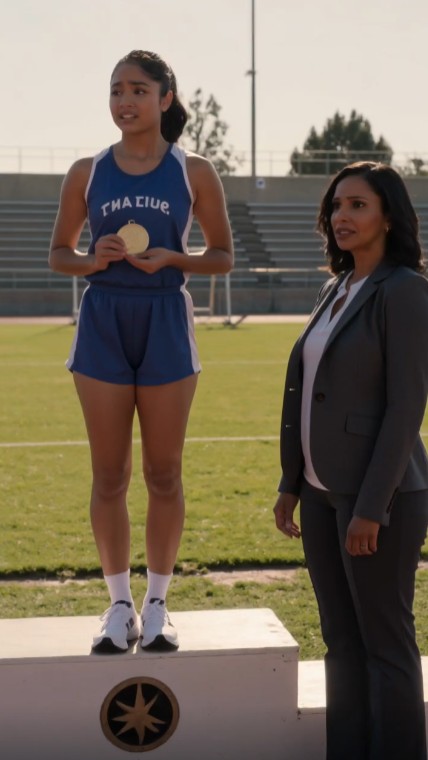
A 17-year-old girl won the biggest race of her life.
Then she walked straight past the photographers.
Past the podium.
Past the coaches waiting to congratulate her.
Past everyone calling her name.
And toward a man standing near the edge of the track holding a broom.
At first, the crowd looked confused.
Then the girl smiled.
The man was her father.
His name was Daniel.
And while hundreds of people knew his daughter Anna as one of the most promising young runners in the region, most of them knew Daniel only as the maintenance worker who arrived before sunrise and often left long after the final athlete had gone home.
Anna stopped in front of him.
Daniel looked embarrassed.
“Sweetheart, go back.”
The medal was still hanging around her neck.
The crowd was waiting.
The photographers were repositioning their cameras.
But Anna shook her head.
Then she removed the medal.
Daniel frowned.
“What are you doing?”
Anna gently placed it around his neck.
Her father froze.
“Anna…”
“You won this.”
She shook her head.
“No, Dad.”
“We did.”
For a moment, Daniel could not speak.
Anna took his hands.
“You worked every weekend so I could stand here today.”
Daniel looked down at the medal.
Then back at his daughter.
His eyes filled with tears.
The crowd slowly began applauding.
At first, only a few people.
Then the sound spread across the stadium.
Because the people watching had seen Anna win the race.
But very few knew how difficult it had been for her to reach the starting line.
Anna had started running when she was eight.
Not because anyone expected her to become an athlete.
She simply liked moving fast.
She raced neighborhood children.
Ran beside her bicycle instead of riding it.
Turned every walk to school into a competition against the clock.
One afternoon, a physical education teacher noticed her running during a school sports day.
Afterward, the teacher found Daniel.
“Your daughter is quick.”
Daniel laughed.
“She never sits still.”
“No.”
“I mean really quick.”
The teacher suggested a local athletics club.
Daniel went home and looked it up.
Then he saw the fees.
Registration.
Uniform.
Shoes.
Travel.
Competition costs.
It was more than he could comfortably afford.
Daniel worked maintenance at the town sports facility.
His salary covered rent, food, utilities, and the ordinary expenses of raising a daughter alone.
Anna’s mother, Elena, had died when Anna was six.
Daniel rarely spoke about how frightened he had been afterward.
He suddenly had to become everything.
Father.
Cook.
Homework helper.
Hair-braiding disaster.
Transportation.
Encouragement.
Discipline.
He learned.
Not perfectly.
But he learned.
When Anna brought home the athletics form, she did not ask him to sign it immediately.
She had already seen the fee.
She left it on the kitchen table.
Then said:
“It’s okay if we can’t.”
Daniel looked at her.
“Do you want to do it?”
Anna shrugged.
“Maybe.”
That meant yes.
Daniel knew her well enough.
The following week, he volunteered for two additional weekend shifts.
He signed the form.
Anna joined the club.
At first, she was nowhere near the best.
She was fast.
But undisciplined.
She started too quickly.
Burned energy.
Lost races she thought she should win.
After one terrible competition, she sat on the curb outside the stadium and cried.
“I’m not good enough.”
Daniel sat beside her.
“You lost one race.”
“I lost three.”
“Then you have three things to learn from.”
Anna glared at him.
“That sounds like something from a terrible motivational poster.”
Daniel nodded.
“Probably.”
She laughed despite herself.
That became their pattern.
Anna trained.
Daniel waited.
In winter, he stood outside practice with two cups of hot chocolate.
One for Anna.
One supposedly for himself.
She usually drank both.
In summer, he brought water.
When practices ended late, he stayed near the facility fixing equipment or sweeping corridors so he would not waste fuel driving home and returning.
The coaches noticed.
One asked:
“Daniel, are you always here?”
He smiled.
“I work here.”
The truth was more complicated.
He arranged his shifts around Anna’s training whenever possible.
If she practiced at six in the morning, Daniel volunteered for early maintenance.
If she had evening sessions, he took closing shifts.
Sometimes that meant working more hours than necessary.
Sometimes it meant cleaning locker rooms at nine o’clock at night while Anna finished strength training nearby.
But Daniel never told her how carefully he arranged everything.
He did not want the sport to feel like a debt.
When Anna was eleven, she needed better running shoes.
The pair her coach recommended cost far more than Daniel expected.
Anna saw the price tag.
“We can get cheaper ones.”
Daniel shook his head.
“These fit you?”
“Yes.”
“Then these.”
“What about your work boots?”
His boots were nearly worn through.
Daniel smiled.
“My feet are less dramatic than yours.”
He bought Anna the shoes.
Then put cardboard inside one of his own boots for another month.
Years later, Anna learned that.
She never forgot it.
At thirteen, she nearly quit.
A new girl joined the club and beat Anna repeatedly.
Anna became obsessed with winning.
Training stopped being fun.
One evening, she threw her running bag onto the kitchen floor.
“I’m done.”
Daniel looked up from making dinner.
“Okay.”
Anna stared.
“That’s it?”
“That’s it.”
“You’re not going to tell me not to quit?”
“No.”
She became angry.
“You always tell me to keep trying.”
Daniel turned off the stove.
“I tell you to keep trying when you still love what you’re trying.”
“If you hate running now, stop.”
Anna went quiet.
Daniel continued.
“But don’t quit tonight because somebody beat you.”
“Quit tomorrow.”
“If you wake up tomorrow and still want to stop, I’ll support you.”
The next morning, Anna put on her shoes.
Daniel said nothing.
She returned to training.
At fifteen, she began winning regularly.
Then came the regional championships.
Then national youth qualifiers.
People started noticing her.
Coaches discussed scholarships.
Local newspapers printed her name.
But success created new expenses.
Travel became farther.
Competitions required overnight stays.
Training became more specialized.
Daniel began working Saturdays and Sundays.
Sometimes both.
Anna believed he simply liked being busy.
Then one evening, she overheard him speaking with the facility manager.
“I can take the Sunday shift too.”
“You’ve worked twelve days straight.”
“I’m fine.”
“You said your daughter has a meet.”
“It’s Saturday.”
“And you’re driving four hours home afterward?”
Daniel laughed.
“I’ll sleep when she gets famous.”
Anna stood outside the office.
For the first time, she understood.
The extra shifts were not random.
They were paying for her.
She confronted him that evening.
“Dad, you can’t keep doing this.”
Daniel was washing dishes.
“Doing what?”
“Working every weekend.”
“I’ve always worked weekends.”
“No.”
“Not like this.”
Daniel did not answer.
Anna said:
“I can stop competing.”
He turned immediately.
“No.”
“We can’t afford it.”
“We can.”
“You’re exhausted.”
Daniel put down the plate.
“Anna.”
“I’m serious.”
“So am I.”
He dried his hands.
Then looked at her carefully.
“I’m not working because you owe me medals.”
“I’m working because right now, I can give you a chance.”
“If one day you decide you don’t want it, that’s fine.”
“But don’t give it up because you’re worried about me.”
Anna started crying.
Daniel hugged her.
Then ruined the moment by saying:
“Also, if you become famous, I expect a very comfortable retirement.”
Anna laughed into his shirt.
“Deal.”
The biggest race came two years later.
The national junior championship.
Anna was seventeen.
The winner would not automatically become a professional athlete.
There were no guarantees.
But scouts would be there.
University coaches.
People who could open doors.
Anna trained for months.
Then, three weeks before the competition, she lost badly in a smaller race.
Her confidence collapsed.
“I’m going to choke.”
Daniel was repairing a broken locker hinge.
“You might.”
Anna stared.
“That is terrible parenting.”
He shrugged.
“You might lose.”
“You might run badly.”
“You might trip.”
“You might run the best race of your life and somebody could still be faster.”
“That’s sport.”
Anna sat beside him.
“Then what am I supposed to do?”
“Show up.”
“That’s it?”
“Run the race you trained for.”
Daniel tightened the final screw.
“Everything after that belongs to the clock.”
On championship morning, Daniel was at the facility before Anna.
Not as a parent.
As an employee.
A pipe had leaked in one of the changing areas the night before.
Maintenance needed extra hands.
Anna found him pushing a mop bucket down the corridor.
“You’re working today?”
“Only this morning.”
“Dad.”
“What?”
“You’re supposed to watch me.”
“I will.”
“You better.”
Daniel saluted with the mop.
Anna rolled her eyes.
Two hours later, she stood on the starting line.
The stadium seemed enormous.
She could hear the crowd.
Then everything became quiet.
The starter raised the pistol.
Anna thought about one thing Daniel always said.
Run your race.
The signal sounded.
She started well.
Not too fast.
At the halfway point, she was third.
Then second.
With less than one hundred meters remaining, the favorite still led.
Anna pushed harder.
Her legs burned.
The noise around her disappeared.
She crossed the finish line.
For several seconds, she did not know who won.
Then the scoreboard changed.
Anna’s name appeared first.
She had won by less than half a second.
She stared.
Then screamed.
Her coach grabbed her.
Teammates surrounded her.
Photographers rushed toward the track.
Someone put a flag around her shoulders.
An official told her to prepare for the podium.
Anna looked toward the stands.
She could not see Daniel.
Then she noticed movement near the service entrance.
Her father was there.
Still wearing his maintenance uniform.
Holding a broom.
He had finished cleaning an area moments before the race and arrived just in time.
Anna started walking toward him.
Her coach called:
“Anna! Podium!”
She kept going.
Photographers followed.
Daniel saw her coming and immediately shook his head.
“Go back.”
Anna smiled.
“No.”
She removed the medal.
Then placed it around his neck.
Daniel tried to stop her.
“Sweetheart, you earned this.”
Anna held his hands.
“So did you.”
Daniel’s face broke.
The man who had stood through freezing practices.
The man who patched his work boots because she needed running shoes.
The man who spent weekends cleaning the same facility where she trained.
The man who never asked her to win enough to justify any of it.
He began crying.
Anna hugged him.
The applause started.
Daniel whispered:
“I didn’t run one step.”
Anna answered:
“You got me to every starting line.”
A photographer captured the moment.
The photograph spread through the local community afterward.
People saw a young champion putting a medal around a maintenance worker’s neck.
Many assumed it was a spontaneous gesture.
It was.
But the story behind it was not one moment.
It was years of small ones.
Early mornings.
Late evenings.
Packed lunches.
Secondhand equipment.
Extra shifts.
Driving in bad weather.
Waiting outside practice.
Listening after losses.
Never making Anna feel that his sacrifices were something she had to repay.
After the medal ceremony, Daniel tried to give it back.
Anna refused.
“You keep it tonight.”
“It’s yours.”
“I know.”
“Then take it.”
“No.”
Daniel sighed.
“You are extremely difficult.”
“You raised me.”
“Unfortunately.”
Anna laughed.
That evening, they went home.
No expensive celebration.
No restaurant.
Daniel made pasta.
Badly.
Anna ate it anyway.
The medal hung from a kitchen chair.
Daniel looked at it.
Then said:
“Your mother would have been loud today.”
Anna smiled.
“She would have embarrassed me.”
“Completely.”
They sat quietly.
Then Anna asked:
“Do you think she would have been proud?”
Daniel looked at her.
“Of the medal?”
Anna nodded.
Daniel shook his head.
“She would have been proud before you ran.”
Anna never forgot that answer.
The victory opened doors.
She received university interest.
Training support.
Eventually, a scholarship that covered much of what Daniel had spent years struggling to provide.
But the medal remained at home.
Anna placed it in a frame.
Not with a photograph of herself crossing the finish line.
With the photograph of Daniel holding the broom while she placed the medal around his neck.
Underneath, she wrote:
He never ran the race.
He made sure I could.
Years later, whenever people asked Anna about her first major victory, they expected her to describe the final hundred meters.
The competitor beside her.
The finish line.
The moment she saw her name on the scoreboard.
Anna usually talked about something else.
A father waiting outside in the cold.
A pair of work boots held together longer than they should have been.
A man accepting extra shifts without telling his daughter why.
And one sentence repeated after every difficult race:
Show up.
That was Daniel’s gift.
Not a guarantee she would win.
A chance to keep showing up.
So when Anna finally crossed the finish line first, she did not walk toward the cameras.
She walked toward the person who had been there before anyone was watching.
The man holding the broom.
Her father.
Because some victories are won in a few seconds.
Others are built quietly over years.
And sometimes the person who deserves part of the medal is the one who never stepped onto the track at all.