
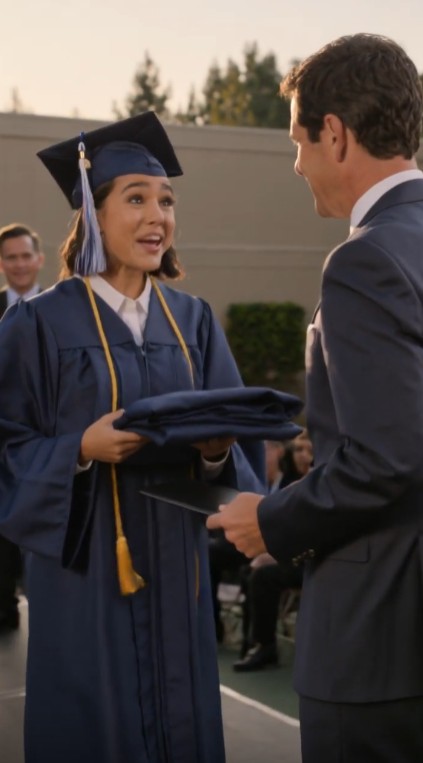
A young woman walked onto her graduation stage carrying two gowns.
The entire auditorium noticed.
One gown was already draped over her shoulders.
The other was folded carefully across her arms.
Her name was Anna.
She was twenty-four years old.
After years of studying, working part-time, and commuting across town for classes, she was finally graduating.
Her mother, Maria, sat in the front row.
She had been smiling from the moment the ceremony began.
Every few minutes, she wiped her eyes.
Anna reached the center of the stage.
The presenter held her diploma folder.
The audience waited for the usual handshake.
Instead, Anna turned toward the front row.
“Mom…”
Maria looked up.
Anna smiled.
“Please come up here.”
Maria froze.
People around her began turning.
She shook her head.
“No, sweetheart.”
Anna laughed through tears.
“Please.”
The presenter smiled too.
“We’re going to need you up here.”
Maria slowly stood.
She looked embarrassed.
Confused.
And completely unprepared.
For twenty-four years, she had worked for this moment.
But she never imagined the stage would include her.
Maria had raised Anna almost entirely on her own.
When Anna was little, Maria worked mornings at a bakery.
Then evenings cleaning offices.
Later, she became a receptionist at a medical clinic.
Whatever job she had, the routine was similar.
Wake early.
Work.
Come home.
Cook.
Pay bills.
Try to make the money stretch until the next paycheck.
Anna grew up understanding that her mother was always tired.
She just didn’t understand why until she got older.
There were school shoes Maria delayed buying for herself.
Trips she never took.
Meals she claimed she wasn’t hungry for.
Courses she wanted to attend but never did.
Whenever Anna asked what Maria had wanted to become when she was young, Maria always gave the same answer.
“It doesn’t matter anymore.”
But it did.
When Maria was nineteen, she had enrolled in a business administration program.
She completed almost a year.
Then Anna’s grandmother became ill.
Maria left school to help the family.
Later, Anna was born.
Returning to college became something she would do someday.
Someday kept moving.
Anna remembered finding one of her mother’s old textbooks when she was thirteen.
Inside was a handwritten note:
Finish degree.
She asked Maria about it.
Her mother laughed.
“That was another lifetime.”
Anna never forgot.
Years later, when Anna started university, Maria was the one who encouraged her through every difficult semester.
When Anna failed her first statistics exam, Maria sat beside her at the kitchen table.
“You’re allowed to fail one test.”
“It doesn’t mean anything.”
When Anna considered dropping a class because tuition and work were becoming too much, Maria took extra shifts.
Anna protested.
Maria refused to discuss it.
“You finish what you started.”
The words stayed with Anna.
Then, during Anna’s second year, something changed.
Maria’s clinic began offering education support for employees.
Part-time courses.
Evening classes.
Online modules.
One day Anna found her mother sitting at the kitchen table staring at an application form.
“Mom.”
Maria closed the laptop.
“What?”
“You’re thinking about going back.”
“No.”
“You absolutely are.”
Maria laughed.
“I’m fifty-two.”
“So?”
“I have a full-time job.”
“So?”
“I haven’t written an academic paper in thirty years.”
Anna smiled.
“I can help.”
Maria shook her head.
“No.”
But Anna pushed.
Not aggressively.
Just persistently.
She helped Maria find old transcripts.
Contact the college.
Transfer qualifying credits.
Complete forms.
Eventually, Maria enrolled in one evening course.
She told almost nobody.
Not because she was embarrassed.
Because she was afraid.
“What if I can’t do it anymore?”
Anna gave her the same answer Maria had given years earlier.
“You finish what you started.”
Maria passed.
Then took another course.
Then another.
For almost four years, mother and daughter studied at the same time.
Different programs.
Different schedules.
Same kitchen table.
Some nights Anna worked on research while Maria read accounting chapters.
Other nights Maria quizzed Anna while folding laundry.
They argued over whose coffee was worse.
They shared deadlines.
They shared exhaustion.
And slowly, quietly, Maria completed the degree she had abandoned decades earlier.
There was only one problem.
Maria’s final credits were approved just weeks before Anna’s graduation.
She assumed her own ceremony would be held later.
She didn’t know Anna had contacted the university.
Anna had discovered that her mother’s program was administered through an affiliated adult-learning division.
Both qualifications were being conferred during the same graduation period.
So Anna asked a question.
Could they graduate together?
Normally, graduates crossed with their assigned group.
But after reviewing the circumstances, the university agreed to a small ceremonial acknowledgment.
Nothing fake.
Nothing honorary.
Maria had completed all required coursework.
Her degree was real.
Her results were finalized.
Her name simply appeared in a different section of the program.
Anna arranged everything without telling her.
That explained the second gown.
Now Maria slowly climbed the stairs to the stage.
The audience began applauding before she even reached the top.
She whispered to Anna:
“What are you doing?”
Anna held up the second gown.
“Mom, there’s something I’ve been waiting to tell you.”
Maria frowned.
“What?”
The presenter opened a second certificate folder.
Then stepped toward the microphone.
The room became quiet.
“We have one additional graduate we would like to recognize.”
Maria’s face changed.
The presenter continued.
“Maria Carter has completed the requirements for her Bachelor’s degree in Business Administration through our adult-learning program.”
Maria stared.
For a moment, she looked as though she had not understood the words.
Then she looked at Anna.
“No.”
Anna was already crying.
“Yes.”
“You knew?”
“For weeks.”
Maria covered her mouth.
The presenter smiled.
“Maria, this certificate is yours.”
Anna unfolded the second gown.
Then gently placed it over her mother’s shoulders.
Maria began crying.
Not politely.
Not quietly.
The kind of crying that comes when decades suddenly collapse into one moment.
She held the certificate with both hands.
Then whispered:
“I thought this part of my life was over.”
Anna shook her head.
“You told me to finish what I started.”
Maria laughed through tears.
“You used my own words against me.”
“Absolutely.”
The audience stood.
Not all at once.
A few people first.
Then rows behind them.
Within seconds, nearly the entire auditorium was on its feet.
Anna hugged her mother.
Maria held her tightly.
For years, Maria had described Anna’s education as the most important thing.
She had never allowed herself to believe her own unfinished dream deserved equal space.
That was why Anna arranged the surprise.
Not to repay her mother.
Anna knew she could never reduce twenty-four years of love to one ceremony.
She wanted Maria to see something else.
Sacrifice did not have to mean disappearance.
A parent could give deeply to a child and still reclaim something for themselves.
After the ceremony, everyone wanted photographs.
Anna and Maria stood side by side in matching gowns.
Maria kept looking down at the certificate.
“I still think there’s been a mistake.”
Anna laughed.
“You did the work.”
“I nearly quit six times.”
“So did I.”
“You failed statistics.”
“Why are we bringing that up today?”
Maria smiled.
Then became serious.
“I went back because of you.”
Anna shook her head.
“No.”
“You went back because you were ready.”
Maria looked at her.
“You helped.”
“So did you.”
That evening, instead of attending a large celebration, they went to the same little diner they had visited throughout Anna’s childhood.
Maria still wore part of her graduation outfit.
Anna placed both certificates on the seat beside them.
The waitress laughed.
“Two graduates?”
Anna pointed toward Maria.
“She’s the important one.”
Maria immediately protested.
“No.”
Anna smiled.
“See? She’s been doing that my entire life.”
Maria reached across the table and held her daughter’s hand.
“When you were born, I thought becoming your mother meant putting everything else away.”
Anna listened.
“And I don’t regret choosing you.”
“Not one day.”
“But I think somewhere along the way, I confused loving you with believing my own dreams no longer mattered.”
Anna squeezed her hand.
“They mattered.”
Maria nodded.
“I know that now.”
Months later, Maria received a promotion at the clinic.
Her degree helped.
But the bigger change was personal.
She stopped describing herself as someone who had “almost gone to college.”
She had finished.
At fifty-six.
Decades later than expected.
Still finished.
Anna framed one photograph from graduation.
It showed the exact moment she placed the gown over her mother’s shoulders.
Maria’s hands covered her mouth.
Anna was smiling through tears.
On the back, Anna wrote:
You gave me a future without realizing yours was still waiting.
Maria kept another photograph.
In hers, they were both holding diplomas.
She wrote beneath it:
We finished what we started.
Years later, when people asked Anna what she remembered most about graduation, she rarely mentioned hearing her own name.
She remembered calling her mother’s.
She remembered the confusion in the auditorium.
The second gown.
The second certificate.
And the moment Maria finally understood that she was not being invited onto the stage only as the proud mother of a graduate.
She belonged there as one herself.
For twenty-four years, Maria helped her daughter chase a future.
Then, quietly, while almost nobody was watching, she went back and reclaimed the one she had once put aside.
That was why Anna carried two gowns.
One represented the life she had worked toward.
The other represented the dream her mother had postponed but never completely lost.
And when the entire auditorium stood to applaud, they were not only celebrating a daughter who graduated.
They were celebrating the mother who discovered it was not too late to graduate too.