
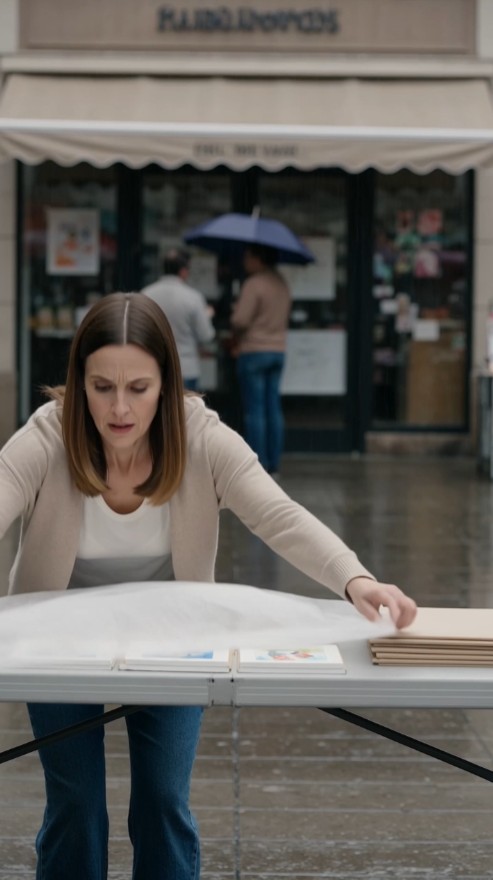
It started with a few drops.
Clara looked up at the sky.
Gray clouds had been gathering over the market square for almost an hour, but the weather forecast had promised only light rain.
She had believed it.
That was a mistake.
Within seconds, the drizzle became heavier.
Clara grabbed the thin plastic sheet beneath her folding table.
“No, no, no…”
Around her were sixteen paintings.
Months of work.
Portraits.
Street scenes.
Small moments between ordinary people.
She had finally saved enough money to rent a stall at the weekend art market.
Now rain was beginning to hit the canvases.
Clara pulled the plastic over the nearest paintings.
It covered maybe half of them.
The wind lifted one corner.
She fought it down with both hands.
People rushed through the square.
Umbrellas opened everywhere.
Vendors lowered awnings.
One jewelry seller had a proper waterproof tent.
A clothing stall had side panels.
Clara had nothing except the cheap sheet.
She tried moving two canvases beneath the table.
Another gust of wind pushed rain across the display.
“Please.”
She did not know who she was talking to.
The weather.
The paintings.
Herself.
Then a woman stopped.
She was carrying a large black umbrella.
She looked at Clara.
Then at the paintings.
Without asking permission, she stepped beside the stall and held the umbrella over three canvases.
“Here.”
Clara looked up.
“What?”
“Move the others underneath.”
“You’ll get soaked.”
The stranger smiled.
“It’s water.”
Clara hesitated.
“Thank you.”
She slid two paintings closer together.
The umbrella covered them.
But rain was still hitting the other side of the display.
Then another person stopped.
A man with a blue umbrella.
He looked at the woman.
Then understood.
“I’ve got this side.”
Clara stared.
“No, really, you don’t have to—”
He opened the umbrella wider.
“Which ones need covering?”
A young couple passing nearby slowed down.
The woman pointed.
“Are those paintings getting wet?”
Her boyfriend looked at his umbrella.
Then walked over.
Within less than a minute, four umbrellas were hovering above Clara’s art stall.
Then six.
Then ten.
People saw what was happening.
Some joined without even asking.
A teenager held a bright yellow umbrella over two smaller canvases.
An elderly man stood beside him with a green one.
A mother handed her umbrella to her teenage daughter and used her coat hood instead.
A delivery cyclist stopped under the awning of a café, looked across the square, then returned carrying another umbrella someone had lent him.
Clara stood in the middle of it all.
Speechless.
A canopy of strangers had formed around her paintings.
Black.
Blue.
Red.
Yellow.
Green.
Twenty people, shoulder to shoulder, holding umbrellas over artwork belonging to a woman most of them had never met.
The market manager eventually appeared with a proper waterproof cover.
But before he could spread it over the stall, one of the women noticed something.
She had been standing beside a large painting showing a bus driver helping an elderly passenger down the steps.
She looked at another.
A waitress placing a meal in front of a tired-looking man.
Another showed a nurse tying a child’s shoelace in a hospital corridor.
Another depicted a woman holding a stranger’s baby while the mother tied her shoe.
The woman frowned.
“Clara?”
Clara looked over.
“How do you know my name?”
“It’s on your sign.”
“Oh.”
The woman pointed toward the paintings.
“Who are these people?”
Clara became still.
For a moment, the rain seemed louder.
She looked around at the portraits.
Then said quietly:
“They’re people who helped me.”
The woman waited.
Clara’s eyes filled with tears.
“When I had almost nothing.”
Nobody planned to stay and listen.
But nobody moved.
Clara had not always been an artist selling paintings at weekend markets.
Five years earlier, she had been twenty-eight years old and working at a small design company.
She had an apartment.
A regular salary.
A routine.
Then the company collapsed.
The closure happened quickly.
Two months of financial trouble.
One Friday meeting.
Everyone dismissed.
Clara assumed she would find another job.
She was talented.
Experienced.
Responsible.
But weeks became months.
Applications disappeared into silence.
Her savings shrank.
Then her landlord announced a rent increase.
Clara moved to a cheaper apartment.
Then another.
She sold furniture.
Canceled subscriptions.
Took short-term work wherever she could find it.
Restaurant shifts.
Cleaning.
Delivery packing.
Anything.
Then her father became ill.
Clara began traveling frequently to help him.
More money disappeared.
More work was missed.
After he died, she returned home carrying grief and several unpaid bills.
That winter, she lost her apartment.
Clara hated saying the sentence even now.
“I became homeless.”
The strangers under the umbrellas became quiet.
She continued.
Not every night was spent outside.
Sometimes she slept on a friend’s sofa.
Sometimes in a temporary hostel.
Several nights in a cheap motel when she could afford it.
Once, after missing the last bus, she slept in a train station waiting area until security told her to move.
Clara had never imagined her life could become unstable that quickly.
People often believed homelessness had one face.
It did not.
Clara still had clean clothes.
A phone.
A backpack.
A few freelance projects.
Sometimes nobody knew.
The first painting in the collection showed a bus driver.
His name was Marcus.
One winter evening, Clara boarded his bus.
Her travel card did not work.
She had almost no money left.
The machine rejected it twice.
Clara began searching her bag.
People behind her became impatient.
Marcus looked at her.
“You getting off downtown?”
She nodded.
“Sit down.”
“I can pay tomorrow.”
“Sit down.”
The next evening, Clara returned with the fare.
Marcus refused the extra money she tried giving him.
“Just pay for today.”
She never forgot it.
The next painting showed a waitress named Elena.
Clara had been sitting in a small café for almost two hours using the Wi-Fi to submit job applications.
She ordered only tea.
Elena brought her a bowl of soup.
Clara said:
“I didn’t order this.”
“I know.”
“I can’t pay for it.”
“I know.”
Clara stared.
Elena shrugged.
“Kitchen made too much.”
Years later, Clara discovered there had been no extra soup.
Elena had paid for it herself.
Another painting showed an elderly woman holding a red umbrella.
Her name was Margaret.
Clara had been carrying all her possessions in two bags when one split open at a crosswalk.
Clothes fell onto wet pavement.
People stepped around her.
Margaret stopped.
She held an umbrella over Clara while helping gather everything.
Then gave Clara the reusable shopping bag she had been carrying.
“Take it.”
“But your groceries?”
“I live around the corner.”
That bag lasted almost two years.
Another portrait showed a barber.
He had allowed Clara to charge her phone every morning from an outlet near his shop.
Another showed a librarian who quietly extended computer sessions when Clara was applying for work.
Another depicted a shelter worker who kept a small box of art supplies in her office.
That was where painting returned to Clara’s life.
The worker’s name was Naomi.
One night, Clara was sitting at a table drawing on the back of an old flyer.
Naomi stopped.
“You’re good.”
Clara laughed.
“I used to be better.”
“Then practice.”
“With what?”
The following morning, Naomi placed a half-used sketchbook and several pencils on the table.
Nothing expensive.
But Clara began drawing again.
Faces.
Hands.
People on buses.
People waiting for food.
People helping without realizing they were being remembered.
Clara eventually found more stable work.
A part-time design position first.
Then freelance illustration.
She rented a small room.
Then a studio apartment.
Slowly, the emergency ended.
But she continued painting.
Not because she wanted to document the worst period of her life.
Because she wanted to document what had interrupted it.
Kindness.
Small kindness.
Usually from people who had no reason to expect anything in return.
One of the strangers beneath the umbrellas asked:
“Did all these people know you painted them?”
Clara shook her head.
“Some.”
“Most don’t.”
“Why not?”
“I never knew how to find all of them.”
The woman looked at the bus-driver painting.
“Did you find him?”
“Yes.”
Clara smiled.
Marcus cried when he saw it.
Then complained that she had painted his nose too large.
Several people laughed.
The tension eased.
Then the teenager with the yellow umbrella pointed toward another canvas.
It showed a man sitting on a park bench while a woman rested her head in her hands.
“What happened there?”
Clara looked at it.
“That man’s name was Henry.”
During one of her worst weeks, Clara had sat in a park trying not to cry.
Henry sat beside her.
He was probably in his seventies.
He never asked what was wrong.
After several minutes, he handed her a tissue.
Then said:
“You don’t have to explain.”
They sat in silence.
Before leaving, Henry pointed toward a bakery across the road.
“They throw away too much at closing.”
Clara did not understand.
He smiled.
“Go ten minutes before they close.”
Then he left.
Clara followed the advice.
The bakery owner gave her two unsold rolls and a pastry.
Henry never knew what that meant.
Clara never saw him again.
She painted him from memory.
The woman with the black umbrella looked around.
“So the whole collection is people helping people?”
“Mostly.”
“Why mostly?”
Clara pointed toward a small unfinished canvas at the edge of the stall.
It showed only the beginning of a rainy market square.
Umbrellas.
No faces yet.
“I hadn’t decided how to finish that one.”
The strangers looked at each other.
Clara laughed through her tears.
“I think I know now.”
By then, the market manager had secured a large waterproof canopy over the stall.
The paintings were safe.
People could leave.
But most did not.
The first woman closed her umbrella.
“What’s this collection called?”
Clara looked toward the paintings.
“Things People Thought I’d Forget.”
The woman smiled.
“That’s beautiful.”
Clara shook her head.
“It’s literal.”
People began examining the paintings properly.
One man bought a small print.
Another asked whether Clara had a website.
A woman wanted to commission a portrait of her late grandmother.
Clara was suddenly embarrassed.
“I wasn’t telling you the story so you’d buy anything.”
The woman laughed.
“We know.”
By the end of the afternoon, Clara had sold more work than during any previous market.
But what happened afterward mattered more.
Someone had taken a photograph of the umbrellas.
Not a close-up of Clara.
Not a staged photo.
Just the colorful canopy formed above the art stall.
They posted it in a local neighborhood group with a short caption explaining what happened.
The photograph spread.
A week later, Clara received a message.
ARE YOU THE ARTIST WHO PAINTED MARCUS THE BUS DRIVER?
It was Marcus’s daughter.
Then another message arrived.
A librarian recognized herself.
Then someone tagged Elena, the waitress.
One by one, people from the paintings began finding Clara.
Some were still in the city.
Some had moved.
Some barely remembered what they had done.
That surprised Clara most.
She met Elena first.
Clara brought the painting to the café.
Elena stared at it.
Then said:
“You remembered the soup?”
“Of course.”
“It was soup.”
“To you.”
Elena became quiet.
Clara added:
“To me, it was dinner.”
The librarian laughed when she saw her portrait.
“I just gave you twenty extra minutes on a computer.”
Clara answered:
“It was enough to send the application that got me my first job afterward.”
Marcus insisted again that his nose was wrong.
Clara refused to repaint it.
Not every person was found.
Henry from the park remained a mystery.
So did several others.
Clara learned to accept that.
Sometimes gratitude has nowhere to be delivered.
It still matters.
Then came an unexpected invitation.
A community gallery had seen the photograph of the umbrella canopy.
They offered Clara a small exhibition.
She hesitated.
Most of the work had never been intended for a gallery.
It felt personal.
Naomi, the shelter worker, convinced her.
“People should see this.”
“You’re in one of them.”
“Exactly.”
The exhibition opened three months later.
Clara titled it:
UNDER THE SAME UMBRELLA.
At the entrance hung the unfinished market painting.
She had completed it.
Twenty figures stood beneath umbrellas of different colors.
Their faces were intentionally indistinct.
At the center, Clara painted herself trying to protect the artwork.
Beneath the painting was a short sentence:
THEY DIDN’T KNOW THEY WERE BECOMING PART OF THE COLLECTION.
Several of the people portrayed in older paintings attended opening night.
Marcus.
Elena.
Naomi.
The librarian.
Margaret, the woman who had helped collect Clara’s belongings from the wet pavement.
Margaret stared at her portrait for a long time.
Then asked:
“Why did you remember me?”
Clara answered:
“Because everyone else kept walking.”
Margaret looked down.
“I nearly did too.”
“That makes it more important.”
One wall of the gallery was left nearly empty.
Visitors were given small cards and invited to write about someone whose small act of kindness they had never forgotten.
By the end of opening night, the wall was full.
A teacher who bought breakfast.
A stranger who changed a flat tire.
A nurse who stayed ten minutes after her shift.
A neighbor who shoveled someone’s driveway.
A child who shared lunch.
A cashier who quietly paid the remaining balance when a customer was short.
Hundreds of tiny stories.
Clara stood reading them.
Naomi came beside her.
“You see?”
“What?”
“You thought your paintings were about your life.”
“Aren’t they?”
Naomi pointed toward the wall.
“They’re about everybody’s.”
Clara smiled.
The exhibition eventually ended.
The gallery asked to extend it.
Clara agreed for another month.
She donated part of the print sales to the temporary housing program that had once helped her.
Not because she believed every problem could be solved by individual kindness.
She knew better.
Affordable housing mattered.
Stable employment mattered.
Accessible public services mattered.
A bowl of soup could not replace any of those things.
But when systems failed or took time, ordinary people could still reduce someone’s loneliness.
That mattered too.
Years later, Clara became a full-time illustrator.
She still attended markets occasionally.
She bought a proper waterproof tent.
A very expensive one.
The first woman who had held an umbrella over her paintings laughed when she saw it.
“You finally learned.”
Clara smiled.
“I check the weather now too.”
They had become friends.
Her name was Julia.
Clara eventually asked why Julia stopped that day.
She expected a meaningful answer.
Julia shrugged.
“You looked like you needed another pair of hands.”
“That’s it?”
“That’s it.”
Clara laughed.
That answer fit the collection perfectly.
Most kindness did not begin with dramatic speeches.
Someone simply noticed.
Then did the next helpful thing.
Hold an umbrella.
Share a meal.
Wait with someone.
Offer a seat.
Listen.
Years after that rainy afternoon, Clara still kept the original small plastic sheet folded in her studio.
It was nearly useless.
Too thin.
Torn at one corner.
A visitor once asked why she had not thrown it away.
Clara looked at it.
“Because it reminds me what happened when it stopped being enough.”
“What happened?”
“Other people became the cover.”
On the wall above it hung a photograph.
Twenty umbrellas.
A tiny art stall beneath them.
Strangers standing shoulder to shoulder in heavy rain.
Some looking toward the paintings.
Some laughing.
Some completely soaked around the edges.
Nobody in that photograph had arrived planning to become part of someone else’s story.
They were simply walking through a square.
Then one woman stopped.
Another followed.
Then another.
Until Clara’s paintings were protected beneath a roof made entirely of people who had decided not to keep walking.
And when those strangers learned that every painting showed someone who had once helped Clara during the hardest period of her life, they understood something beautiful.
The collection had not ended.
It had simply reached its next canvas.