
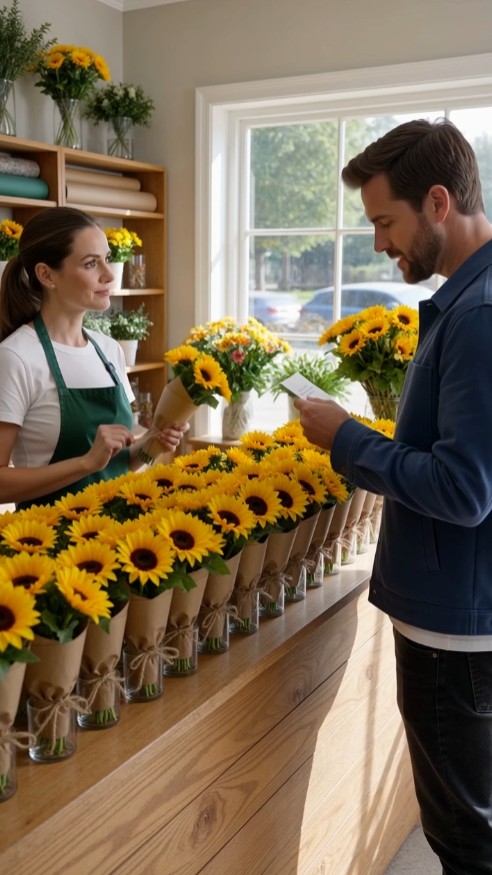
The florist thought her ordering system was broken.
Twenty-six bouquets.
Twenty-six different customers.
And every single order had the exact same destination.
Not a house.
Not a hospital.
Not an office.
A wooden bench.
Under an old oak tree.
In the middle of a public park.
The florist, Clara, stared at the screen.
“That can’t be right.”
She refreshed the orders.
Nothing changed.
Roses.
Tulips.
Sunflowers.
Lilies.
Wildflowers.
Different messages.
Different names.
Same delivery point.
BENCH NEAR THE EAST GARDEN.
UNDER THE LARGE OAK TREE.
Clara called her delivery driver.
“Alex, can you check something?”
He walked over.
She turned the monitor toward him.
Alex read the first few orders.
Then laughed.
“Who sends flowers to a bench?”
“I don’t know.”
“Twenty-six people?”
“Apparently.”
“Are they all paid?”
“Yes.”
Alex looked again.
“Then I guess the bench is having a very good day.”
By late morning, the van was full.
Alex drove across town toward the park.
He expected to find a memorial gathering.
Maybe a birthday.
Maybe some kind of public event.
But when he arrived, the bench was completely empty.
No people.
No signs.
No balloons.
Nothing.
Just an old wooden bench beneath an enormous oak tree.
Alex checked the instructions again.
Correct location.
He began unloading the bouquets.
One by one.
He arranged them carefully beside the bench.
Then an older woman in a green gardening vest approached.
She was pushing a small cart filled with tools.
Her name was Margaret.
She had worked in the park for more than twenty years.
“Are those for someone?”
Alex shrugged.
“Apparently.”
“How many?”
“Twenty-six.”
Margaret looked surprised.
“Twenty-six?”
“Different customers.”
“All sent here.”
She stared at the flowers.
Then noticed one of the cards.
A cream-colored envelope was tucked into a bouquet of yellow tulips.
Margaret pointed.
“Can I see that?”
Alex hesitated.
“They’re private messages.”
“I understand.”
Then she noticed a name written on the outside.
Her expression changed.
She whispered:
“Please.”
Alex handed her the envelope.
Margaret opened it.
The first line read:
FOR THE WOMAN WHO SAT WITH ME HERE WHEN I HAD NOWHERE ELSE TO GO.
Margaret stopped breathing for a moment.
She read it again.
Then covered her mouth.
Her eyes filled with tears.
Alex became concerned.
“Ma’am, are you okay?”
Margaret nodded.
Then whispered:
“I thought nobody remembered.”
Alex looked at the card.
“You know who these are for?”
Margaret looked toward the bench.
“Yes.”
“They’re for me.”
Alex stared at her.
All twenty-six bouquets?
Margaret sat down slowly.
For years, she had taken her lunch break on that same bench.
It was quieter than the staff room.
She could watch the trees.
Listen to birds.
And for thirty minutes each day, nobody asked her to trim anything, water anything, or fix anything.
But Margaret rarely spent those breaks completely alone.
The bench sat beside one of the busiest walking paths in the park.
Over the years, people stopped there.
Tourists.
Workers.
Teenagers.
Parents.
Older people.
Sometimes they spoke to Margaret.
Sometimes they didn’t.
She never thought much about those conversations.
Apparently, other people did.
Alex picked up another card.
Margaret nodded.
“Read it.”
It said:
YOU GAVE ME YOUR SANDWICH THE DAY I LOST MY JOB AND COULDN’T AFFORD LUNCH.
Margaret laughed softly.
“I remember him.”
“Who?”
“A man named Peter.”
“He used to sit here every Tuesday.”
She looked at the flowers.
“He told me he worked nearby.”
One afternoon, Peter came to the park looking devastated.
He had been dismissed that morning.
He sat beside Margaret for nearly an hour.
She did not try to solve his life.
She simply listened.
When she opened her lunch bag, she noticed he kept looking at the sandwich.
So she broke it in half.
Peter refused.
Margaret insisted.
That was all.
At least that was all she remembered.
Alex opened another envelope.
THANK YOU FOR TEACHING MY DAUGHTER HOW TO PLANT HER FIRST SUNFLOWER.
Margaret smiled immediately.
“A little girl named Sophie.”
The girl visited the park every afternoon with her father.
One spring, she asked Margaret why one flower bed looked empty.
Margaret explained that seeds had just been planted.
Sophie wanted to know how something so tiny became a flower.
Margaret brought her a spare pot.
Soil.
One sunflower seed.
Then showed her how to plant it.
Sophie came back every few days to give Margaret updates.
The seed sprouted.
The plant grew.
Eventually, Sophie brought the sunflower back to the park in a bright yellow pot.
Margaret had almost forgotten.
Another card read:
YOU TOLD ME I DIDN’T HAVE TO HAVE MY WHOLE LIFE FIGURED OUT AT NINETEEN.
Margaret covered her eyes.
“Oh.”
She remembered that one too.
A university student named Rachel.
She had been crying on the bench after failing an important exam.
Rachel said she had disappointed her parents.
Ruined her degree.
Ruined her future.
Margaret asked:
“How old are you?”
“Nineteen.”
Margaret answered:
“Then you are much too young to have ruined everything.”
Rachel laughed through tears.
Margaret told her about the jobs she had tried before becoming a gardener.
Waitress.
Shop assistant.
Receptionist.
Factory worker.
Nothing had happened according to plan.
And somehow she still ended up somewhere she loved.
Alex continued reading.
One card after another.
YOU CALLED AN AMBULANCE WHEN MY FATHER COLLAPSED HERE.
YOU SAT WITH MY SON UNTIL I FOUND HIM AFTER HE GOT LOST.
YOU REMEMBERED MY WIFE’S NAME A YEAR AFTER SHE DIED.
YOU GAVE ME YOUR UMBRELLA AND WALKED HOME IN THE RAIN.
YOU ALWAYS SAID HELLO WHEN I WAS LONELY.
YOU NEVER ASKED WHY I WAS CRYING. YOU JUST SAT BESIDE ME.
Margaret shook her head.
“I don’t understand.”
Alex asked:
“What?”
“Why today?”
That was the part neither of them knew.
Then Clara, the florist, called.
“Alex?”
“Yes?”
“I figured something out.”
“What?”
“One customer left a phone number.”
Clara had contacted the woman because one bouquet had incomplete delivery instructions.
The woman’s name was Rachel.
The same former student whose card Margaret had just read.
Rachel explained everything.
Several weeks earlier, she had visited the park.
She expected to see Margaret.
Instead, another gardener told her Margaret planned to retire at the end of the month.
Rachel suddenly realized she had never properly thanked her.
So she posted a message in a local community group.
It was simple:
DOES ANYONE ELSE REMEMBER THE GARDENER WHO SITS ON THE EAST-PARK BENCH UNDER THE OAK TREE?
Responses arrived almost immediately.
Yes.
I know her.
Margaret.
She helped my family once.
She used to talk to my son.
She found my wallet.
She helped me when I was having a terrible day.
Within hours, dozens of people had stories.
Rachel had an idea.
She contacted the florist.
Instead of organizing a public surprise that might embarrass Margaret, she asked everyone who wanted to participate to send flowers to the bench.
No big ceremony.
No speeches.
Just one bouquet and one note from each person.
Twenty-six people participated.
Rachel told Clara:
“We wanted her to see what she probably never saw.”
“What?”
“How many people carried those tiny moments with them.”
Alex put the call on speaker.
Margaret listened quietly.
Then Rachel’s voice came through.
“Is she there?”
Alex looked at Margaret.
She nodded.
He handed over the phone.
“Hello?”
There was silence.
Then Rachel said:
“Hi, Margaret.”
Margaret immediately recognized her voice.
“Rachel?”
“You remember me?”
Margaret laughed through tears.
“You cried on my bench for almost two hours.”
Rachel laughed.
“I remember.”
“You passed that exam eventually?”
“No.”
Margaret paused.
Rachel continued.
“I changed courses.”
“And?”
“I’m a teacher now.”
Margaret smiled.
“Good.”
Rachel’s voice became softer.
“You told me failing one thing didn’t mean my life was finished.”
“I really needed that.”
Margaret looked around at the bouquets.
“You organized this?”
“Some of it.”
“The others wanted to do it too.”
Margaret shook her head.
“You people spent too much money.”
“That sounds exactly like what everyone said you’d say.”
Alex laughed.
Margaret wiped her eyes.
Then Rachel asked:
“Did you read all the cards?”
“Not yet.”
“Please do.”
Margaret stayed on the bench long after Alex finished his delivery.
She read every one.
Some names came back immediately.
Others took time.
A few she could not remember at all.
That bothered her.
But the cards made something clear.
Many of the moments that had mattered deeply to someone else had felt completely ordinary to Margaret.
She was not trying to change lives.
She was taking lunch.
Doing her job.
Talking to people.
Noticing things.
That was all.
The last card had no flowers attached.
Just a small envelope.
Inside was a photograph of the bench.
Margaret sat on one side.
A young boy sat beside her.
Both were holding ice creams.
On the back, someone had written:
YOU FOUND MY SON HERE AFTER HE RAN AWAY FROM ME DURING A FESTIVAL.
HE IS TWENTY-THREE NOW.
HE STILL REMEMBERS “THE PARK LADY.”
THANK YOU.
Margaret stared at the photo for a long time.
She remembered the boy.
He had been six.
Terrified.
Trying not to cry.
Margaret found him hiding beside the flower beds.
She gave him an unopened ice cream she had bought for herself.
Then stayed with him until security located his mother.
She had never seen him again.
Until now, in a way.
Later that afternoon, several of the people behind the bouquets began arriving.
Not because that had been the plan.
They simply could not resist.
Peter came first.
Older now.
Wearing a business shirt.
He hugged Margaret.
“You got another job?”
She asked immediately.
He laughed.
“A long time ago.”
“Good.”
Sophie came next.
No longer a little girl.
She was studying environmental science.
Margaret stared at her.
“The sunflower girl?”
Sophie grinned.
“You remember.”
“Of course.”
Rachel arrived after work.
Then others.
Not all twenty-six.
Some lived far away.
Some could not come.
But enough arrived that the quiet bench became crowded.
Someone brought coffee.
Someone else brought cake.
Margaret protested everything.
Then ate two slices.
The park manager heard what was happening and came over.
He looked at the flowers.
Then at Margaret.
“I knew people liked you.”
She pointed at him.
“Don’t start.”
He laughed.
Margaret’s retirement was still several weeks away.
The flowers did not change that.
She was tired.
Her knees hurt.
Twenty years of physical work had taken a toll.
But something about those final weeks felt different.
People began stopping more often.
Not because they had heard about the flowers.
Most knew nothing.
Margaret simply noticed them more.
A man sitting alone.
A nervous teenager.
A woman walking slowly with an elderly parent.
She realized the bench had always been more than a place to eat lunch.
It was a pause.
People sat because they needed to stop somewhere.
Sometimes stopping made them talk.
On Margaret’s final day, the park staff gave her a proper retirement celebration.
No twenty-six bouquets this time.
Margaret had specifically forbidden it.
Instead, they gave her a small wooden box.
Inside were copies of all twenty-six cards.
The original notes had become fragile after being carried home with the flowers.
Rachel had scanned them.
On top was a brass plaque.
It read:
FOR ALL THE MOMENTS YOU THOUGHT WERE SMALL.
Margaret cried again.
Then complained that people had made her cry too much that month.
After retirement, she still visited the park.
Usually on Thursdays.
She sat beneath the oak tree.
Sometimes alone.
Sometimes with old coworkers.
Sometimes complete strangers sat beside her.
One afternoon, a nervous young man dropped onto the bench and stared at his phone.
After several minutes he sighed.
“I just got rejected from a job.”
Margaret looked at him.
“How old are you?”
“Twenty-two.”
She smiled.
“Then you are much too young to have ruined everything.”
The young man laughed.
Margaret smiled too.
Some sentences were worth repeating.
Years later, the bench was replaced after the wood began deteriorating.
The park considered installing a small dedication plaque.
Margaret refused to have her name on it.
So instead, the new bench carried five words:
SIT. REST. SOMEONE MAY LISTEN.
Margaret approved.
The oak tree remained.
People kept stopping there.
The florist kept the original order list in her office for years.
Twenty-six customers.
Twenty-six bouquets.
One bench.
Whenever a new employee asked about it, Clara told the story.
Not as a story about flowers.
As a story about attention.
Because Margaret had never done anything she considered extraordinary.
She did not donate millions.
She did not save a city.
She did not become famous.
She simply spent twenty years in a public park and repeatedly treated strangers as though their bad day mattered.
Most of them walked away.
Margaret assumed the moment ended there.
It didn’t.
People carried it.
For years.
Sometimes decades.
And on one ordinary morning, twenty-six of them sent something back.
That was why the gardener covered her mouth when she read the first card.
She had thought nobody remembered.
The truth was almost the opposite.
She had simply never realized how many people had been remembering quietly.