
Leo had been delivering food around the city for years.
His old blue bicycle was everything to him.
It was how he paid rent.
How he bought groceries.
How he sent a little money to his mother every month.
It was not fast.
It was not expensive.
The paint was scratched.
The seat had been repaired with black tape.
One pedal clicked whenever he rode uphill.
But Leo knew every sound that bicycle made.
Then one morning, the front wheel failed.
He was turning onto a quiet street when the rim suddenly shifted.
Leo stopped before falling.
He looked down.
The wheel was finished.
The brakes were badly worn too.
Both tires were almost smooth.
He pushed the bicycle nearly two miles to a small neighborhood repair shop.
The owner, Martin, inspected it.
Then gave Leo the estimate.
Leo stared at the number.
“I can’t do that.”
Martin looked at him.
“You need the wheel.”
“I know.”
“And the brakes.”
“I know.”
“The tires shouldn’t be on the road either.”
Leo rubbed his forehead.
“I know.”
He opened his wallet.
Not enough.
Not even close.
Martin could see the embarrassment on his face.
“I can keep it here for a few days.”
Leo nodded.
“I’ll come back.”
“When?”
“When I save enough.”
Martin watched him leave on foot.
For Leo, losing the bicycle meant losing work.
He tried borrowing one.
No luck.
He tried doing deliveries on foot in the city center.
That lasted half a day.
The orders were too far apart.
By that evening, Leo had earned almost nothing.
The next day was worse.
He began calculating what he could delay.
Rent?
No.
Phone bill?
Maybe.
Groceries?
He could stretch them.
Then, two days later, his phone rang.
Martin.
“Leo?”
“Yes?”
“Come by the shop.”
Leo immediately became nervous.
“Is something wrong?”
“No.”
“Then what?”
Martin paused.
“We have something to show you.”
Leo arrived twenty minutes later.
He pushed open the workshop door.
Then stopped.
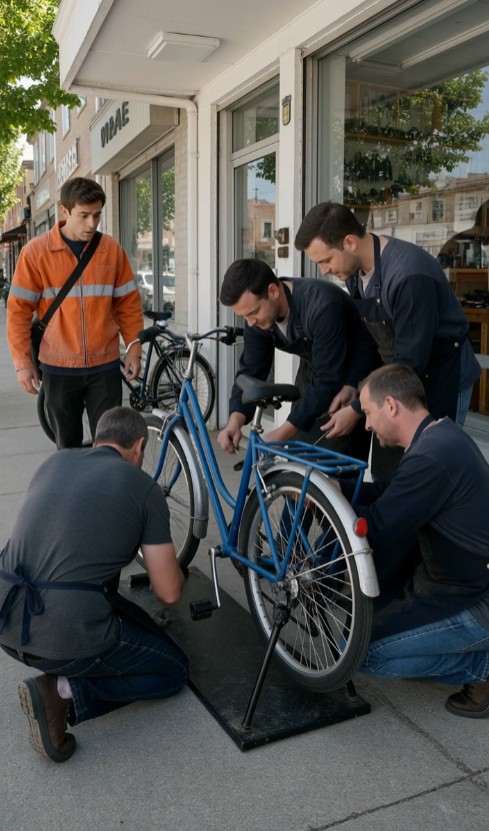
Six mechanics were standing around his old blue bicycle.
One was adjusting the rear derailleur.
Another was fitting a new tire.
Someone else was tightening the brake assembly.
A new front wheel was already installed.
Leo stared.
“What are you doing?”
One mechanic looked up.
“Fixing your bike.”
Leo stepped closer.
The bicycle looked almost new.
Fresh tires.
Working lights.
New brake pads.
Straight wheel.
Clean chain.
Even the damaged pedal had been replaced.
Leo’s expression changed.
“I can’t pay for all this.”
Martin smiled.
“You don’t have to.”
Leo shook his head.
“No.”
“Martin, I told you I’d come back.”
“I know.”
“I don’t want charity.”
Martin leaned against the workbench.
“It isn’t charity.”
“Then what is it?”
He handed Leo an envelope.
Inside was a handwritten note.
Leo opened it.
It said:
LAST MONTH, YOU STOPPED WORKING FOR TWENTY MINUTES TO HELP MY FATHER WHEN EVERYONE ELSE WALKED PAST.
YOU WOULDN’T ACCEPT MONEY.
SO PLEASE DON’T ARGUE NOW.
Leo read it again.
His face changed.
“I don’t understand.”
Martin smiled.
“Someone remembered.”
Leo tried to think.
He helped people constantly.
Not because he was trying to be heroic.
Because he spent all day outside.
He saw things.
People carrying too much.
Tourists lost in the wrong street.
Older people struggling with bags.
Children dropping things.
Cars that would not start.
He could not remember anything special.
Then Martin said:
“Do you remember an older man near the bus terminal?”
Leo froze.
He did.
About a month earlier, Leo had been carrying two food orders when he saw an elderly man sitting on the pavement beside a grocery bag.
At first, Leo thought the man had simply stopped to rest.
Then he noticed the man’s hands shaking.
Leo parked his bicycle.
“Sir?”
The man looked up.
“I’m fine.”
He clearly was not.
Leo asked whether he needed an ambulance.
The man refused.
He had become dizzy while walking home.
His medication was in his coat pocket.
Leo helped him sit more comfortably.
Then called the phone number labeled DAUGHTER in the man’s contacts.
She answered immediately.
Her name was Sarah.
She was twenty minutes away.
Leo waited.
That meant his food deliveries were late.
One customer canceled.
Another complained.
Leo did not care.
When Sarah arrived, she was terrified.
Her father was conscious.
Stable.
Embarrassed.
Sarah thanked Leo repeatedly.
Then tried to give him money.
Leo refused.
“No.”
“Please.”
“No.”
“You lost work because of us.”
Leo smiled.
“He needed someone.”
“That’s all.”
Then he left.
He never thought about it again.
Martin pointed toward one of the mechanics.
“That older man was my father.”
Leo stared.
The mechanic laughed.
“No, not me.”
Then he pointed toward Martin.
“His uncle.”
Martin nodded.
Sarah was Martin’s cousin.
When she heard Leo had left his bicycle at the shop because he could not afford repairs, she recognized his name.
Delivery rider.
Old blue bike.
The same man.
She told Martin what happened at the bus terminal.
Martin then told the mechanics.
One said:
“We can fix that.”
Another offered a spare wheel from a refurbished bicycle.
Someone else had two almost-new tires a customer had replaced unnecessarily.
Another mechanic donated brake parts.
Martin covered the remaining components.
The six of them worked after closing.
Nobody was paid for the extra time.
Leo looked around.
“You all did this because I sat with someone for twenty minutes?”
One mechanic shrugged.
“Twenty minutes matters when it’s the right twenty minutes.”
Leo looked down.
He did not know what to say.
Martin handed him the note again.
“There’s more.”
Leo unfolded the second page.
Sarah had written:
MY FATHER STILL TALKS ABOUT THE MAN ON THE BLUE BICYCLE.
HE SAID YOU TREATED HIM LIKE HE MATTERED BEFORE YOU EVEN KNEW HIS NAME.
I WANTED YOU TO KNOW THAT MATTERED TO US TOO.
Leo sat down.
For several seconds, the workshop became quiet.
Then he said:
“I was just doing what anybody would do.”
One mechanic laughed.
“No.”
“That’s why we noticed.”
The bicycle was not the only surprise.
Martin had serviced everything.
Chain.
Cables.
Bearings.
Lights.
Reflectors.
The mechanics had even installed a stronger rear rack after seeing the worn one Leo used for deliveries.
Leo touched the handlebars.
“This is too much.”
Martin shook his head.
“No.”
“Too much would be buying you a motorcycle.”
Everyone laughed.
Leo did too.
Then his eyes filled with tears.
He looked embarrassed.
Martin pretended not to notice.
“You want to test it?”
Leo nodded.
Outside, he climbed onto the bicycle.
The first thing he noticed was silence.
No clicking pedal.
No rubbing brake.
The wheel turned perfectly straight.
He rode around the block.
Then came back smiling.
“It feels wrong.”
Martin frowned.
“Wrong?”
“Too good.”
One mechanic shouted:
“Bring it back and we’ll break something.”
Leo laughed.
He returned to delivering that afternoon.
His first order was twenty-two minutes late because he kept stopping to check the new wheel.
By evening, he had completed more deliveries than he had managed during the previous two days combined.
But the story did not end with the repaired bicycle.
A week later, Leo returned to the shop.
Martin looked worried.
“What broke?”
“Nothing.”
“Then why are you here?”
Leo pulled a small envelope from his bag.
Inside was some cash.
Martin immediately pushed it back.
“No.”
“I said I don’t want the money.”
Leo nodded.
“I know.”
“So?”
“Use it for the next person.”
Martin looked at him.
“What next person?”
“The next one who comes in with something they need but can’t fix yet.”
Martin smiled.
“That’s your plan?”
“Yes.”
The amount was small.
Barely enough for a basic repair.
But Martin placed it in a metal box behind the counter.
On the lid, one mechanic wrote:
KEEP THEM MOVING.
The box stayed.
A few weeks later, a teenager came in with a damaged bicycle chain.
His mother could not afford the full repair until payday.
Martin used part of Leo’s money.
Then the teenager returned later and added five dollars to the box.
Another customer heard about it.
Added twenty.
A local courier donated spare parts.
Nobody created a charity organization.
No press conference.
No complicated system.
Just a small box.
If someone genuinely relied on a bicycle for work or school and was short on a basic repair, the shop sometimes used it.
People who received help were never required to pay it back.
But some did.
Others paid forward something different.
One woman brought coffee for the mechanics.
Another left a set of unused lights.
One delivery rider donated an old but usable tire.
The box became part money, part spare parts, part neighborhood habit.
Leo continued riding his blue bicycle.
The new wheel eventually became scratched.
The tires wore down.
The repaired pedal picked up new marks.
That made him happy.
It meant the bicycle was working.
Months later, he saw Sarah and her father near the same bus terminal.
Leo stopped.
Her father recognized him.
“There he is.”
Leo smiled.
“You doing okay?”
The elderly man lifted his walking stick.
“Better than this thing.”
Sarah laughed.
Then asked:
“How’s the bike?”
Leo looked at the blue bicycle.
“Still working.”
Her father said:
“Good.”
Then he became serious.
“You stayed with me that day.”
Leo nodded.
“You needed help.”
The older man reached out and shook his hand.
“That’s what I wanted to say.”
No long speech.
No dramatic revelation.
Just thank you.
Leo understood.
A year passed.
Then another.
The neighborhood began recognizing Leo.
Not as the delivery rider who had been rewarded.
As the man who stopped.
One winter evening, another courier crashed near an intersection.
No serious injury.
But his bicycle wheel bent badly.
Leo finished making sure the rider was okay.
Then looked at the damaged bike.
“Come with me.”
“Where?”
“I know a shop.”
Martin was closing when they arrived.
He looked at Leo.
Then at the broken bicycle.
Then at the KEEP THEM MOVING box.
He sighed dramatically.
“You’re becoming expensive.”
Leo smiled.
“I learned from you.”
Martin corrected him.
“No.”
“You started this.”
That was not exactly true.
There had been no single starting point.
An older man became dizzy.
Leo stopped.
Sarah remembered.
Martin noticed Leo’s broken bicycle.
Six mechanics donated their time.
Leo returned with a small envelope.
Someone else added to it.
Kindness moved in circles like that.
Not always back to the person who gave it.
Sometimes forward.
Years later, the original blue bicycle finally reached the end of its life.
The frame developed a crack that could not be repaired safely.
Martin told Leo:
“That’s it.”
Leo looked devastated.
“Can’t you weld it?”
“I could.”
“But I wouldn’t trust it.”
Leo stood quietly beside the bicycle.
It had carried thousands of meals.
Thousands of miles.
Rain.
Heat.
Cold.
Long nights.
Good weeks.
Terrible weeks.
And one day when it broke badly enough to bring him into a workshop where six strangers decided his kindness mattered.
Martin helped him find a reliable replacement.
Used.
Strong.
Affordable.
Leo insisted on paying for it himself.
But he kept one piece from the old bicycle.
The original scratched blue bell.
He attached it to the new handlebars.
Martin laughed.
“That bell barely works.”
Leo pressed it.
A weak metallic sound came out.
“It works enough.”
The old bicycle frame stayed at the shop for a while.
One of the mechanics eventually cut out a small piece of the blue tubing.
They mounted it above the KEEP THEM MOVING box.
Underneath, they added a small sign:
SOMETIMES PEOPLE JUST NEED HELP GETTING TO THE NEXT STOP.
Leo hated that people knew the sign was about him.
Martin refused to take it down.
The six mechanics never considered what they did extraordinary.
Neither did Leo.
That was probably why the story mattered.
Nobody involved had much to spare.
Leo certainly did not.
The mechanics worked ordinary jobs.
The repair shop was not wealthy.
Sarah was not wealthy.
They simply encountered moments when they could help.
Leo had twenty minutes.
The mechanics had spare parts and an evening.
Another customer had five dollars.
Someone else had a tire.
Those small things accumulated.
And it all began with a delivery rider who thought he was only helping an elderly stranger sit safely beside a bus terminal.
He never expected repayment.
He almost forgot it happened.
Then his bicycle broke.
Two days later, he returned to the repair shop expecting another discussion about money.
Instead, he opened the door.
Six mechanics were standing around his old blue bicycle.
The brakes worked.
The tires were new.
The wheel was straight.
And for the first time in days, Leo could work again.
He asked:
“Why would you do this for me?”
Martin handed him the envelope.
Because sometimes an act of kindness disappears from your mind the moment it is over.
But not from the life of the person who received it.