
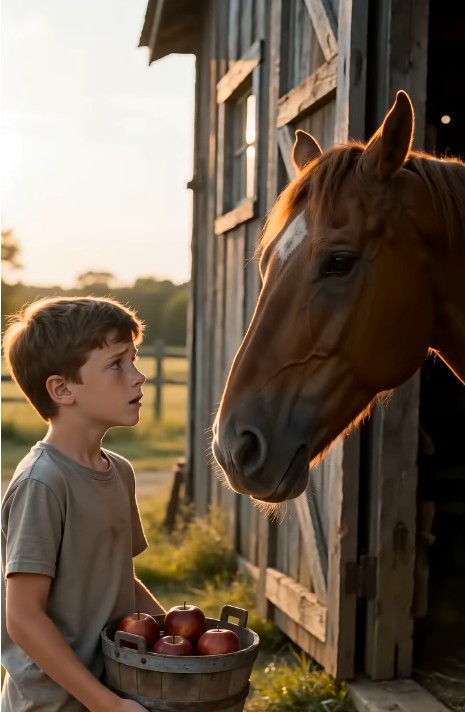
Everyone thought the old horse had gone crazy.
Until they heard the sound coming from the barn roof.
Eight-year-old Oliver was carrying a bucket of apples toward his grandfather’s barn.
It was a normal afternoon.
Warm air.
Quiet fields.
Dust floating in the sunlight.
The old barn had stood at the edge of the property for longer than Oliver had been alive.
His grandfather, Henry, used it mostly for tools, feed and storage now.
The horses stayed in the newer stable nearby.
Oliver had been told not to enter the old barn without an adult.
But he was not planning to stay.
He only wanted to put the apples down beside the doorway.
Then Buddy stepped in front of him.
Buddy was an elderly chestnut horse.
Slow.
Gentle.
Usually more interested in food than anything else.
Oliver laughed.
“Buddy, move.”
The horse did not move.
Oliver stepped left.
Buddy moved left.
Oliver stepped right.
Buddy moved right.
“Come on!”
Then Buddy lowered his head and gently pushed Oliver backward with his nose.
The bucket tilted.
Several apples rolled into the grass.
Oliver frowned.
“Stop it.”
Buddy struck the ground with one hoof.
Once.
Then again.
Then again.
Oliver had never seen him behave like that.
“Grandpa!”
Henry came around the side of the stable.
“What happened?”
“Buddy won’t let me go inside.”
Henry walked closer.
“Buddy.”
The horse ignored him.
His ears were pointed forward.
His neck was rigid.
And he was not looking at Oliver.
He was staring at the barn.
More precisely, at the roof.
Henry followed the horse’s gaze.
At first he saw nothing unusual.
Old timber.
Weathered boards.
A section of corrugated roofing.
Then he heard it.
Crack.
Very faint.
Henry froze.
Another sound followed.
A long wooden groan.
“Oliver.”
The boy looked up.
“Back away.”
“What?”
“Now.”
Henry grabbed his grandson’s shoulder and pulled him away from the entrance.
Buddy backed up too.
Then came a much louder crack.
The front corner of the roof shifted.
For half a second, it seemed to hang in place.
Then part of the structure collapsed.
Boards.
Roofing.
Dust.
Old insulation.
Everything crashed down directly over the spot where Oliver had been standing.
The boy screamed.
Henry wrapped both arms around him and moved farther back.
Dust rolled across the yard.
Buddy startled but did not run.
When the noise finally stopped, everyone stood silent.
Oliver began crying.
Not because he had been hurt.
Because he understood how close he had been.
He pulled away from his grandfather.
Then wrapped both arms around Buddy’s neck.
“You saved me.”
Henry said nothing.
He was still looking at the roof.
Then at the horse.
Then back at the destroyed entrance.
He did not know exactly what Buddy had perceived.
Perhaps the horse had heard the timber shifting before they did.
Horses have highly sensitive hearing.
They also react strongly to unfamiliar vibration, movement and sound.
Buddy may simply have detected something in the old structure that the humans had missed.
Whatever the reason, his refusal to move had delayed Oliver long enough.
That delay mattered.
Henry walked toward Buddy.
Then stopped.
Something blue was tangled near the horse’s mane.
A narrow strip of fabric.
Henry frowned.
He reached carefully toward it.
“Where did you get this?”
It was an old ribbon.
Faded almost gray-blue from age.
Attached to it was a tiny silver tag.
Henry turned it over.
His face changed.
Engraved on the back were two initials.
M.H.
Oliver wiped his eyes.
“What is it?”
Henry did not answer immediately.
He stared at the tag.
Then whispered:
“This belonged to your grandmother.”
Oliver looked confused.
“My grandma?”
Henry nodded.
His wife, Margaret, had died twelve years earlier.
Long before Oliver could remember her.
She had loved horses more than anyone Henry had ever known.
One horse in particular.
A mare named Willow.
Margaret had raised Willow from a foal.
They spent nearly twenty years together.
The faded blue ribbon had once been tied around Willow’s mane during local farm exhibitions.
The little silver tag had Margaret’s initials engraved on one side.
Willow’s name on the other.
Henry turned it over.
There it was.
WILLOW.
His hands began trembling.
“That’s impossible.”
Oliver looked at Buddy.
“Was Buddy friends with Willow?”
Henry shook his head slowly.
“No.”
Buddy had arrived on the farm years after Willow died.
At least, that was what Henry believed.
Buddy came from a small horse rescue when he was already older.
His paperwork was incomplete.
He had passed through several owners.
Nobody knew much about his earliest years.
Henry had never cared.
Buddy was gentle.
That was enough.
But now an object connected to Willow was tied into Buddy’s mane.
Oliver asked the obvious question.
“How did he get it?”
Henry had no answer.
At first, grief tried to fill the gap.
A sign from Margaret.
A message.
Something impossible.
Henry wanted to believe it.
But he also knew there had to be a real explanation.
So after the fire department and building inspector arrived to secure the barn area, Henry began looking.
The inspector gave them the first answer of the day.
The roof collapse had not been sudden in the technical sense.
Water had entered around an old seam for years.
Several support timbers were badly rotted.
One beam had recently split.
The weight above it had shifted.
The roof had probably been close to failure for days or weeks.
Henry felt sick.
“I should have caught it.”
The inspector shook his head.
“The damage was mostly hidden.”
The barn was immediately declared unsafe.
Nobody would enter until stabilization work was completed.
That evening, Henry placed the blue ribbon and silver tag on the kitchen table.
Oliver sat beside him.
“Do you think Grandma put it there?”
Henry smiled sadly.
“No.”
“How do you know?”
“I don’t.”
“But if we don’t know something, we shouldn’t invent the answer just because we like it.”
Oliver thought about that.
“So what do we do?”
“We find out.”
The next morning, Henry called the horse rescue where he had adopted Buddy seven years earlier.
The current manager had not worked there at the time.
But she still had archived intake records.
Buddy had arrived under another name.
Chestnut gelding.
Approximate age twenty.
Transferred from a farm auction.
Previous ownership uncertain.
Then she found an older note.
“Wait.”
Henry sat up.
“What?”
“There’s a property name attached to one of the transfer records.”
She read it.
Henry went silent.
It was not his farm.
But he recognized it.
Pine Ridge Stables.
Thirty years earlier, Margaret had occasionally boarded Willow there during winters when their own barn was undergoing repairs.
Henry had almost forgotten.
“Do you have anything else?”
The manager found an old livestock identification number.
Then a handwritten name.
Buster.
Henry frowned.
“Buddy used to be called Buster?”
“Possibly.”
The records were not complete.
But the number gave them somewhere to look.
Pine Ridge Stables had closed long ago.
The property had been sold.
Henry started making calls.
Eventually, he reached an elderly former stable hand named Frank.
Henry explained the situation.
There was silence on the line.
Then Frank asked:
“Chestnut gelding?”
“Yes.”
“Small white mark above the left eye?”
Henry stood.
“Yes.”
Frank laughed softly.
“Well, I’ll be.”
Henry’s heart began pounding.
“Do you remember him?”
“I remember a young horse called Buster.”
Frank explained that Buster had been boarded at Pine Ridge for several years.
Not with Margaret.
With another owner.
But during that same period, Margaret frequently brought Willow there.
The horses had spent time in neighboring paddocks.
Sometimes the same pasture.
Frank remembered them because Willow was older and calm, while Buster had been young and constantly bothering her.
“She tolerated him.”
Frank laughed.
“That mare tolerated everybody.”
Henry sat down.
“So Buddy knew Willow?”
“Looks like he might have.”
It was not proof yet.
Memories after thirty years could be wrong.
So Henry asked for more.
Frank still had several old photographs from the stable.
A week later, an envelope arrived.
Henry opened it at the kitchen table with Oliver beside him.
One photograph showed Margaret standing near Willow.
Another horse was visible behind the fence.
Chestnut.
Young.
A small white mark above the left eye.
Henry turned the photograph over.
Someone had written:
MARGARET + WILLOW — BUSTER BEING NOSY AGAIN — 1992.
Oliver’s mouth fell open.
“That’s Buddy.”
Henry stared.
It certainly looked like him.
But they wanted stronger confirmation.
The rescue compared old records.
Approximate age.
Markings.
Transfer history.
Identification number.
The chain was messy.
But consistent enough that the rescue believed Buddy was very likely the same horse once known as Buster.
That explained the connection.
It did not explain the ribbon.
Henry returned to the collapsed barn after engineers had made the area safe.
The front storage section had been exposed when the roof fell.
Inside was an old tack cabinet.
Henry had forgotten it existed.
The door had broken open during the collapse.
Inside were old brushes.
Leather straps.
A cracked saddle pad.
And several boxes Margaret had packed decades earlier.
One cardboard box had fallen onto the ground.
The lid was open.
Henry searched through it.
Photographs.
Old competition numbers.
Ribbons.
Then he found a small handwritten label:
WILLOW.
The blue ribbon had apparently been stored there.
But the tag was missing from the box.
Henry looked toward the paddock.
The explanation began to form.
Days earlier, before the roof completely failed, strong wind had damaged one of the barn’s side panels.
Henry had found loose debris in the yard.
He remembered now.
A few old papers had blown across the grass.
He cleaned most of it.
But he never checked the paddock.
It was possible the ribbon had escaped from the deteriorating barn.
Buddy may have picked it up while nosing through the grass or brushing against fencing and vegetation.
The fabric could easily have caught in his mane.
No one saw it happen.
So nobody could know exactly.
But there was no need for a mystery involving the impossible.
The old object had probably come from a forgotten box in a failing barn.
And Buddy, by coincidence, was almost certainly a horse who had known Willow decades earlier.
Oliver seemed slightly disappointed.
“So Grandma didn’t send it?”
Henry sat beside him.
“I don’t think we need to say she did.”
Oliver looked at the ribbon.
“Is that less special?”
Henry smiled.
“No.”
“In some ways, it’s more special.”
“How?”
“Because it actually happened.”
He pointed toward Buddy.
“That old horse lived in a place your grandmother used to visit.”
“He probably stood in the same fields as Willow.”
“Thirty years later, he ended up here.”
“And today, when that barn was about to come down, he stopped you from going near it.”
Oliver looked toward the window.
Buddy was standing in the pasture.
Quietly eating.
As if nothing important had happened.
The barn investigation uncovered another surprise.
The collapse could have been far worse.
The damaged beam supported a large portion of the entrance roof.
If it had failed later, someone might have been inside.
Henry had planned to spend that weekend clearing tools from the barn.
The inspector told him:
“You got lucky.”
Henry looked at Buddy.
“Yes.”
“Very.”
The old barn could not be saved.
Repair costs were too high.
Much of the structure was unsafe.
Henry decided to have it dismantled.
That was harder than he expected.
The barn had been part of the farm his entire adult life.
Margaret had painted its doors.
Their children had played inside.
Willow had once stood there during storms.
Every board seemed to carry some memory.
But the collapse had made something clear.
Memories were not a reason to keep dangerous structures standing.
So the barn came down carefully.
Before demolition, workers helped Henry remove everything that could safely be recovered.
He found more of Margaret’s belongings.
An old grooming brush.
A photograph of Willow as a foal.
Several handwritten veterinary records.
A small wooden sign.
OLIVER’S favorite discovery was a photograph of Margaret sitting on the barn floor.
Willow’s head rested over her shoulder.
In the distant background stood a young chestnut horse.
Buster.
Buddy.
Henry had looked at that photograph before.
Many times.
He had simply never paid attention to the horse in the background.
Now he could not stop seeing him.
They framed it.
The blue ribbon went into the same frame.
So did the little silver tag.
Henry added a note beneath it:
MARGARET, WILLOW & BUSTER — BEFORE WE KNEW HE WOULD COME HOME TOO.
Oliver insisted on one correction.
“And save me.”
Henry smiled.
He added a second line:
AND BUDDY — THE HORSE WHO MADE US STOP AND LISTEN.
That wording mattered to Henry.
He did not tell people Buddy “predicted” the roof collapse.
He could not prove that.
He did not say the horse understood that Oliver would be injured.
Nobody knew what Buddy understood.
The animal may simply have heard cracking timber.
Felt vibration.
Seen small movements in the roof.
Or become alarmed by sounds humans could not yet detect.
Horses are sensitive to their surroundings.
And Buddy’s behavior happened to keep Oliver away from danger.
That was remarkable enough.
The story spread through the small community.
People called Buddy a hero.
Henry did not argue.
But he always added:
“Maybe he heard something before we did.”
A local reporter asked whether the ribbon proved some mysterious connection between Buddy and Margaret.
Henry answered:
“It proved something better.”
“What?”
“That we hadn’t known his whole history.”
The rescue later updated Buddy’s file.
Likely formerly known as Buster.
Previously boarded at Pine Ridge Stables.
Historical photographs supported the identification.
Henry received copies.
He kept them all.
Oliver became fascinated with Buddy’s past.
He asked Frank endless questions over the phone.
What did Buddy eat?
Was he fast?
Did Willow like him?
Frank answered what he remembered.
Then said:
“You know, kid, horses don’t care much about our stories.”
Oliver frowned.
“What do you mean?”
“They’re busy being horses.”
Oliver thought about Buddy standing in the pasture.
Frank continued:
“The stories are mostly for us.”
That stayed with Oliver.
The following year, Henry built a small open shelter near the paddock.
Not a replacement for the old barn.
Something simpler.
Safer.
Modern supports.
Proper drainage.
Regular inspections.
On the front, Oliver wanted a sign.
BUDDY’S BARN.
Henry agreed.
Buddy ignored it completely.
Most days, he preferred standing outside.
As Buddy grew older, Oliver spent more time with him.
He brushed him.
Brought him apples.
Walked beside him.
And occasionally retold the roof story to visitors.
Each version became slightly more dramatic.
Henry always corrected him.
“He didn’t drag you away.”
“I know.”
“He nudged you.”
“I know.”
“And the entire barn did not collapse.”
“Grandpa.”
“Just part of the roof.”
“You’re ruining it.”
Henry laughed.
But accuracy mattered.
The true story did not need exaggeration.
An eight-year-old boy was walking toward an unsafe barn.
An old horse repeatedly blocked him.
The horse appeared focused on the building.
Then the humans heard cracking.
Seconds after they stepped away, part of the roof failed.
Nobody could prove what the horse understood.
But his behavior changed what happened next.
And afterward, a faded ribbon tangled in his mane revealed that Buddy’s life had crossed the family’s story decades before anyone knew it.
Years later, Oliver would remember two sounds from that afternoon.
The terrible crash of the roof hitting the ground.
And the much quieter sound that came first.
Buddy’s hoof.
Striking the earth.
Again.
And again.
As if asking the humans around him to pay attention.
Sometimes animals do not need to understand danger the way people do.
Sometimes they only need to notice something we missed.
And sometimes noticing is enough.