
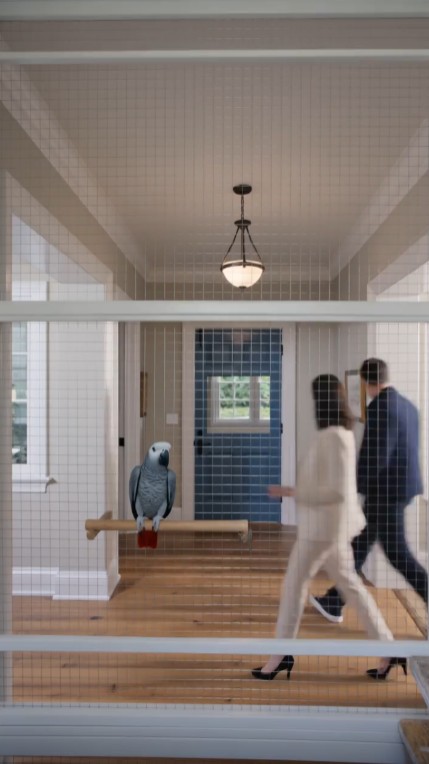
A parrot suddenly shouted:
“DON’T SELL THE HOUSE!”
The real estate agent laughed nervously.
“He says that to everyone.”
But the buyer wasn’t laughing.
Neither was the agent’s elderly father.
The parrot’s name was Charlie.
He was an African gray who had lived in the old country house for more than twenty years.
The house belonged to a woman named Anna.
She had grown up there.
Her father, Robert, still lived in a small downstairs apartment connected to the property.
But at eighty-one, he could no longer manage the place.
The roof needed work.
The heating system was old.
The garden had become too much for him.
So Anna had finally convinced him to sell.
That afternoon, she was showing the house to a couple interested in buying it.
Everything was going normally.
Until Charlie spoke.
“DON’T SELL THE HOUSE!”
Anna forced a smile.
“He’s been saying strange things lately.”
The buyer looked toward the cage.
Charlie tilted his head.
Then said:
“ASK MARGARET!”
Anna frowned.
“Who’s Margaret?”
She looked toward her father.
Robert had entered the room quietly.
The moment he heard the name, he stopped.
His face changed.
“Dad?”
He said nothing.
Charlie repeated:
“ASK MARGARET!”
Anna stepped closer.
“Who is Margaret?”
Robert finally whispered:
“My sister.”
The room went silent.
Anna stared at him.
“You have a sister?”
Robert nodded.
“Had.”
Anna had never heard the name.
Not once.
No photographs.
No stories.
Nothing.
Before she could ask another question, Charlie flapped his wings.
Then shouted:
“BLUE ROOM! BLUE ROOM!”
Everyone looked toward the hallway.
At the far end stood a blue door.
Anna knew it well.
It had been locked for as long as she could remember.
Her father always called it an old storage room.
Whenever she asked what was inside, he said:
“Nothing important.”
Now Robert’s hands were trembling.
The buyer quietly said:
“What’s in there?”
Robert looked at the door.
Then at Charlie.
Finally, he whispered:
“Something I should have dealt with years ago.”
Anna ended the viewing.
The buyers were understanding.
They left their number and said they could return another day.
As soon as the front door closed, Anna turned toward her father.
“Start talking.”
Robert sat down.
Charlie climbed quietly along his perch.
For several seconds, Robert stared at the floor.
Then he said:
“Margaret was my younger sister.”
They had grown up in the same house.
Robert was three years older.
They were close as children.
Margaret loved music.
Painting.
Animals.
Especially birds.
When she was nineteen, she left home to study art.
Their father strongly disapproved.
He wanted Margaret to stay nearby and work in the family business.
Arguments became frequent.
Then one night, Margaret left.
Robert said:
“She was supposed to come back.”
Anna frowned.
“What happened?”
Margaret did come back.
Years later.
But by then, the family had changed.
Their father had died.
Robert was married.
Anna was a baby.
Margaret arrived carrying boxes, paintings, and a small cage.
Inside was a young parrot.
Charlie.
Anna looked toward the bird.
“That Charlie?”
Robert nodded.
Margaret had rescued him from a family that could no longer keep him.
She planned to stay at the house only temporarily.
But she remained for almost a year.
That was when she used the blue room.
It became her studio.
Paintings covered the walls.
She stored letters there.
Photographs.
Sketchbooks.
And a collection of recordings she made while practicing music.
Charlie spent hours in the room with her.
“He learned her phrases,” Robert said.
“What phrases?”
Robert looked toward the parrot.
“Lots of things.”
Margaret often talked aloud while she worked.
She would say:
“Ask Margaret.”
Usually jokingly whenever Robert complained he couldn’t find something.
If a document was missing:
Ask Margaret.
If a tool disappeared:
Ask Margaret.
If nobody knew where the keys were:
Ask Margaret.
Anna looked at Charlie.
“That explains one phrase.”
Robert nodded.
But not the others.
The reason Charlie had learned “Don’t sell the house” was more complicated.
Margaret had discovered something in the family papers.
The property had been divided incorrectly after their father died.
An old legal document indicated that a portion of the land had been placed into a family trust.
Not a huge fortune.
Not some secret treasure.
But enough that the property could not simply be sold without checking several old obligations first.
Margaret urged Robert to speak with a solicitor.
Robert refused.
At the time, he was overwhelmed.
Young child.
Mortgage.
Work.
Family problems.
He accused Margaret of creating drama.
She accused him of ignoring their father’s paperwork.
They argued.
Badly.
During several of those arguments, Margaret repeatedly said:
“Don’t sell the house until you check the trust.”
Charlie heard it.
Over and over.
Eventually, the bird shortened it.
“DON’T SELL THE HOUSE!”
Anna stared at her father.
“So Margaret was warning you?”
“Yes.”
“Was she right?”
Robert closed his eyes.
“I don’t know.”
“You never checked?”
“No.”
Anna stood up.
“Dad.”
“I know.”
“Why?”
Because the argument did not end there.
Margaret left again.
This time after saying things both siblings regretted.
Robert assumed she would return once she calmed down.
She did not.
Months passed.
Then years.
Letters came.
Robert did not answer the first few.
When he finally tried, Margaret had moved.
They lost contact.
Anna asked:
“What happened to her?”
Robert looked toward the blue door.
“She died fourteen years ago.”
Anna’s expression changed.
“You knew?”
Robert nodded.
A distant cousin informed him.
By then, Margaret had lived in another state for decades.
She never married.
No children.
She worked as an art teacher.
Robert attended the funeral.
Alone.
He never told Anna.
“Why?”
“Shame.”
He had spent so long refusing to speak about his sister that admitting her existence felt harder with every passing year.
After the funeral, Margaret’s executor contacted him.
She had left several boxes for him.
Robert brought them home.
Placed them inside the blue room.
And locked the door.
Anna stared.
“You’ve kept her things in there for fourteen years?”
Robert nodded.
“And you told me it was empty?”
“Yes.”
Anna’s voice softened.
“Why?”
“I couldn’t open them.”
That answer changed her anger.
Not erased it.
But changed it.
Robert had not locked the room because it held something dangerous.
He locked it because opening it meant facing the sister he had spent decades avoiding.
Charlie kept repeating pieces of the past because those were sounds he had learned in the room long ago.
No prophecy.
No magical message.
Just memory through repetition.
Anna asked:
“Do you have the key?”
Robert reached into his pocket.
He carried it.
Every day.
That surprised her more than anything.
They walked to the end of the hallway.
Robert inserted the key.
It stuck.
He tried again.
Then the lock turned.
The blue door opened.
Dust floated in the light.
Inside stood an easel.
Several covered paintings.
Shelves of boxes.
A small desk.
And another empty bird stand beside the window.
Charlie’s old perch.
Anna stepped inside.
“This was hers?”
Robert nodded.
On the wall was a photograph.
Young Robert.
Margaret.
Their parents.
All standing in the garden.
Anna stared.
She had never seen her father look that young.
Or that happy.
Then she noticed a large envelope on the desk.
ROBERT.
Her father stopped.
“I’ve never opened that.”
Anna looked at him.
“Maybe now.”
Robert sat down.
Then opened it.
Inside was a letter from Margaret.
The first line read:
Robert,
If you are reading this, then you finally opened the blue room.
Robert laughed once.
Then began crying.
Anna sat beside him.
Margaret’s letter was not angry.
That surprised him.
She wrote that they had both wasted too many years being stubborn.
She admitted her own mistakes.
Leaving without explaining.
Refusing some of Robert’s later attempts to contact her.
Holding onto old anger because it felt easier than risking rejection.
Then she wrote:
I was right about the trust.
But I was wrong to make you feel like the house mattered more than our relationship.
Please check the documents before you ever sell.
Not because I need you to keep the house.
Because Dad’s paperwork was complicated and I don’t want Anna inheriting a legal mess.
Anna looked at Robert.
“She knew about me.”
Robert nodded.
“She asked about you in every letter.”
Anna felt tears forming.
Margaret had included copies of the old property documents.
There was also a note naming the law firm that had handled the trust.
Anna did not assume everything was still legally valid.
The papers were decades old.
The next day, she contacted a property attorney.
That was when the real explanation emerged.
Margaret had been partly right.
The house itself could be sold.
There was no hidden restriction preventing that.
But a narrow strip of woodland at the edge of the property had been placed under a conservation covenant decades earlier.
It could not be developed the way the buyers’ preliminary plans assumed.
There was also a small dormant family trust connected to maintenance of that land.
Nothing life-changing financially.
But legally important.
If Anna had sold without resolving the paperwork, the transaction could have become messy.
Margaret’s warning had been valid.
Not dramatic.
Just careful.
Robert stared at the attorney’s summary.
“She tried to tell me.”
Anna nodded.
“She did.”
Then they opened more boxes.
Inside were Margaret’s paintings.
Some unfinished.
Some signed.
One showed the house in summer.
Another showed Robert standing beneath an apple tree.
Then Anna found a painting of herself.
A baby.
Wrapped in a yellow blanket.
She turned toward her father.
“She met me?”
Robert smiled sadly.
“Many times.”
Anna’s eyes filled.
Another secret.
Another piece of childhood she did not remember.
Then they found a cassette recording.
Robert located an old player.
The tape crackled.
Margaret’s voice filled the room.
She was talking while she painted.
Charlie could be heard in the background.
Margaret laughed.
Then said:
“Charlie, stop chewing that.”
A younger Robert’s voice answered from somewhere else:
“Ask Margaret where she put my screwdriver.”
Margaret laughed.
“ASK MARGARET!”
Charlie repeated.
Anna and Robert both started laughing.
Then the recording continued.
Later, the voices became serious.
Margaret said:
“Robert, I mean it. Don’t sell the house until someone checks Dad’s papers.”
Charlie repeated:
“DON’T SELL THE HOUSE!”
Robert closed his eyes.
There it was.
The exact origin.
Not a mysterious warning from an animal that somehow understood a property transaction.
A phrase learned decades earlier during repeated family conversations.
And preserved because African gray parrots can retain and reproduce familiar sounds and phrases for years.
Anna reached toward Charlie later that evening.
“So you’ve been repeating family arguments for decades.”
Charlie tilted his head.
“ASK MARGARET!”
Anna laughed.
“Unfortunately, we finally did.”
The property sale was paused.
Not canceled.
Anna had the legal issues clarified properly.
The conservation area remained protected.
The prospective buyers adjusted their plans.
The sale eventually moved forward.
But before the family left, Anna made one request.
She wanted the blue room documented.
Not preserved forever like a shrine.
Photographed.
Cataloged.
Margaret’s best paintings were evaluated.
Several had genuine artistic quality.
Anna donated a selection to the school where Margaret once taught.
Others stayed with the family.
The old recordings were digitized.
Robert kept one painting.
The one of the apple tree.
Anna kept the portrait Margaret made of her as a baby.
And Charlie?
He moved with Robert into a smaller home near Anna.
The blue room disappeared.
But the secrets did not return to silence.
Robert began telling Anna stories about his sister.
Funny ones.
Embarrassing ones.
Arguments.
Road trips.
The time Margaret painted their father’s bicycle blue without permission.
The afternoon Charlie escaped his cage and spent six hours sitting on top of the kitchen cabinet refusing to come down.
Anna listened to all of it.
One evening, she asked:
“Why didn’t you tell me any of these before?”
Robert thought for a long time.
“Because eventually silence became a habit.”
That sentence stayed with her.
Families often imagine secrets require one enormous lie.
Sometimes they don’t.
Sometimes one person avoids a story once.
Then again.
Then again.
Years pass.
A missing name becomes normal.
A locked room becomes normal.
A daughter grows up assuming there is nothing behind the door.
Until a parrot says two words nobody expects.
Ask Margaret.
The house was eventually sold.
The new owners kept the woodland protected.
The blue door remained, though the room behind it became a small library.
Before Anna left for the last time, she stood in the hallway with Robert.
Charlie sat in a travel carrier.
Anna looked at the old door.
“Ready?”
Robert nodded.
Then Charlie shouted:
“DON’T SELL THE HOUSE!”
Robert laughed.
“A little late, Charlie.”
The bird tilted his head.
“ASK MARGARET!”
Robert smiled sadly.
“I should have.”
Then he looked at Anna.
“But at least we finally listened.”
What Charlie had repeated for years was not a supernatural warning.
It was something more believable.
And perhaps more meaningful.
Fragments of a family conversation everyone else had spent decades trying not to remember.
A sister’s name.
A room.
A warning.
And when the family finally opened the door, they discovered the house had never really been hiding the secret.
They had.