
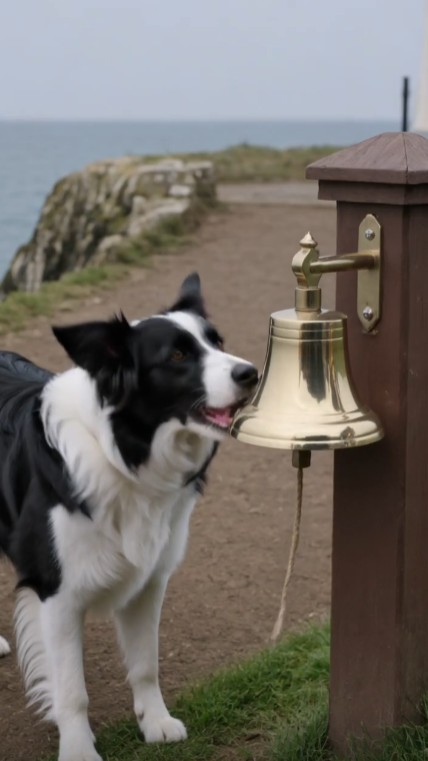
Every morning, a rescued dog rang the same brass bell outside an old lighthouse.
One ring.
Then he walked to a locked blue shed.
And waited.
His name was Finn.
A gentle border collie who had recently arrived at a coastal rescue center built beside the old lighthouse grounds.
Finn was friendly.
Healthy.
Comfortable with staff.
He ate normally.
Loved walks.
And seemed to settle into shelter life better than many dogs did.
But every morning, almost at the same time, he followed the same strange routine.
He walked toward the lighthouse entrance.
Stopped beneath an old brass bell once used by keepers to signal across the grounds.
Raised one paw.
Touched the hanging rope.
The bell rang once.
Then Finn turned.
Walked directly to the small blue maintenance shed behind the lighthouse.
And sat beside the door.
The first time, caretaker Emma laughed.
The second time, she took a video.
By the fifth morning, nobody was laughing.
“He knows exactly where he’s going,” she told the maintenance worker, David.
David shrugged.
“He probably smells something.”
That was possible.
The blue shed stored old rope, wooden tools, lamp parts, buckets, and boxes of lighthouse equipment.
Plenty of smells could interest a dog.
But Finn never scratched at the door.
Never barked.
Never tried to force his way inside.
He simply sat there.
And waited.
So one morning, Emma asked David to unlock it.
The door creaked open.
Finn stood.
But he did not rush inside.
He stayed beside Emma.
The shed was dusty.
Old shelves covered one wall.
A rusted lantern sat on the floor.
Then Emma noticed something on the highest shelf.
A tiny model sailing boat.
Its hull was white.
Its sail was bright red.
Emma stared.
“Wait.”
David looked at her.
“What?”
“I’ve seen that.”
She hurried out.
The lighthouse included a small historical display for visitors.
Old photographs showed keepers who had worked there decades earlier.
Emma searched through them.
Then stopped.
There it was.
A photograph taken outside the lighthouse.
An elderly keeper stood beside the same red-sailed model boat.
At his feet sat a young border collie.
White chest.
Black ears.
And a narrow white stripe running straight down his forehead.
Emma looked through the window toward Finn.
Then back at the picture.
“That looks exactly like him.”
David came closer.
He read the caption.
Keeper: Arthur Miller.
Dog: Finn.
Emma stared.
“Finn?”
David looked at her.
“That can’t be coincidence.”
The date on the photograph was only eight years earlier.
That made it possible.
Finn was estimated to be around nine or ten.
Emma brought the rescue paperwork.
The dog had arrived after being found wandering near a fishing road several miles inland.
His microchip was present but outdated.
The registered phone number no longer worked.
The listed owner was:
Arthur Miller.
Emma whispered:
“It is him.”
The little dog in the photograph had grown older.
But the facial markings matched.
The age matched.
The chip matched.
Finn had lived at the lighthouse.
That explained why he knew the bell.
Why he knew the blue shed.
But another question appeared immediately.
Why was he here now?
And where was Arthur?
David searched the lighthouse archives.
Arthur had been one of the final full-time keepers before the site became mostly automated.
He lived in the keeper’s cottage with Finn.
According to staff notes, Arthur had a simple morning routine.
At seven o’clock, he rang the brass bell once before checking the weather equipment.
Finn usually followed him.
Then they walked to the blue shed.
Inside, Arthur kept maintenance tools.
And the little red-sailed boat.
It was not an ordinary decoration.
Arthur built model boats.
The red one had been made with his late wife, Margaret.
The records included another photograph.
Arthur and Margaret standing together.
Holding the model.
Finn sitting nearby.
Emma smiled.
“So that’s why he comes here.”
A routine.
A familiar place.
A sound repeated every morning.
Nothing mysterious was necessary.
Finn had learned the pattern.
Bell.
Shed.
Arthur.
But then David found something odd.
The model boat should not have been there.
According to an inventory from five years earlier, the boat had been removed after Arthur retired.
The entry read:
Personal item returned to owner.
David frowned.
“That means Arthur took it.”
Emma looked back toward the shed.
“Then how did it get back?”
They checked newer records.
Two years after Arthur retired, someone had returned the red-sailed boat to the lighthouse.
No name was recorded.
Only:
Personal artifact returned by family representative.
Emma asked:
“Who?”
David kept searching.
Then he found a handwritten note attached to an archived donation form.
Returned by: Claire Miller.
Relationship: Daughter.
Emma looked surprised.
“Arthur had a daughter?”
David nodded.
But the next line changed everything.
Claire had written:
Please keep the boat near the old maintenance shed if possible. Dad asked that Finn see it again someday if he ever came back.
Emma stared.
“He expected the dog to come back?”
David shook his head.
“Maybe not literally.”
There was a phone number.
Still active.
Emma called.
A woman answered.
When Emma explained where she was calling from, the woman became quiet.
Then Emma said:
“We have a border collie named Finn.”
Silence.
Then:
“Finn?”
“Yes.”
“White stripe down his forehead?”
“Yes.”
The woman started crying.
“Oh my God.”
Claire arrived at the rescue center the following afternoon.
She was in her fifties.
The moment she entered the lighthouse grounds, Finn saw her.
His ears lifted.
He approached slowly.
Claire crouched.
“Hi, old man.”
Finn sniffed her hands.
Then leaned against her.
Claire covered her face.
“I thought you were gone.”
Emma sat beside her.
“What happened?”
Claire told them.
After Arthur retired from lighthouse work, he moved inland with Finn.
The red-sailed boat went with him.
For several years, life was quiet.
Then Arthur developed serious health problems.
Claire began helping him.
Eventually, he moved into assisted living.
Finn could not go with him.
So Claire arranged for Finn to live with her brother, Michael, who had a fenced property nearby.
Arthur hated being separated from the dog.
Claire brought Finn to visit whenever possible.
Then Arthur’s memory began declining.
Some days, he could not remember names.
But whenever Claire mentioned the lighthouse, he remembered the morning bell.
The blue shed.
The boat.
And Finn.
One afternoon, Arthur gave the model boat to Claire.
He said:
“Take it back.”
She asked:
“To the lighthouse?”
“Yes.”
“Why?”
Arthur answered:
“That’s where Finn thinks mornings begin.”
Claire did not fully understand.
But she returned it.
The lighthouse staff placed it inside the blue shed.
Then life became harder.
Arthur died the following year.
Finn remained with Michael.
Until a violent winter storm damaged part of Michael’s fencing.
Finn got out.
The family searched immediately.
Posters.
Calls to shelters.
Social media.
But Finn was never found.
Claire assumed someone had picked him up.
Weeks became months.
Then more than a year passed.
What nobody realized was that Finn had been found outside the county.
The person who picked him up brought him to a small rescue network.
His microchip information still listed Arthur’s old number.
The family name was correct.
But no updated secondary contact existed.
Finn was transferred twice before arriving at the coastal rescue center.
Only a few miles from the lighthouse.
Emma asked:
“Do you think he came here on his own?”
Claire shook her head.
“There’s no way to know.”
The rescue center had transported Finn there from another facility.
He had not navigated the full distance himself.
But once he arrived on the lighthouse grounds, the old environment may have been familiar.
The bell.
The paths.
The shed.
The smells.
The routines.
That explained his behavior far better than imagining Finn was intentionally searching for a lost owner.
Claire walked with Emma to the blue shed.
David unlocked it.
Finn followed.
Claire picked up the model boat.
The red sail was faded now.
Finn sniffed it.
Then walked toward the doorway and sat down.
Claire smiled through tears.
“My dad used to put this on the bench while he worked.”
Emma asked:
“And Finn waited?”
“Every morning.”
There it was.
The final piece.
The dog had not been waiting for someone to solve a mystery.
He had simply returned to a sequence he had practiced for years.
Bell.
Shed.
Boat.
Wait.
A routine connected to the most stable period of his life.
Claire asked whether she could adopt Finn.
The rescue center still followed normal procedures.
Identity verification.
Veterinary review.
Home suitability.
Nobody skipped anything because the story was emotional.
Claire also had an older dog at home, so introductions were handled carefully.
They went well.
Two weeks later, Finn left the rescue center with her.
Before going, Claire brought him to the lighthouse one last time.
Seven in the morning.
Cold air.
Empty grounds.
Finn walked toward the bell.
He touched the rope.
One ring.
Then headed to the blue shed.
But this time Claire opened the door.
She placed the red-sailed model boat on the bench.
Finn settled beside it.
Claire sat next to him.
For a few minutes, neither moved.
Then she said:
“Dad would have loved this.”
Emma stood farther away.
She did not take a video.
Some moments did not need one.
Later, Claire decided the model boat should remain at the lighthouse.
Not because Finn needed it forever.
Because it belonged to the history of the place.
She donated it formally.
The lighthouse added a small label:
Handmade by keeper Arthur Miller and Margaret Miller.
Used in the keeper’s cottage during Arthur’s years of service.
Returned by their family.
Nothing about a miraculous dog reunion.
Nothing exaggerated.
But staff added one photograph nearby.
Arthur.
The red-sailed boat.
Young Finn.
Months later, Claire sent another photograph.
Older Finn sleeping beside her fireplace.
His head resting on a red blanket.
Emma placed a copy in the staff office.
Finn stopped ringing the lighthouse bell every morning after moving to Claire’s house.
There was no bell there.
No blue shed.
Instead, he developed a new routine.
Breakfast.
Walk.
Then sleep beside the front door while Claire drank coffee.
Dogs do that.
They adapt.
They attach meaning to routines, places, sounds, and people through repeated experience.
Finn’s behavior at the lighthouse did not require a supernatural explanation.
The truth was already enough.
Years earlier, an old lighthouse keeper had begun every morning with one ring of a brass bell.
His dog followed him to a blue shed.
A small model boat sat nearby.
Then life changed.
The keeper retired.
The boat disappeared.
The dog moved away.
Years later, the boat returned first.
Then, through an entirely separate chain of events, so did Finn.
And when the rescue staff finally opened that locked blue shed, they discovered that the strange routine was not strange at all.
It was an old morning.
Repeated one more time.