
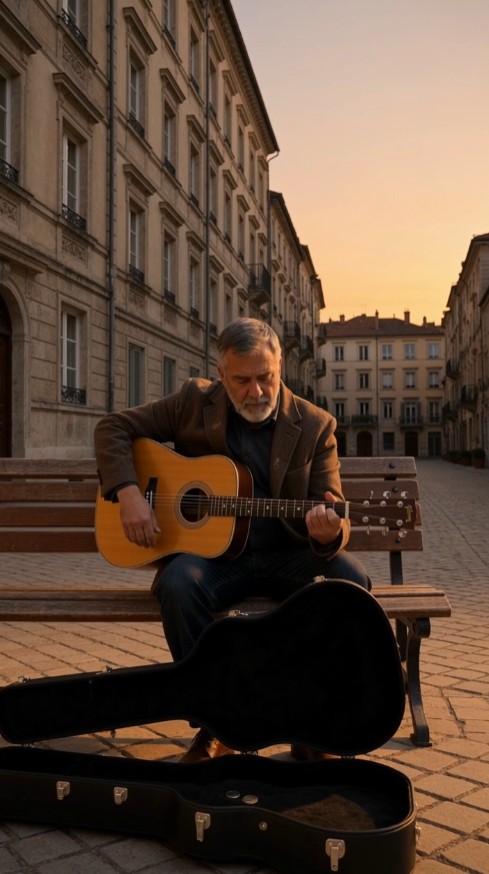
Samuel had been playing in the same square for almost eleven years.
Same wooden bench.
Same battered guitar case.
Same corner beneath a row of old apartment buildings.
People knew him.
At least he thought they did.
Every evening, just before sunset, Samuel carried his guitar across the square and sat beneath a plane tree near the fountain.
Then he played.
Old folk songs.
Soft ballads.
Occasionally something cheerful if children were nearby.
Some evenings, people stopped.
Tourists recorded videos.
Couples sat on the steps.
Someone might leave a few coins.
Sometimes a restaurant waiter brought him coffee.
But lately, the square had changed.
A nearby shop had closed.
Construction diverted foot traffic.
The weather had been colder.
And most evenings, Samuel played to nearly empty pavement.
At first, he told himself it did not matter.
He had never played only for money.
Music had been part of his life since he was a teenager.
His father taught him three chords.
Samuel taught himself everything else.
He played at weddings when he was young.
Then cafés.
Later, after years working in a printing factory, he began performing outside after work.
When the factory closed, street music became more important.
Not enough to make him comfortable.
But enough to help.
More than that, it gave his days shape.
He woke knowing that, whatever else happened, he would play that evening.
Then Samuel’s wife, Elena, died.
The square became even more important.
Home was painfully quiet.
The apartment still contained her cup.
Her books.
Her slippers by the bedroom door.
Samuel could not bear the silence.
So he stayed outside longer.
Music became the way he moved through grief without having to explain it.
For years, people came and went.
Then, slowly, fewer people stopped.
Samuel noticed.
He tried different songs.
Played louder.
Then softer.
Nothing seemed to help.
One Tuesday evening, he counted three coins in the guitar case.
The next evening, two.
By Friday, nobody stopped at all.
Samuel finished a song his wife had loved.
He waited.
No applause.
No footsteps slowing.
Just the fountain.
A bus passing at the end of the street.
And somewhere above him, a window closing.
Samuel looked inside the guitar case.
A few coins.
He smiled sadly.
“Maybe nobody wants to hear me anymore.”
He began packing away the guitar.
He folded the cloth he kept beneath it.
Closed the small notebook where he wrote song lists.
Then he heard something.
Clapping.
Once.
Twice.
Slowly.
Samuel looked up.
A woman stood at a third-floor window across the square.
She was applauding.
Samuel stared.
Then another window opened.
An older man leaned out.
He began clapping too.
Then a balcony door opened two buildings down.
A young couple stepped outside.
Another person appeared above the bakery.
Then another.
Within seconds, the quiet square was no longer empty.
People were standing at windows and balconies all around him.
Smiling.
Waving.
Calling his name.
“Samuel!”
“Don’t stop!”
“One more!”
Samuel stood completely still.
He looked around as though someone had arranged a joke.
Then a woman came through the entrance of the building opposite him.
She carried a bouquet of sunflowers.
Samuel recognized her.
Her name was Anna.
He had seen her many times.
Usually at the window.
Never downstairs.
She crossed the square.
Samuel asked:
“What is happening?”
Anna handed him the flowers.
“We’ve been listening.”
Samuel looked confused.
“To what?”
“To you.”
“Every evening.”
He glanced toward the buildings.
People were still standing outside.
Anna continued.
“You think because we don’t come down here that nobody hears you.”
Samuel did not answer.
She pointed upward.
“That woman on the fourth floor listens while she cooks dinner.”
A hand waved.
“The old gentleman above the pharmacy listens from his chair.”
The man lifted one hand.
“The students in the corner apartment open their window when they study.”
Someone shouted:
“It helps!”
Samuel laughed nervously.
Anna pointed toward another balcony.
“And my mother hears you from her bedroom.”
Samuel’s expression softened.
Anna’s mother had limited mobility after surgery.
She rarely left the apartment.
Anna explained that every evening, when Samuel began playing, her mother asked for the window to be opened.
“She calls you the man with the brown guitar.”
Samuel looked down at his instrument.
“It used to be red.”
Anna smiled.
“That was apparently a long time ago.”
He laughed.
Then his eyes filled.
For years, Samuel had measured whether anyone cared by what he could see.
People stopping.
Coins dropping.
Applause in front of him.
He never thought about the windows.
The kitchens.
The bedrooms.
The people listening while washing dishes, doing homework, folding laundry or sitting alone.
Anna said:
“You’ve been part of this square for years.”
Samuel looked around again.
A child on a balcony shouted:
“Play the fast one!”
Someone else yelled:
“No, the old love song!”
Samuel wiped his eyes.
“How long have you all been planning this?”
Anna shook her head.
“We weren’t.”
“What?”
“One of us saw you packing up early.”
“She messaged the building group.”
Samuel stared.
“You have a building group?”
Anna laughed.
“Of course.”
“Apparently the emergency was you quitting.”
That made him laugh harder.
People began clapping again.
Samuel looked at the guitar case.
Then at the sunflowers.
Then back at Anna.
“I was going home.”
“I know.”
“I was thinking maybe I should stop.”
“I know.”
Samuel sat down.
He took the guitar out again.
Adjusted the strap.
Then looked up toward the windows.
“Well.”
His voice cracked slightly.
“If you’re all listening…”
People became quiet.
Samuel smiled.
“Then this one’s for all of you.”
He began playing.
Not the sad song from earlier.
Something warm.
Simple.
Familiar.
Within seconds, several people recognized it.
A woman on one balcony began humming.
Then someone else.
Samuel kept playing.
He did not need perfect silence.
He heard doors opening.
Children whispering.
Glasses being set down.
People calling relatives to the window.
The square felt different.
Not crowded.
Connected.
After the song ended, applause rolled through the buildings.
Samuel bowed dramatically.
People laughed.
Then he played another.
And another.
By the time he stopped, it was dark.
Anna remained near the bench.
Samuel asked:
“Why didn’t anyone tell me before?”
She thought about it.
“Maybe because we assumed you knew.”
Samuel shook his head.
“I didn’t.”
That answer stayed with her.
The next evening, Samuel returned.
There were more people in the square than usual.
Not hundreds.
Maybe fifteen.
But enough that Samuel noticed.
A father sat with his little boy near the fountain.
Two students brought folding chairs.
Anna’s mother listened from above.
Someone left coffee beside Samuel’s case.
A handwritten note was taped to the lid.
PLEASE KEEP PLAYING.
Samuel kept the note.
Over the following weeks, the square developed an informal routine.
No official event.
No tickets.
No stage.
Samuel simply played.
People who wanted to listen did.
Sometimes from benches.
Sometimes from windows.
Sometimes while passing through.
The restaurant nearby began keeping one outdoor table free for elderly residents who wanted to sit close enough to hear.
A bakery owner occasionally brought pastries.
One student asked Samuel if he gave guitar lessons.
Samuel said no.
Then changed his mind.
“Maybe one.”
One became three.
Then five.
Every Sunday afternoon, Samuel taught a small group of beginners in the square.
He charged almost nothing.
Sometimes nothing.
He enjoyed complaining about their chord changes.
They enjoyed ignoring him.
The square became busier again after construction ended.
Tourists returned.
People dropped more coins.
But Samuel no longer watched the guitar case as closely.
He had learned something that changed the way he thought about performing.
Visible response was not the same as impact.
One evening, a man approached after a song.
“You don’t know me.”
Samuel smiled.
“That describes most people.”
The man laughed.
“My wife was in the hospital last year.”
Samuel’s smile faded.
The man continued.
“She could hear you from one of the upper rooms.”
Samuel stared.
“The hospital?”
A small rehabilitation clinic occupied part of a building near the far end of the square.
Samuel had barely noticed it.
“My wife stayed there for three months.”
The man said she often kept the window slightly open.
She could not always hear full songs.
Sometimes only fragments.
“But she waited for them.”
Samuel did not know what to say.
The man handed him a folded piece of paper.
“My wife wanted you to have this.”
Samuel opened it later.
It read:
I never met you, but your music made 6:30 feel less like another hospital evening.
Thank you.
Samuel added the note to the first one.
Soon he had a small box at home filled with letters.
Some were simple.
“My daughter falls asleep to your songs.”
“You remind me of my father.”
“I study better when you play.”
“Your song was playing the night I proposed.”
Samuel found the last one suspiciously dramatic.
He loved it anyway.
But the most important change happened quietly.
He stopped thinking of himself as a man playing to strangers.
He began seeing the square differently.
Each lighted window represented a life he knew almost nothing about.
Someone lonely.
Someone celebrating.
Someone tired after work.
Someone caring for a child.
Someone grieving.
Someone simply enjoying dinner.
Samuel’s music entered those moments without invitation.
Sometimes people noticed.
Sometimes they did not.
That was enough.
A year later, the city announced plans to renovate the square.
New paving.
Benches.
Lighting.
Trees.
Samuel worried.
Would street performers still be allowed?
Anna helped him attend a public meeting.
Samuel hated meetings.
He sat in the back.
Then someone asked whether residents had comments about how the square was used.
Anna raised her hand.
“The music stays.”
Several people laughed.
Then more residents agreed.
Samuel looked embarrassed.
The project manager explained that street performance would remain permitted within existing local rules.
Samuel whispered:
“I wasn’t even planning to speak.”
Anna said:
“That’s because we did it for you.”
When renovation finished, Samuel found something unexpected.
The new bench near his usual spot had a tiny plaque.
It did not carry his name.
Samuel had refused that.
Instead it read:
FOR EVERYONE WHO MAKES THIS SQUARE FEEL LIKE HOME.
Samuel approved.
Mostly.
He complained that the new bench was less comfortable.
Nobody listened.
Years passed.
Samuel’s hands became stiffer.
He could no longer play as long.
Some evenings he performed only twenty minutes.
Other evenings, not at all.
The younger guitar players he had taught began filling the gap.
One Tuesday, Samuel arrived and found a teenager already sitting near his bench.
The boy was playing badly.
Very badly.
Samuel stood listening.
Then said:
“That chord is criminal.”
The boy looked up.
“Samuel!”
“Start again.”
The teenager did.
Samuel sat beside him.
For several minutes, they played together.
Windows opened.
People listened.
Samuel smiled.
That was when he understood something else.
The square did not need him forever.
It simply needed people willing to show up.
Eventually Samuel played his wife’s favorite song again.
The same one he had played the night he nearly quit.
But this time, before the final chord faded, he looked upward.
Windows were open.
Anna stood on her balcony.
Her mother was no longer there.
She had died months earlier.
Anna listened for both of them.
Samuel finished.
Then quietly said:
“That one was for Elena.”
Anna called down:
“And my mother.”
Samuel nodded.
“For her too.”
The square applauded.
Samuel never became famous.
Nobody offered him a recording contract.
No viral video transformed him into a millionaire.
He remained what he had always been.
A man with an old guitar.
A wooden bench.
And a collection of songs.
But he stopped confusing fame with being heard.
That distinction mattered.
Because on the evening Samuel almost quit, he believed his music had been disappearing into an empty square.
It had not.
It was passing through open windows.
Into kitchens.
Bedrooms.
Hospital rooms.
Study desks.
Quiet dinners.
Ordinary lives.
He simply could not see the audience.
And sometimes the most important difference you make is happening somewhere beyond your view.
Samuel learned that because one person finally opened her window.
Then another.
And another.
Until the square he thought had forgotten him answered back.