
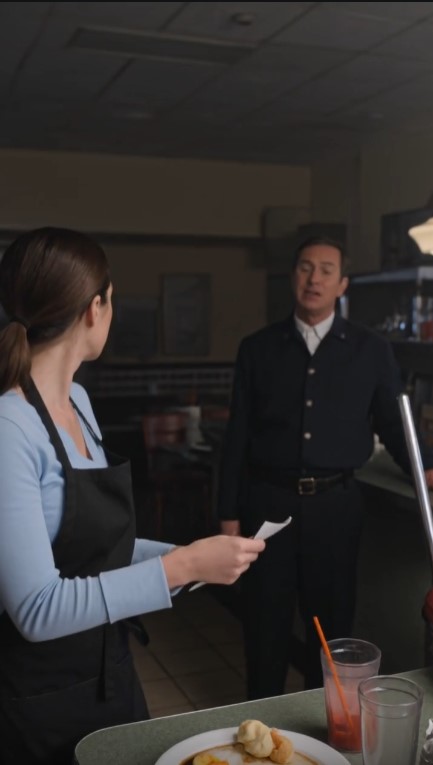
A waitress refused to clear the last table after closing.
The restaurant was already quiet. The dinner rush had ended, the chairs were stacked on top of the tables, and the kitchen lights had been turned off one by one. Only the soft hum of the refrigerator and the sound of a mop moving across the floor remained.
Grace was tired.
Her feet hurt. Her apron was stained with coffee, and all she wanted was to finish cleaning the final table and go home.
But when she reached the corner booth near the window, she stopped.
An elderly woman had sat there earlier with her adult son.
Grace remembered them because the woman barely spoke.
She sat with both hands folded tightly in her lap, her shoulders hunched, her eyes lowered toward the table. Her son did all the ordering. He answered every question. He corrected her when she reached for the menu.
“She’ll have soup,” he said sharply.
The old woman had looked up at Grace only once.
Just once.
And in that moment, Grace had seen fear.
Now the table was empty.
The son had already paid.
They had already walked out.
But a napkin had been left beside the woman’s teacup.
Grace reached for it, ready to toss it away, when she noticed a strange mark near the edge.
At first, it looked like a coffee stain.
The manager called from the counter, “Grace, hurry up. We closed ten minutes ago.”
But Grace didn’t answer.
She lifted the napkin and turned it toward the light.
The stain was not a stain.
It was writing.
Small.
Shaky.
Almost hidden.
Three words appeared across the thin paper.
“I am afraid.”
Grace’s body went cold.
For a second, she could not move.
Then she looked toward the front windows.
Outside, the son was helping the old woman into a dark car near the far end of the parking lot. His hand was tight around her arm. The woman moved slowly, like someone afraid to resist.
Grace ran.
“Grace!” the manager shouted. “Where are you going?”
But she was already pushing through the front door.
Cold night air hit her face as she stepped into the parking lot.
The old woman was halfway into the passenger seat.
Then she looked back.
Her eyes met Grace’s through the car window.
Tears were running down her face.
Grace didn’t run closer. Something told her not to frighten the woman or alert the man too soon.
Instead, she stepped back behind the restaurant door and called police.
“My name is Grace,” she said, her voice shaking. “I’m at Miller’s Diner. An elderly woman left a message on a napkin. She wrote, ‘I am afraid.’ Her son is trying to leave with her now.”
The dispatcher told her to stay calm.
Grace watched the car.
The son closed the passenger door and walked around to the driver’s side.
Then he looked toward the restaurant.
Grace held her breath.
The manager had followed her outside by then, annoyed and confused.
“What is going on?”
Grace handed him the napkin.
His expression changed instantly.
The car engine started.
Grace whispered, “Please hurry.”
Before the car could leave the parking lot, blue lights appeared at the entrance.
One police car pulled in.
Then another.
The son stopped suddenly.
An officer stepped out and approached the driver’s side while another officer walked toward the passenger door.
The old woman was crying silently.
Grace stood near the restaurant entrance, clutching her apron with both hands.
She could not hear everything the officers said, but she saw the son’s face turn angry. He waved his hands. He pointed toward the restaurant. He acted offended, as if everyone else had misunderstood.
But the old woman lifted one trembling hand and pointed toward Grace.
Then she whispered something to the officer.
The officer opened the passenger door and helped her out.
That was when Grace started crying.
The woman was safe.
Inside the restaurant, police asked Grace what had happened. She told them about the dinner, the silence, the way the son spoke for the woman, the fear in her eyes, and the napkin left behind.
Officers searched the son’s bag.
What they found made the manager cover his mouth.
There were bank cards that belonged to the old woman. Withdrawal slips. Signed checks. Medication bottles. Papers showing transfers from her account. A notebook filled with amounts, dates, and threats written in harsh, angry handwriting.
The truth came out slowly.
For months, the woman’s son had been taking her money and controlling her life. He told her no one would believe her. He threatened to leave her alone without care. He forced her to withdraw cash, sign papers, and stay quiet.
That night, he had taken her to the diner after another argument.
Grace’s kindness during the meal had given the woman one small chance.
When her son looked away, she dipped her finger into spilled tea and wrote the only words she could manage on the napkin.
“I am afraid.”
She left it behind and prayed someone would notice.
Most people would have thrown it away.
Grace almost did.
But she looked closer.
The old woman was taken somewhere safe that night. Her name was Margaret, and before she left with the officers, she asked to speak to Grace.
She held Grace’s hands in both of hers.
“I didn’t think anyone would see it,” Margaret whispered.
Grace shook her head, tears slipping down her cheeks.
“I saw you,” she said. “Before I saw the napkin.”
The manager stood nearby, ashamed.
“I told her to hurry,” he admitted quietly. “I thought she was just cleaning a table.”
One officer looked at the napkin sealed carefully in an evidence bag.
“No,” he said. “She was reading a cry for help.”
Weeks later, Margaret returned to the diner.
This time, she came with a social worker and a small bouquet of flowers. She looked different. Still fragile, still quiet, but lighter somehow. Her eyes no longer stayed on the floor.
She sat in the same corner booth and ordered tea.
Grace brought it to her with shaking hands.
Margaret smiled and placed a folded napkin on the table.
Grace opened it.
This time, the words were written clearly in blue ink.
“Thank you for listening.”
Grace framed that napkin and kept it behind the counter.
Not for attention.
Not for praise.
But as a reminder.
Sometimes fear does not shout.
Sometimes it sits quietly in a corner booth.
Sometimes it looks like a coffee stain on a napkin.
And sometimes, saving someone begins with one tired waitress refusing to throw away the last thing left on a table.